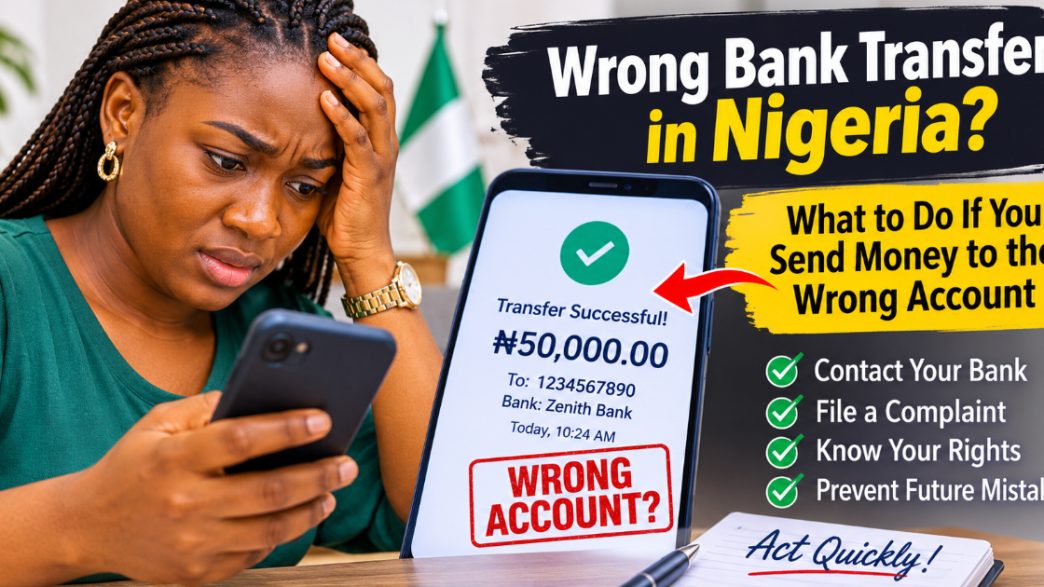
It takes just a few seconds to transfer money these days. Unfortunately, it also takes just a few seconds to transfer your money to the wrong bank account in Nigeria. To donate your hard-earned cash to someone you have never met, thanks to one misplaced digit or a careless tap on your phone.
One minute, you are paying a supplier, settling a friend’s debt or sending urgent 2k to a family member. The next, you are staring at your banking app, wondering how an account number you barely recognise managed to receive your money.
A wrong bank transfer in Nigeria can be particularly frustrating because successful transactions often reflect almost immediately, leaving little room to correct a mistake before the recipient gets the alert. 
But before you start calling random numbers or begging strangers on social media to return your money, take a breath.
There are proper channels for reporting mistaken transfers, and Nigerian banks have procedures for investigating them. However, getting your money back is not always automatic.
Here is what to do, who to contact and what you should realistically expect.
7 things to do immediately you transfer money to wrong bank account in Nigeria
1. Contact your bank immediately
The first thing to do after discovering a wrong bank transfer in Nigeria is contact the bank that sent the money.
Do not wait until the next morning or assume the recipient will notice the mistake and return the funds out of kindness. The recipient has probably not eaten since morning and has been praying for a miracle, and will see your money as mana from heaven.
Use your bank’s official customer service channels, including:
- Its customer service telephone line.
- The official mobile app or live chat.
- Its verified email address.
- A physical branch, particularly if you need to submit a written complaint.
Explain that you made an erroneous transfer and request an urgent transfer recall. Ask your bank to contact the receiving bank and initiate the appropriate recovery process. You can also request that the receiving bank place a hold or lien on the disputed funds while it investigates.
Importantly, obtain a complaint reference number. This will help you track the case and follow up without repeatedly explaining the same unfortunate story.
ALSO SEE: How Fake FRSC Fine Links Are Costing Nigerians Millions
2. Understand how the bank reversal process works
Getting money back after a wrong bank transfer is not always as simple as asking your bank to press a reversal button. The CBN’s Regulation on Instant (Inter-Bank) Electronic Transfer Services distinguishes between mistakes caused by banks and those made by customers.
When the bank makes the mistake
If your bank sends money contrary to your instructions because of an operational error, the receiving bank must reverse the transaction within one business day of receiving a written request, provided the funds remain available.
The regulation also provides for recovery procedures when the recipient has already withdrawn the money.
When YOU enter the wrong account details
This is different.
Under the CBN’s customer-error procedure, your bank must notify the receiving bank after receiving a valid complaint. The receiving bank can place a lien on the disputed funds and seek the recipient’s consent before refunding the money.
If the recipient refuses, the internal auditors of both banks must mediate within two weeks.
Where the recipient has spent the money and refuses to replenish the account, the regulation provides for possible BVN watch-listing and reporting to law enforcement.
The important distinction is that a customer who enters the wrong account number should not expect the same automatic reversal procedure that applies to a bank’s operational error.
3. Keep every piece of evidence
If you want your bank to take your complaint seriously, provide enough information for its investigation.
Prepare the following:
- Transaction receipt: Screenshot or download the transfer confirmation.
- Transaction reference: Keep the unique transaction ID or session ID.
- Beneficiary details: Provide the incorrect account number, account name and receiving bank.
- Your account details: Identify the account from which you sent the money.
- Complaint records: Save emails, chat conversations and complaint reference numbers.
- Written explanation: Briefly explain how the mistake happened and state the amount you want recovered.
If you visit a bank branch, submit a written complaint and request an acknowledgement.
One important warning: never include your ATM PIN, banking password or one-time password (OTP) in a complaint letter. Your bank does not need these details to investigate a mistaken transfer.
4. What if your bank refuses to help?
You do not have to accept silence or endless promises from your bank.
The CBN provides a formal escalation process for customers whose complaints remain unresolved.
Start by exhausting your bank’s internal complaint channels. According to the CBN’s complaints management guidance, customers should generally allow their bank two weeks to resolve a complaint before escalating it.
If the bank fails to resolve the matter, contact the CBN’s Consumer Protection Department via their email address (cpd@cbn.gov.ng) or complaints management portal. Include your bank’s name, transaction details, complaint reference number and evidence that you first reported the matter to your bank. The CBN also expects customers to provide supporting documents and transaction records when submitting complaints.
If the transaction involves suspected fraud rather than an innocent mistake, report it through your bank’s fraud desk and appropriate law enforcement channels.
ALSO READ: Why Your Data Finishes So Fast: MTN Nigeria Explains
5. Can you contact the person who received the money?
If you know the recipient, you can contact them politely and explain what happened.
For instance, if you mistakenly transferred ₦50,000 to a friend, supplier or business associate, an honest conversation may resolve the problem faster than a lengthy banking investigation.
However, if the recipient is a complete stranger, avoid trying to obtain their private information through unofficial means. Your bank can communicate with the receiving institution through the appropriate channels.
Do not threaten the recipient, publish their account details online or attempt to access their account. Such actions could create additional problems for you.
The CBN’s electronic transfer rules provide a formal bank-to-bank recovery process when the recipient is unknown or refuses to cooperate.
6. How long does it take to recover money sent to the wrong account?
This is where expectations need a little adjustment.
There is no universal guarantee that every mistaken transfer will return to your account within 24 hours.
The CBN’s rules provide specific timelines for different situations. For customer-error transfers, the receiving bank may place a lien on available funds, seek the recipient’s consent and involve both banks’ internal auditors if necessary.
However, several factors can affect the outcome:
- Whether the recipient still has the money.
- Whether the receiving bank can secure the disputed funds.
- Whether the recipient cooperates with the refund.
- Whether both banks resolve the dispute.
- Whether legal or law enforcement intervention becomes necessary.
If the recipient has already spent the money, recovery becomes considerably more complicated. The earlier you report the mistake, the better your chances of securing the funds before the recipient spends them.
7. How to avoid a wrong bank transfer in Nigeria
The easiest way to deal with a wrong bank transfer is to avoid making one in the first place.
A few simple habits can save you considerable stress:
- Verify the account name: Check the beneficiary’s name before completing a transfer.
- Double-check the account number: Pay particular attention to the final digits.
- Send a test amount: For large transfers to unfamiliar beneficiaries, consider sending a small amount first.
- Avoid rushing: Do not complete transfers while distracted or under pressure.
- Save trusted beneficiaries: Store frequently used account details in your banking app, but review them before sending money.
- Confirm unusual payment requests: Verify new bank details through a separate communication channel.
These precautions may seem basic, but they are considerably cheaper than spending weeks trying to recover money sent to a stranger.
Final word on wrong bank transfer in Nigeria: Act quickly, but understand your rights
A wrong bank transfer in Nigeria can turn an ordinary day into a financial nightmare, particularly when the amount represents months of savings or money meant for an urgent expense.
Fortunately, the CBN has established procedures that allow customers to report mistaken transfers and seek recovery through their banks.
The most important thing is to act immediately, preserve your transaction evidence and follow the official complaint process. Remember, however, that a customer-error transfer does not automatically qualify for an unconditional refund. The availability of the money, the recipient’s cooperation and the circumstances surrounding the transaction all matter.
And perhaps the most useful lesson is this: before tapping that transfer button, spend an extra five seconds checking the account number.
Those five seconds could save you several weeks of begging a stranger to return your money.
READ ALSO: From Lagos To Abuja: Why Fuel Price In Nigeria Changes From State To State

About The Author