


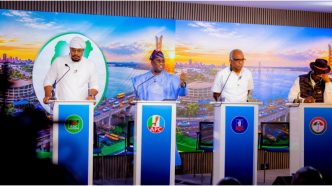
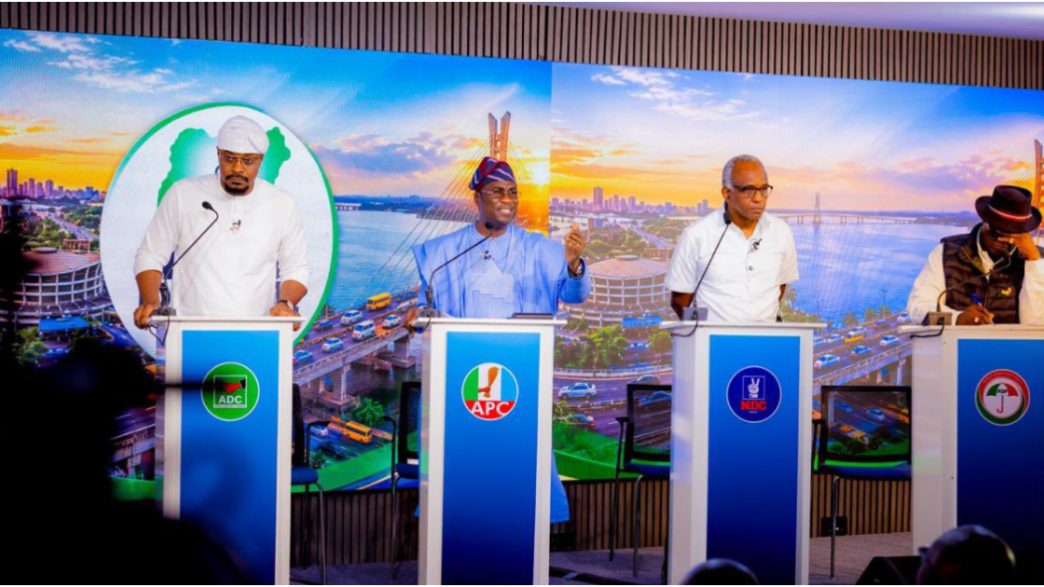
The Lagos Governorship debate was held on Sunday, November 8 and housing affordability, traffic congestion, flooding, healthcare funding and waste management dominated the discussion.
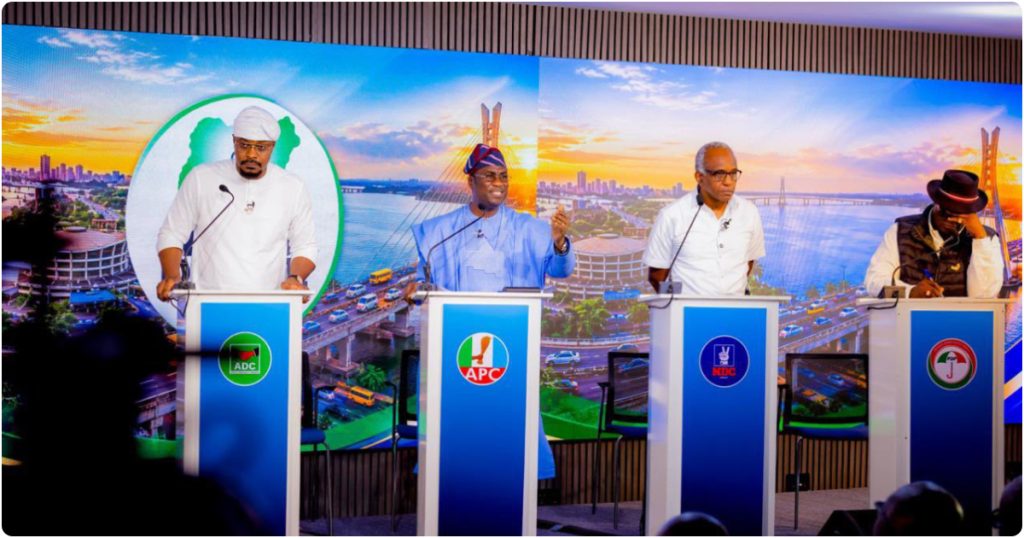
Lagos Governorship debate was organised by Channels Television, TVC News, Vanguard, The Punch and TheCable, the debate brought together candidates from four political parties. They included Kadri Obafemi Hamzat of the All Progressives Congress (APC), Deji Doherty of the Peoples Democratic Party (PDP), Gbadebo Rhodes-Vivour of the African Democratic Congress (ADC) and Funso Doherty of the Nigeria Democratic Congress (NDC).
While Hamzat defended aspects of the current administration’s record, opposition candidates questioned its approach to infrastructure, public services and accountability. They also outlined alternative plans for addressing the state’s challenges. 
Housing: Candidates Debate Government’s Role
Hamzat called for greater collaboration between residents and private developers to make homeownership more accessible. He also argued that lower transportation costs could improve access to housing, especially for people living far from their workplaces.
Funso Doherty, however, criticised the government’s response to the shortage of affordable homes. He called for stronger social housing policies to bridge the gap between supply and demand.
Deji Doherty proposed a more direct approach, arguing that the government should become Lagos’s biggest property developer. Under his proposal, residents would purchase homes directly from the state.
He questioned how ordinary workers could afford houses, given the minimum wage of ₦120,000.
Flooding and Infrastructure Under Scrutiny
During the Lagos Governorship Debate, candidates also disagreed over how Lagos should tackle flooding and maintain its infrastructure.
Deji Doherty acknowledged the administration’s construction of link bridges but said poor drainage remained a major problem. He argued that effective drainage systems and proper water channelling could help manage flooding.
Funso Doherty called for stronger protection of wetlands, which help absorb water. He criticised buildings encroaching on drainage channels, only for authorities to demolish them years later.
He also questioned the government’s environmental impact assessments before infrastructure projects begin.
Hamzat stressed the need to maintain existing drainage systems and keep them free from obstruction.
Rhodes-Vivour criticised road maintenance and the pace of infrastructure delivery. He questioned why Lagos struggled to complete a 16-kilometre road project within a reasonable period.
He also called for better water management and greater accountability in public projects.
Transport: Ferries, Bridges and Alternative Routes
On traffic congestion, Rhodes-Vivour proposed designated parking areas where motorists could leave their cars and continue their journeys by ferry. He also advocated bicycle infrastructure.
Hamzat highlighted existing transport initiatives, saying more than four million residents had obtained Cowry cards for public transport services, including BRT buses and ferries.
He added that the government was considering transport fare subsidies. He also proposed larger ferries to carry more passengers, particularly along routes such as Oworonshoki.
Funso Doherty called for transport modernisation and questioned the influence of the Agbero network in the sector.
Deji Doherty proposed additional bridges, including a Fourth, Fifth or even Sixth Mainland Bridge, to create alternative routes and ease pressure on existing roads.
READ ALSO: Lagos Concrete Jungle: Ikoyi, VI Residents Lament Loss of Trees to High-Rise Buildings
Healthcare and Waste Management
Rhodes-Vivour called for greater investment in preventive healthcare, public education and medical training. He proposed allocating 50 per cent of the state budget to healthcare, citing difficulties residents face accessing medical facilities.
Hamzat defended the Ilera Eko health insurance scheme and referenced new healthcare facilities, including hospitals in Ojo. He also proposed establishing a university of medicine to train more doctors.
Funso Doherty argued that the government should commit more public funds to healthcare rather than placing much of the financial burden on residents.
Deji Doherty focused on pharmaceutical regulation. He called for closer scrutiny of drug manufacturers and sanctions against companies producing harmful or substandard medicines.
Waste management also featured in the debate. Rhodes-Vivour described the existing system as focused more on collecting and dumping rubbish than managing waste sustainably. He also called for greater local government involvement.
Hamzat proposed converting waste into useful resources, while Funso Doherty urged the state to take greater responsibility for public services.
Hamzat Defends His Record as Debt Concerns Emerge
Beyond the policy discussions, Hamzat highlighted his experience in education, science and technology, and works and infrastructure.
He also presented his seven-pillar Lagos Promise, which contains 100 pledges covering people-first governance, renewal, opportunity, inclusion, security and integrity.
“Lagos has prepared me for this role with different assignments. A government serves better when it knows the people. I know the people, I know the work and I know the state,” he said.
On the October 2020 Lekki tollgate incident, Hamzat described the period as a sad moment for Lagos. He acknowledged the breakdown of public trust and pointed to the judicial panel of inquiry, its published report and the government’s white paper.
Deji Doherty, meanwhile, raised concerns about Lagos’s debt obligations. He described the burden as a constraint on the state’s finances.
“The debt burden is heavy. When you’re paying close to about 19, 20 billion in external debt, in domestic debt, in foreign debt, then you have a burden that you’re carrying that is weighing you down,” he said.
Beyond Campaign Promises
The debate exposed different approaches to Lagos’s challenges. Hamzat defended existing interventions and proposed expanding them, while opposition candidates called for changes in housing, transport, healthcare and environmental management.
Ultimately, residents will want to know how the candidates intend to turn their proposals into measurable improvements.
With traffic congestion, expensive housing, flooding and access to public services affecting daily life, the debate allowed voters to examine the candidates’ plans for the state.
READ MORE: Ex-BBNaija Star Adekunle Spotlights Youth Despair Amid Rising Poverty in Lagos
Story written by Aramide Okunbor, edited by Sola Sanusi.

About The Author