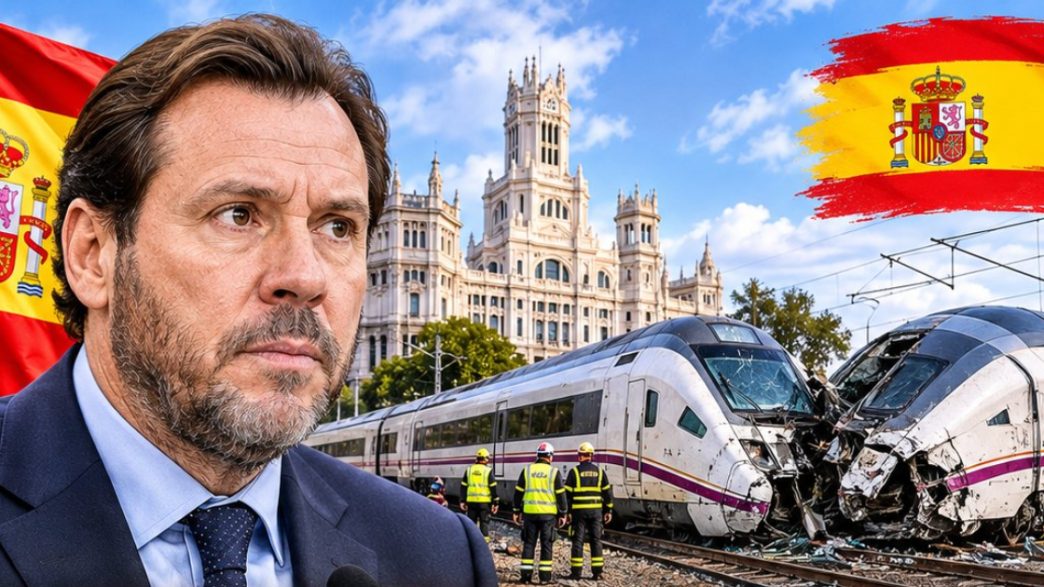
Spain’s Transport Minister, Óscar Puente, has resigned and withdrawn from the country’s November 29 general election following a train crash that killed 69 people and intensified concerns about railway safety.
Puente announced his decision on Tuesday, November 3, during a lengthy appearance before lawmakers, nearly a week after the October 28 collision near Urda, in central Spain. He had previously rejected calls to step down from opposition parties and labour unions following the disaster.
However, the now former Spain transport minister later said he could not remain in office after two railway accidents of such severity within less than a year, regardless of whether investigators establish his direct responsibility for either incident. 
Spain transport minister resigns after two deadly train crashes
The October 28 accident happened when a high-speed train operated by state-owned Renfe struck a stationary train belonging to private operator Iryo near Urda, approximately 130 kilometres (80 miles) south of Madrid.
The collision killed 69 people and injured about 100 others. The two trains carried a combined 544 passengers, according to EFE.
Preliminary accounts indicate that a signalling system failure automatically stopped several trains along the Madrid-Seville line. However, controllers at a Madrid control centre subsequently authorised the Renfe train to continue despite the stationary Iryo train ahead.
Investigators estimated that the Renfe train struck the stationary train at between 160 and 200 kilometres per hour. Authorities have yet to establish the full circumstances behind the disaster, and investigations remain ongoing.
The crash followed another deadly collision in January near Adamuz, Córdoba, which killed 46 people and also involved trains operated by Renfe and Iryo.
Puente said the two incidents made it impossible for him to continue as transport minister. He explained that he had decided to resign shortly after learning about the Urda accident but remained in office to coordinate the immediate response, support investigations and introduce emergency safety measures.
“I am not only stepping down from my position as minister of transport, but that I am also withdrawing my name from the lists for the early legislative elections on November 29,” he told lawmakers.
SEE ALSO: Tenerife Striker Jesus de Miguel Dies After Collision With Goalkeeper During Match
Government announces €30 million compensation package
Before announcing his resignation, Puente presented a €30 million emergency support package for victims and their families.
The Spanish government allocated €15 million for direct financial assistance and another €15 million for advance payments against civil liability compensation. Families of deceased passengers can receive €72,121.46 in direct assistance and an additional €72,121.46 as an advance payment.
Injured passengers can receive between €2,404 and €84,141, depending on the severity of their injuries.
The government also introduced special protections for workers affected by the accident and promised to limit prices for alternative transport while the damaged high-speed railway line remains closed. La Moncloa, the Spanish government’s official website, confirmed the measures.
Carlos Cuerpo takes over as Spain transport minister temporarily
Prime Minister Pedro Sánchez accepted Puente’s resignation and appointed Deputy Prime Minister Carlos Cuerpo as the temporary Spain transport minister until the November 29 election.
Sánchez said Puente’s decision demonstrated respect for the victims and their families, while expressing confidence that Cuerpo would continue the safety reforms already announced.
Puente’s departure comes at a difficult time for Sánchez’s Socialist Party, with the two deadly railway disasters overshadowing the run-up to the snap general election.
The government now faces mounting pressure to restore public confidence in a railway network that had enjoyed a strong safety reputation before the two fatal accidents in 2026.
Spain plans AI monitoring and tighter railway safety measures
The disaster has pushed the government to introduce additional safeguards across Spain’s high-speed railway network.
Among the proposed measures, Puente announced plans to deploy artificial intelligence to detect operational irregularities and monitor conversations between train drivers and railway controllers. The government also plans to create a real-time digital model of the railway network to help identify potential problems.
Other measures include requiring a second controller to validate decisions when automatic safety systems are unavailable, improving working conditions in railway control centres and strengthening staff training.
The government will also reduce services on the Madrid-Seville line until the Railway Safety Agency completes an extraordinary review and authorities advance the deployment of the European Rail Traffic Management System.
READ ALSO: Heidi Klum Stuns in Horrific Outfit For Her 25th Halloween Anniversary Party

About The Author