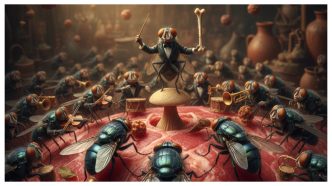

Before we begin this story, note that Blowflies are often larger than houseflies and have that shiny, metallic blue, green, or copper body, because they are larger and heavier, their buzz is much deeper and louder.
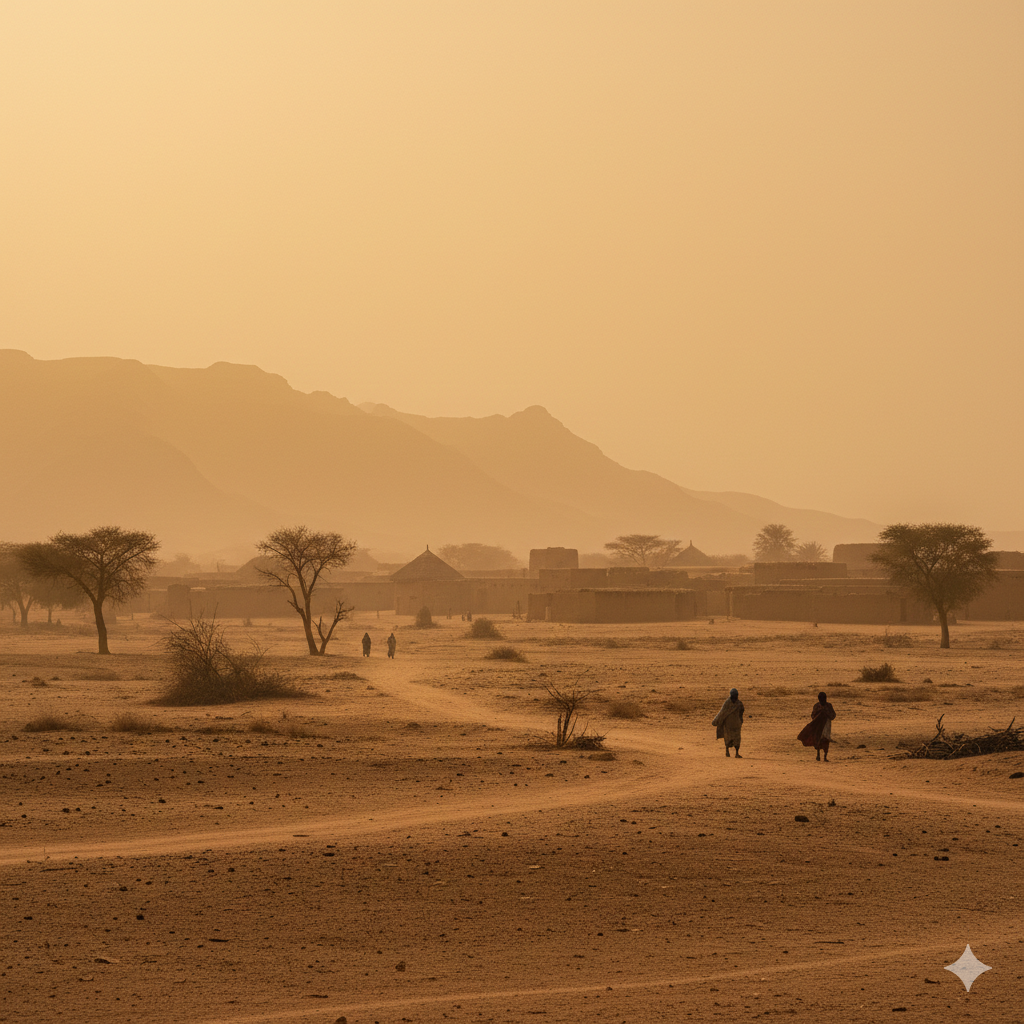
The largest live musical performance I have ever witnessed was by a massive band of flies at a butcher’s table in Gubio, Borno State, during my service year. This roughly 2,000-member band chose a cow lap offered for sale as their stage. 
There were no stack amps or giant woofers, yet the music was loud enough. The musical output was a non-stop, modulated chittering and buzzing (performed in concert and in solo) rising from the tables of all the butchers nearby.
I eventually grew used to it, but I was spooked the first time I experienced it. That, however, was not because of the music. When approaching a butcher’s table in that market, you never actually saw the meat. Instead, you saw vast sheets of flies completely covering the flesh like a marquee. When you informed the butcher of your desire to purchase, he would wave a knife to send the flies fleeing, finally offering a glimpse of red meat.
The butchers didn’t give a damn if you felt repulsed. They didn’t even think it was an issue, let alone something to bother about; “blasé” doesn’t quite capture it. The flies would return to base once the sale was concluded, and the butchers would return to their chit-chat until the next wave of the knife.
During the months I spent there, I found that flies were not a source of bother to many people, not just the butchers. I would see young children totally unconcerned by flies nestling and humming on their eyelids, upper lips, and heads. If I remember correctly, the flies were more numerous during the Harmattan. They nestled on the backs of our shirts, chittering happily to our discomfort. It was worse, I believe, if you wore white clothes. That ceaseless buzzing did my head in.
ALSO READ: The Amala Protection Bill: Why It’s Needed Now
After NYSC, the next place I saw similar scenes was in Gusau, Zamfara State, while I was working with a research firm. I was about to eat at an amala joint when five almajiri walked in. Their heads were encrusted with ringworm and their lips were embroidered with flies, a sight that killed my appetite instantly. I almost had a seizure; the food was abandoned. The population of flies I saw in Gusau wasn’t huge, perhaps because I had no use for a butcher then, or because the ones I saw were of a species that preferred human company.
The next assault by flies on my person, aside from their kamikaze acts of flinging themselves into my liquor, was some years ago at the Lagos State Abattoir in Oko-Oba, a blowflies paradise by right.
A few minutes before I drove into the complex, my tummy started rumbling in a mightily uncomfortable way. By the time I got out of the car, the sensation was so intense that I started walking as though on stilts, like a footballer with a fresh hamstring injury.
I asked if there was a toilet, as there should be, and was told it would cost ₦20. Small trouble. I was shown a row of toilets, I paid, and was directed to one. The entire lavatory complex stung the nose viciously. The smell of poop and urine overpowered the disinfectant, but given my situation, which was an absolute ordeal, that didn’t occupy my mind for more than a nanosecond.
As I was badly pressed, I flung the door of the stall open like a prize fighter. “Hmmmmmmmmmmmmmmmmmzzzzzzzzzzgzzzzzzzzzzzzzz,” about a thousand flies welcomed me to their concert with the hit track from their one-song repertoire. It was discomforting, but not using the facility would have been much worse. I was luckless to be exposed to such a foul-smelling facility, but lucky to have one to use at all. In the short time I endured the ordeal, I felt like a ship tossing about, desperate to find a place to dump radioactive materials.

About The Author