


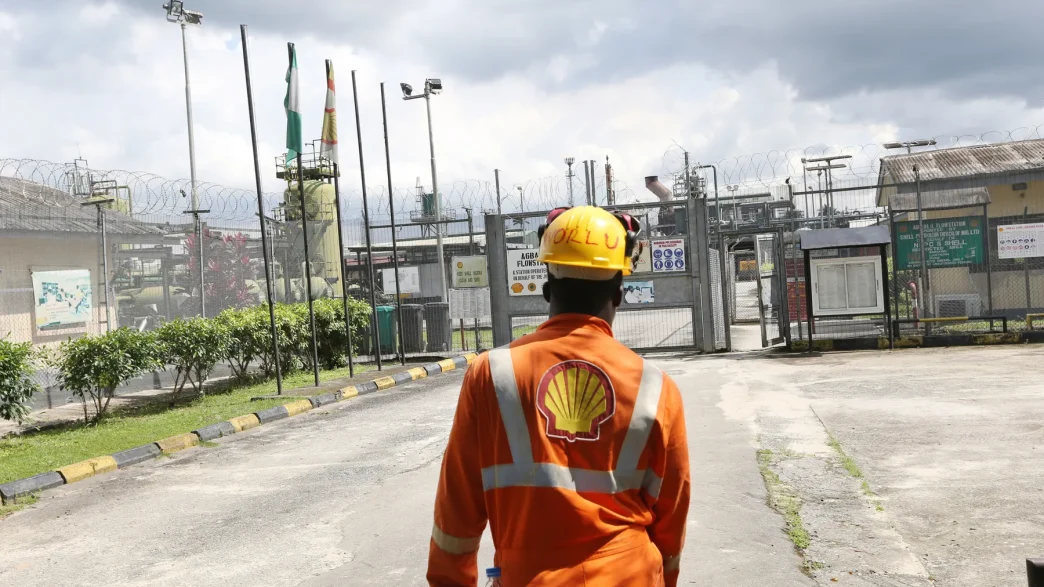
Shell has agreed to sell its Nigerian domestic gas distribution business to Vaaris Energy, ending its involvement in the sector after more than 25 years.
It is a quiet goodbye by oil-major standards. There are no fireworks, and the financial terms were not disclosed. For a country that keeps promising a “gas-powered economy,” though, the Shell Nigeria gas sale says a lot about who will carry that promise from here.
What exactly is Shell selling?
The deal covers Shell Nigeria Gas (SNG), the company’s piped gas distribution arm. The sale includes Shell Nigeria Gas Holding B.V., set up in 2019, which holds all but one of the shares in SNG Limited. 
SNG was established in 1998, supplies natural gas to industrial and commercial customers, and runs roughly 170 kilometres of pipeline across Ogun, Abia and Rivers states. It serves more than 130 connected commercial and industrial customers.
It is a small slice of Shell’s Nigerian footprint. The sale excludes Shell’s upstream gas production, liquefied natural gas operations and international gas trading. Think of it as selling the delivery van, not the warehouse.
Nothing changes on day one. The deal is subject to regulatory conditions and approvals, and SNG will keep serving customers as usual until it closes.
Why is Shell exiting the gas market?
The short answer is focus.
The sale forms part of CEO Wael Sawan’s strategy to simplify Shell’s portfolio and prioritise investments expected to deliver stronger returns, particularly in oil and gas. A 170-kilometre distribution network serving a little over 130 customers doesn’t move the needle for a company of Shell’s size.
Shell’s Nigeria country chair, Elohor Aiboni, said the agreement gives the business a much stronger platform for its next chapter under new ownership. She added that Shell continues to focus on strategic deepwater and integrated gas positions in Nigeria.
The sale also fits a pattern. Shell completed the $2.4 billion sale of its onshore subsidiary SPDC to the Renaissance consortium in 2025, ending nearly a century of onshore oil and gas operations and joining a broader retreat by Western majors, including ExxonMobil, Eni and Equinor. Distribution was the next piece to go.
READ: Petrol Discount or Subsidy: What Nigerians and Transporters Need to Know
Is Shell leaving Nigeria altogether?
No, and anyone writing that headline is getting ahead of the facts. Shell still holds a 25.6% interest in Nigeria LNG. It is also leaning into deepwater.
President Tinubu approved the gazetting of targeted, investment-linked incentives meant to speed a final investment decision on Shell’s proposed Bonga South-West deep-offshore project.
So Shell is shrinking its footprint to the parts it considers worth the capital. The big, deep and export-oriented assets stay. The small, local and onshore ones go.
Vaaris Energy is a privately held Nigerian energy company with interests across the oil and gas value chain and an existing operational presence in the country. That’s about all the public detail on offer. Reports haven’t spelled out the buyer’s plans for tariffs, staff or network expansion, so anyone predicting what happens to prices is working from a crystal ball.
What the Shell Nigeria gas sale means for the sector
Here is where it gets interesting. The sale lands just as regulators are trying to reshape distribution.
A licensing shake-up is coming
The Nigerian Midstream and Downstream Petroleum Regulatory Authority (NMDPRA) plans a digital licensing round for gas distribution areas before the end of 2026, after a nationwide gas-grid mapping exercise expected in October. The round is modelled on how upstream blocks are awarded and is part of a push towards open access, where infrastructure is shared across operators rather than built separately by each.
A new owner stepping in just as the rules of the game are being redrawn is either very good timing or very brave.
Turf wars are already happening
A $100 million gas pipeline project in Ibadan has stalled after NIPCO Gas, which holds a distribution licence for the area, accused Shell Nigeria Gas of trying to operate within the same licensed territory despite having no infrastructure there.
Vaaris inherits that business, and presumably its in-tray.
READ: From ₦20 to ₦1,400: History of Petrol Price Hikes in Nigeria Since 1999
The bigger problem isn’t ownership, it’s delivery
Nigeria has huge reserves, and the minister has said its roughly 210 trillion cubic feet would be “useless” if gas never reaches homes, hospitals, schools and industries. The gap shows in the numbers.
A THISDAY analysis of regulator data found Nigeria exported an average of 45.8% of its utilised gas in January and February 2026, even as supply to thermal power plants weakened. Investors, meanwhile, have flagged payment security, supply reliability and pricing as concerns.
Local ownership, local accountability
Moving the network to a Nigerian company fits the wider push for Nigerian-led energy firms. If Vaaris invests, it could mean new connections and better reliability. If it doesn’t, the same bottlenecks stay in place under a different logo.
What to watch next
Four things matter over the coming months:
- Regulatory approval: the deal doesn’t close without it.
- Vaaris Energy’s plans: the buyer hasn’t said much about investment, tariffs or staff.
- The distribution licensing round: the regulator’s timetable runs through the end of the year.
- The Ibadan dispute: how it resolves will show how crowded and contested the market has become.
The Shell Nigeria gas sale is small in dollar terms, as far as anyone can tell given the undisclosed price. However, it is big in what it signals. A global major is stepping back from last-mile gas, a Nigerian company is stepping in, and regulators are rewriting distribution rules in real time.
Whether that adds up to more gas reaching more people depends on what Vaaris does next, and on whether the market around it works.
READ: Dangote Refinery IPO: What Nigerians Need to Know Before the Offer Opens

About The Author