


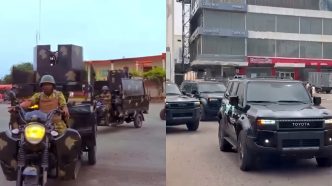
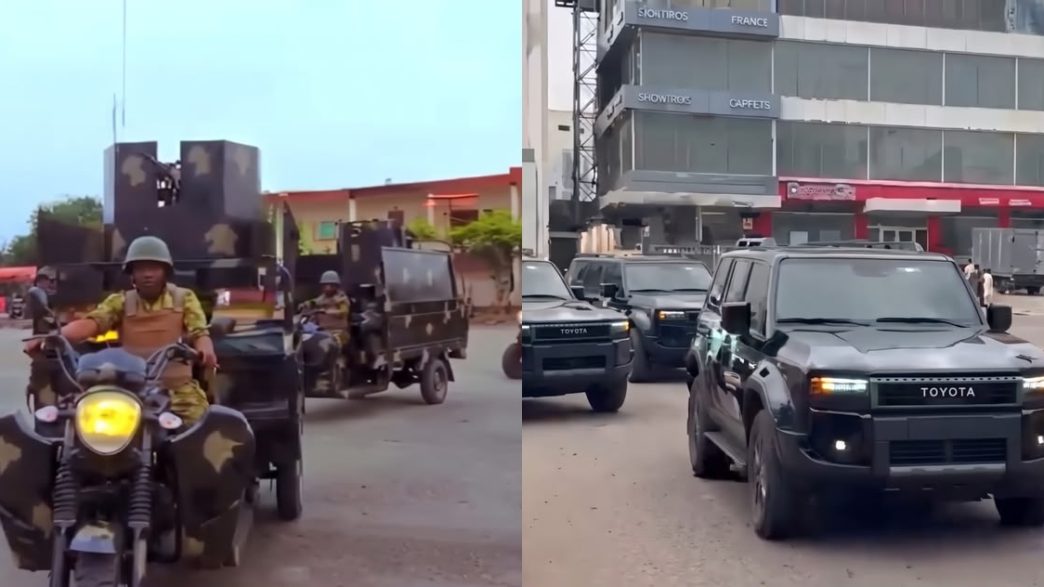
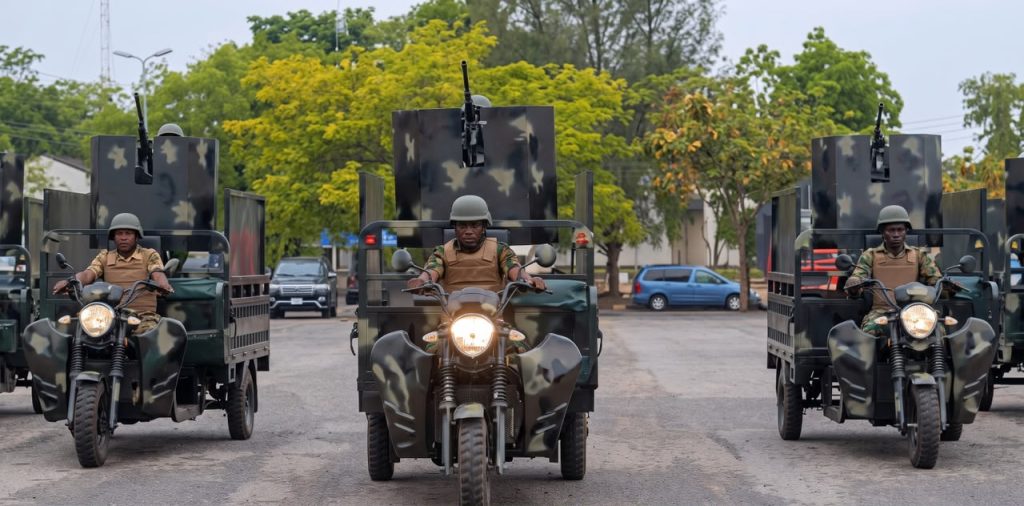
A video circulating online on November 10 showing troops of the Nigerian army using armed modified three-wheeled tricycles fitted with heavy weapons and metal plating has triggered precisely that kind of reaction.
For some Nigerians, the sight of soldiers riding what looks like an armoured version of a commercial tricycle popularly called Keke Napep is proof that the government has misplaced its priorities. Others have defended the arrangement, arguing that smaller vehicles can navigate muddy roads, narrow forest paths and difficult terrain where larger military vehicles might struggle.
Only weeks earlier, the ruling All Progressives Congress (APC) was making headlines over the presentation of brand-new 2026 Toyota Prado SUVs to selected party youth leaders ahead of the 2027 elections. 
So, while political mobilisers are getting luxury SUVs, soldiers appear to be making do with something that could easily be mistaken for a Keke driver who took his vehicle to a blacksmith so he could audition for the next Fast and Furious movie.
Nigerian Army armed tricycles trigger online reactions
The footage prompted a mixture of amusement, disbelief and concern across social media.
Some users laughed at the apparent contrast between the military’s heavy responsibilities and the rather unconventional vehicles. Others described the arrangement as a potential “sacrificial lamb” setup, questioning whether soldiers sitting on exposed three-wheelers would have meaningful protection if they came under enemy fire.
The comparison with the APC’s Toyota Prados also became a running joke. Nigerians wondered how a country could find the resources to provide expensive SUVs for political mobilisation but still appear to be improvising when it came to equipment for troops operating in dangerous environments.
ALSO SEE: Adams Oshiomhole: Is N2,000 Really Equal to $1? Here’s What He Got Wrong
Not everyone agreed with the criticism, however.
Some users argued that soldiers do not always need massive armoured vehicles. They pointed to the practical advantage of motorcycles and other lightweight vehicles in areas where narrow tracks, thick vegetation and muddy roads make conventional military transport difficult.
Others invoked the Second World War, when armies used motorcycles for reconnaissance, communication and movement across battlefields. And that argument is not entirely wrong. But it also needs a little context.
Did soldiers use motorcycles during World War II?
Military motorcycles were widely used during the Second World War. The United States Army, for instance, operated the Harley-Davidson WLA, a military adaptation of a civilian motorcycle.
The US Army Transportation Museum explains that the motorcycles supported reconnaissance, messenger services, police operations and convoy control. They also carried ammunition boxes and equipment.
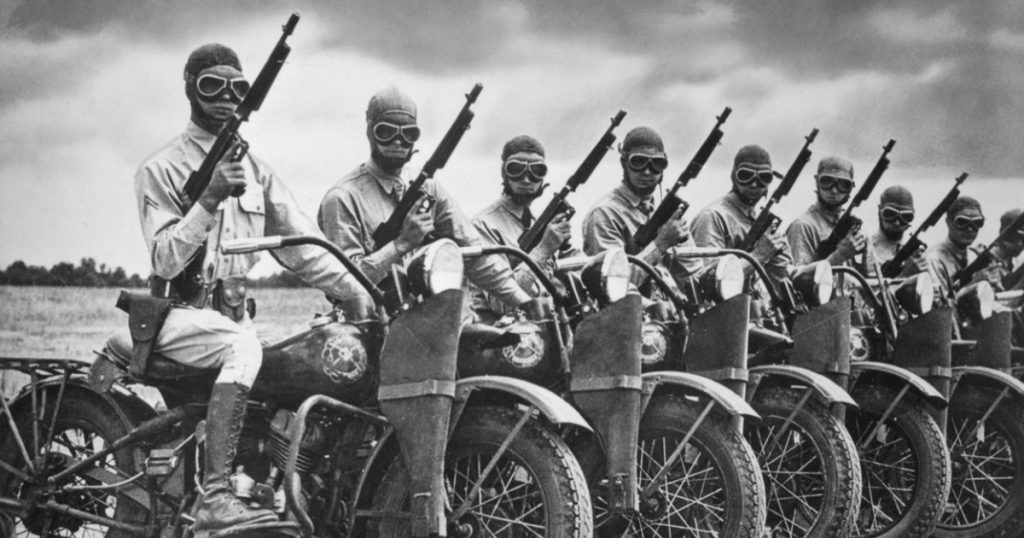
However, there is a detail that supporters of the tricycle arrangement might want to consider: the museum explicitly notes that the WLA was not designed for combat use. Its limited ground clearance also made it unsuitable for serious off-road operations.
In other words, the fact that soldiers used motorcycles during World War II does not automatically mean every motorcycle-like contraption is suitable for modern warfare.
There is a difference between using a lightweight vehicle to move messages or scout an area and sending exposed soldiers into a firefight with heavy weapons mounted on a three-wheeler. The military application depends on the mission, terrain, weapon system, protection, reliability and tactical support available.
A vehicle that works brilliantly for reconnaissance may be a terrible choice for transporting troops into an ambush.
Nigerian Army has also invested in modern military vehicles
It would be unfair to suggest that the Nigerian Army has abandoned modern military equipment altogether.
In July 2026, defence publication Janes reported that the Army commissioned several locally designed and manufactured vehicles at the Ikeja Military Cantonment in Lagos. They included an upgraded Infantry Patrol Vehicle, a Tactical Patrol Vehicle, a Light Tactical Vehicle and the Proforce Ara 2 mine-resistant ambush-protected vehicle.
The Ara 2 features substantial armour protection designed to help protect occupants against mines and improvised explosive devices.
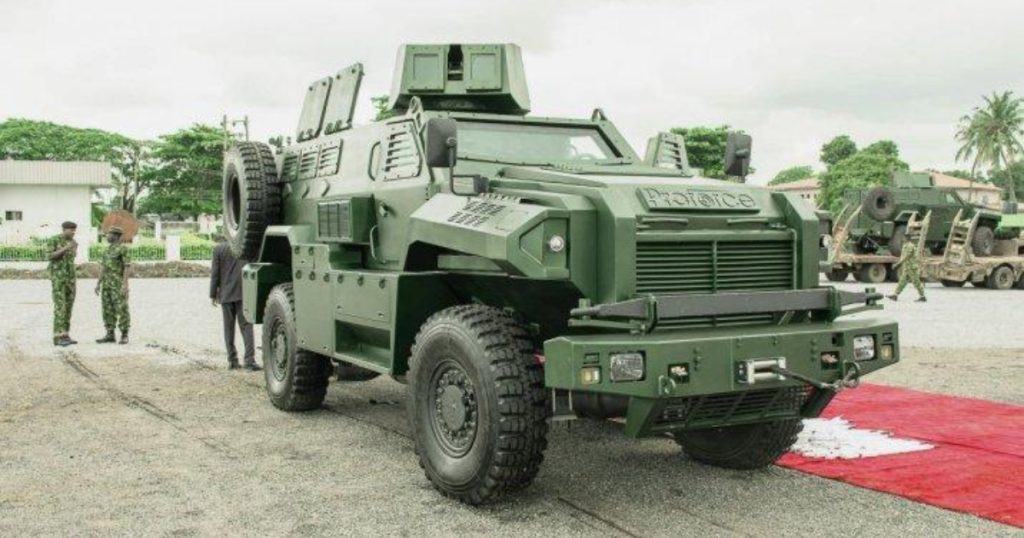
Earlier that year, the Army also took delivery of locally manufactured Vanquisher Light Armoured Personnel Carriers from the Defence Industries Corporation of Nigeria.
These developments show that Nigeria is making efforts to improve its military hardware and strengthen local defence manufacturing. However, they do not answer the questions raised by the viral tricycle footage. The Army has not publicly explained the specific purpose, protection level or operational status of the vehicles shown in the clip.
Until it provides that context, both the criticism and the defence of the arrangement remain partly speculative.
SEE ALSO: Will The Lagos-Calabar Coastal Road Ever Be Completed: What The Latest Diversion Means
From Toyota Prados to armed tricycles: Nigeria’s spending priorities
The comparison with political gifts is where the conversation becomes particularly uncomfortable.
In October 2026, APC National Youth Leader Dayo Israel shared a video showing seven brand-new Toyota Land Cruiser Prado SUVs presented to selected party youth leaders to support mobilisation ahead of the 2027 general elections.
The post attracted widespread criticism and was subsequently deleted.
First Lady Oluremi Tinubu later confirmed that she donated vehicles to the APC National Youth Wing, alongside campaign materials and other items. Israel also said the vehicles would help party mobilisers reach rural communities.
He did not disclose the full cost of the vehicles. However, BusinessDay estimated that a 2026 Prado could cost between ₦120 million and ₦160 million, depending on the specification and dealer.
The APC youth leader separately told the ICIR that the seven vehicles came from donors rather than government allocations.
That distinction matters. There is no established evidence that the particular Prado donation came directly from the public purse. Nevertheless, the spectacle raises questions about the culture of expensive political patronage in a country where public institutions routinely struggle to meet basic needs.
And this is not an isolated debate.
Lawmakers, luxury SUVs and generous political benefits
In June 2026, Premium Times reported that a Federal High Court in Lagos had declared the National Assembly’s controversial ₦110 billion vehicle procurement and allowance schemes unlawful.
The procurement covered Toyota Land Cruisers for 109 senators and Toyota Prado SUVs for 360 members of the House of Representatives, with individual vehicle costs reportedly exceeding ₦100 million.
The court held that the expenditure violated procurement laws, constitutional provisions and principles of public trust. Senate Leader Opeyemi Bamidele, however, defended the vehicles as official assets intended for constituency work rather than personal gifts.
There is also the question of lawmakers’ remuneration.
The Revenue Mobilisation Allocation and Fiscal Commission (RMAFC) has previously stated that a senator’s prescribed monthly salary and allowances total ₦1,063,860, excluding certain non-regular payments such as furniture allowance and severance gratuity.
That official figure is worth noting because claims that every senator receives ₦13.5 million monthly as a prescribed salary and allowance package have circulated widely. RMAFC specifically disputed that claim.
The broader issue, however, is not simply how much politicians earn. It is the combination of official remuneration, additional benefits, vehicle procurement and the wider culture of political incentives that often attracts public criticism.
ALSO READ: Lagos Crime Index: See Where Lagos Ranks Among the Most Dangerous Cities in the World
Nigeria’s security and education budgets are not small
There is another important qualification to the argument that government spends lavishly on politicians but refuses to fund essential services.
President Bola Tinubu’s 2026 budget proposal allocated ₦5.41 trillion to defence and security, ₦3.52 trillion to education and ₦2.48 trillion to health. These are substantial sums. The government has also highlighted military modernisation, intelligence gathering and locally manufactured equipment as priorities.
The problem, therefore, cannot simply be reduced to the claim that no money goes into security or education.
The more difficult question is whether the money delivers adequate results.
Nigeria continues to battle insurgency, banditry, kidnapping and other forms of insecurity. Schools and healthcare facilities also face persistent challenges, including infrastructure gaps, staffing shortages and uneven access to essential services.
A large budget allocation looks impressive on paper. But soldiers need reliable equipment, teachers need functional classrooms and patients need hospitals that can actually treat them.
A country cannot measure success by how much it announces it will spend. It must also show what that spending has achieved.
The real issue behind the Nigerian Army armed tricycles debate
Ultimately, the Nigerian Army armed tricycles debate is about more than an unusual military vehicle.
Lightweight transport may have a legitimate place in military operations, particularly in difficult terrain. And Nigeria’s recent investment in locally manufactured armoured vehicles shows that the military is not relying exclusively on improvised equipment.
But soldiers operating in dangerous environments deserve vehicles suited to their missions, adequate protection, reliable communications and the equipment necessary to return home safely.
Meanwhile, political parties and public institutions must explain why expensive perks and mobilisation incentives so often appear easier to organise than improvements to essential public services.
If the tricycles are genuinely useful for a specialised operation, the Army should explain their purpose. If they expose soldiers to unnecessary danger, that deserves scrutiny too.
Because the ultimate measure of military modernisation is not whether a vehicle looks expensive or impressive. It is whether it helps soldiers do their jobs and survive.
And perhaps the government should remember that the people defending the country deserve at least as much attention as the people trying to win the next election.

About The Author