



A new report by the World Bank’s Women, Business, and the Law (WBL) shows that where you live in Nigeria can seriously affect your rights as a woman. The report evaluates how fair laws are for women who want to work, start businesses, or simply live their lives across different regions. From marriage to employment, finance, and safety, these legal factors determine the extent of a woman’s rights.
Typically, WBL measures legal and supportive frameworks in each economy’s primary business city. However, for Nigeria, the study expanded beyond Lagos, the country’s commercial capital. This shift occurred because a one-city method fails to capture the full picture. In 2024, researchers conducted a “deep dive,” zeroing in on the Federal Capital Territory and various states, including Anambra, Bauchi, Kaduna, Kano, Oyo, and Rivers. These locations represent all six geopolitical zones and the nation’s major ethnic and religious groups. 
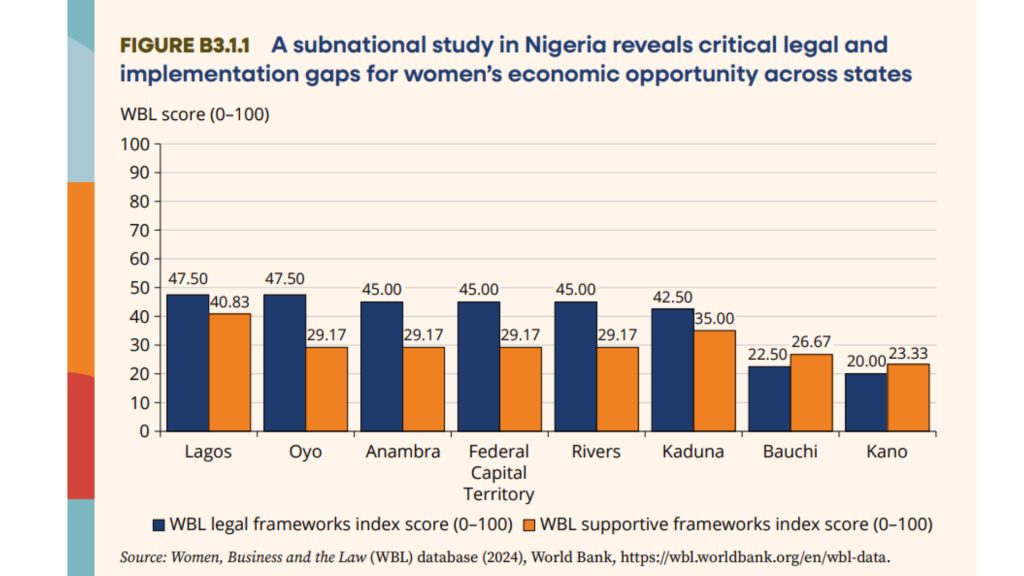
The goal of this expansion was to see how women’s lives differ across the country, and the results revealed a very uneven landscape. Lagos ranked highest, yet its scores remained low: 47.5% for legal rights and 40.8% for women’s support systems. Even in Nigeria’s most developed city, women lack full equality and strong institutional support. In northern states like Bauchi and Kano, scores are roughly half those of Lagos, largely due to Islamic personal laws affecting marriage and inheritance.
SEE ALSO: How Many African Countries Offer Menstrual Leave? The Answer Will Surprise You
Laws Change Depending on Where You Are
Nigeria utilizes a mix of federal, customary (traditional), and Islamic law. This plural legal system means a citizen’s rights can literally change based on their location. For example, while women have equal rights in some areas, in others, they inherit less than men, are legally mandated to obey their husbands, or have fewer legal protections.
In many parts of Nigeria, women are not fully protected by the law. The legal age of marriage also varies; while it is pegged at 18 in some states, in Kano, any girl who has reached puberty can legally marry.
Furthermore, domestic violence is only fully criminalized in Anambra, Rivers, and Abuja. Similarly, laws against sexual harassment in workplaces and schools exist only in a few states, such as Bauchi, Kaduna, and Lagos.
The Support Gap
Scores for Work, Parenthood, Childcare, and Entrepreneurship support are consistently low nationwide. No state scored above 25 in these parameters, highlighting a lack of support for working mothers, the absence of systems to ensure fair pay, and limited help for balancing work and family life.
Although the country struggles with women’s economic opportunities, some states are making progress. Bauchi reportedly offers loans to women-owned businesses, Kaduna provides discounted property registration for women, and Abuja has implemented training programs to help women advance their careers.
What This Means
Being a woman in Nigeria is not a “one-size-fits-all” experience. Rights, safety, and opportunities are heavily dependent on state laws, local culture, and religion.
This study aims to show Nigerian political, community, and religious leaders exactly where the gaps exist, providing a roadmap to fix discriminatory laws and help women participate fully in the economy.
This year’s WBL report shows that almost everyone has the ability to start a business. However, 91 economies still lack laws that prohibit gender-based discrimination in access to credit, making it harder for women to grow and scale their businesses.

About The Author