


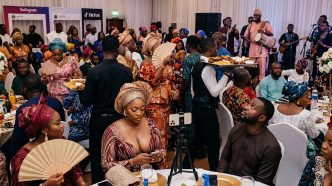

There is a special kind of chaos that belongs only to owanbe parties. Not owambe, please. It is not the chaos of poor planning or terrible music. Music is almost never the problem. From the opening praise and worship remixes to the inevitable transition to “handsome, handsome bobo,” when the devil-through liquor-begins to exert control, the sound usually does exactly what is expected of it.
The chaos here is something else. It is excess. Too much food, sometimes. Too much colour, always. Too much make-up to the point where your own cousin becomes a stranger, hand-held fans are working overtime and now, increasingly, too much breast making an unapologetic intrusion into the shared air. 
Before, just before, anybody reaches for outrage, I need to clear the ground. Women can dress however they like. It is their body, their clothes, their money, their moment. Nobody has been sworn in as Inspector-General of Necklines. At a party where gele alone can claim the airspace of a small satellite, it would be silly to start policing fabric.
Now that we are settled, we can start talking. Somewhere between the band moving through “Ma fi sia pa won,” “sukusuku sabadibo,” “ade ori okin” and “pakuru m oko jo daada,” waiters weaving through the crowd with trays of small chops that are sometimes big chops, a problem quietly presents itself. You are trying to focus. Maybe you are in the middle of a conversation. Maybe you are calculating whether it is socially acceptable to eat amala immediately after ofada and still go ahead with a bottle of Budweiser. Maybe you are straining to hear the MC announce that one Uber-type Corolla is blocking a top-of-the range SUV outside.
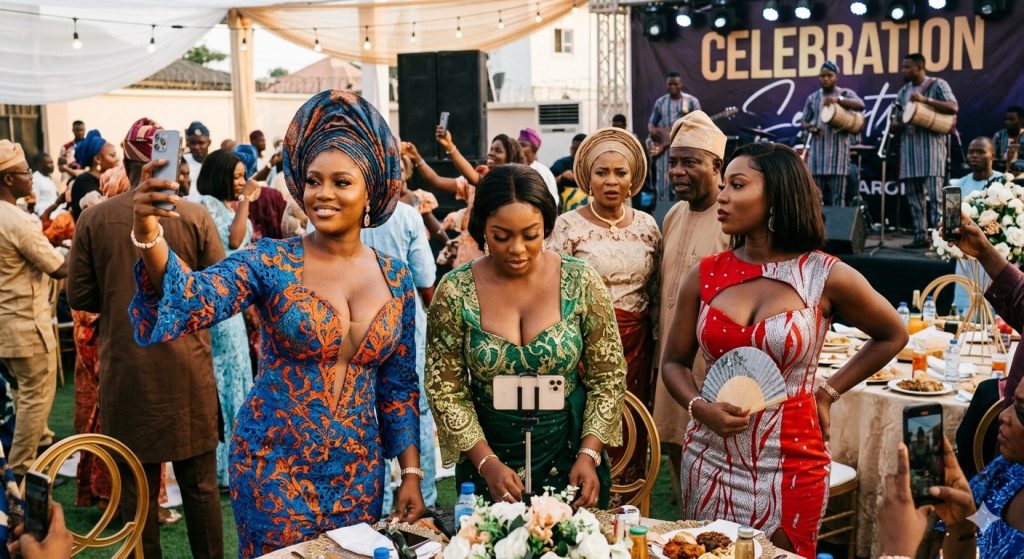
Then someone sits across from you, and suddenly the laws of concentration begin to wobble and fumble. Watermelon-sized breasts, barely contained, threaten to spill forward like they have somewhere urgent to go. You could be excused to think some are detachable or inclined towards secession. You look away out of second-hand embarrassment, only to discover that this is not an isolated event. Left, right and centre, table after table, there are women who appear convinced that their breasts are Iboobsprofen, an analgesic, prescribed for the very headaches they might cause.
There is a rhythm to it. The bigger the mounds, the more determined they seem to heave. Rising, swelling, falling in soft waves like they are part of the live band and not subject to the usual rules of discretion. Back when plunging necklines became the rage, the cleavage was the headline act. It annoyed plenty of people at the time. These days, the cleavage feels almost quaint. Nobody, except a committed hornball, would give the cleavage more than one second of attention when everything short of the areola and teat is already public appearance.
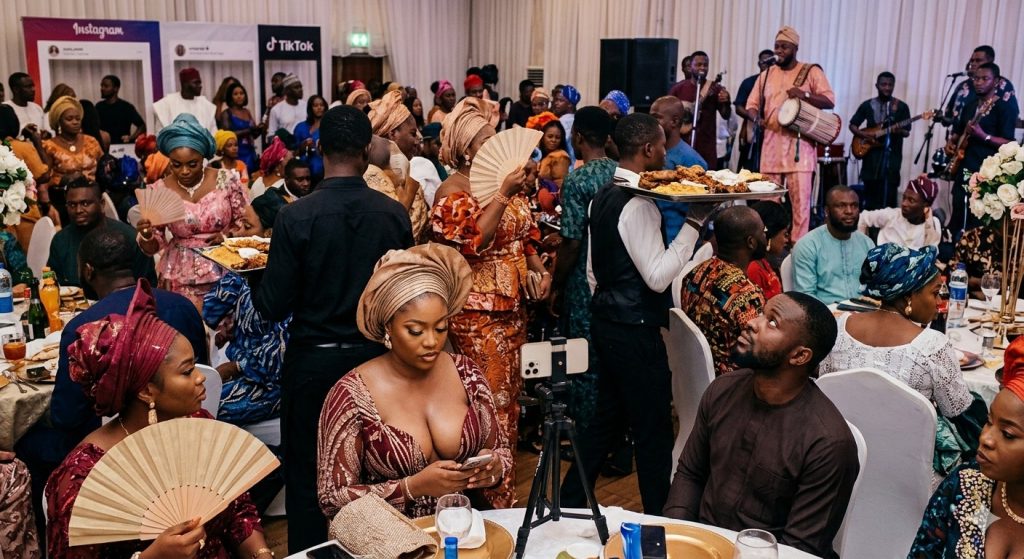
The plunging neckline has not just evolved. It has quietly retired. What has taken its place is something closer to surrender and it did not happen in isolation. Social media has poured petrol on the whole affair. Instagram, TikTok, Snapchat have all turned parties into performance stages. Owanbe is no longer just a gathering. It is now content. Angles are considered. Lighting is negotiated. Outfits are selected not only for the room, but for the camera that will carry them far beyond it. The reward system is instant and addictive. Likes, comments, shares, reposts, admiration from strangers.
In that kind of economy, subtlety does not cut it. Suggestion is too quiet. What wins is what stops the scroll; state-of-the-tart, let’s say. What wins is spectacle.
So the neckline keeps dropping. The fabric keeps retreating. And the room, whether it likes it or not, must adjust. Again, nobody is arguing against freedom. The issue is what happens to everyone else sharing the space. Public gatherings run on an unspoken agreement. You bring your style. I bring my appetite. Someone else brings their dancing shoes and we all behave like people who can co-exist without having to stare at the ceiling as if it holds a divine revelation.
That agreement is threatened. At a typical modern-day owanbe, maintaining eye contact has become a quiet test of discipline. Look up and you seem unserious. Look down, you seem worse. Look straight and you begin to understand the meaning of self-control in its purest form. It is not that people lack restraint. It is that the environment now feels engineered to test it.
Context used to be of great help. A nightclub is a nightclub. A beach party is a beach party. The rules are clear. An owanbe occupied a middle ground. While colourful and stylish, it existed within a social mix that included grannies and grandads, aunties, uncles, colleagues and in-laws. Now everything is blending into everything else and escalation, once it begins, rarely stops politely.
Today, it is the neckline showing aspiration be be somewhere near the waist. Tomorrow it will be something even more ambitious. Fashion, like competition, does not like second place. What started as elegance is drifting steadily towards spectacle and spectacle has a habit of swallowing everything in its path, including the party itself.
It becomes harder to notice the details that once defined the occasion. The aso-ebi chosen with care. The talking drum that deserves attention. Even the celebrant risks becoming background noise in a room that increasingly feels like a contest. This, I wish to state, is not a call for dullness or forced modesty. That would suck life out of the whole thing. Owanbe thrives on colour and a certain degree of excess. Take that away and you might as well serve jollof rice on your farm and call it a day.
However, restraint has its own quiet power. Style is at its strongest when it suggests, not when it overwhelms. When it frames, not when it floods the senses. There is a difference between dressing to impress and dressing like a billboard that forgot it is indoors. Freedom and awareness are not enemies. They are supposed to work together. One gives you the right to express yourself. The other reminds you that you are sharing space with other human beings who are also trying to function.
An owanbe should be loud, joyful, slightly chaotic, generous with food and drinks, music as well as laughter. It does not need to require survival strategies just to hold a simple conversation. We need the glamour, the confidence and desire that you turn heads if you must. But try to leave us with somewhere safe to look when you are done. I am no prude, by the way.
ALSO READ: VAT Has No Religion: Unpopular Opinion About The Hisbah and “Alcohol Tax” in Nigeria

About The Author