



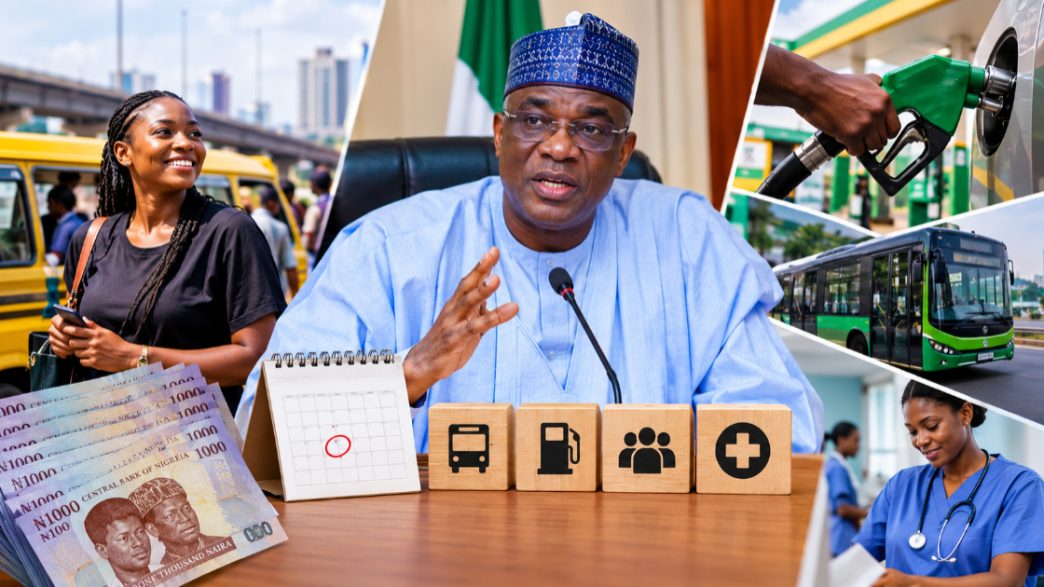
The Federal Government of Nigeria has agreed to pay public servants a monthly transport allowance of ₦70,000 for six months, beginning in November 2026. This is one of its latest palliatives attempt announced in October 2026 to ease the financial pressure on Nigerian workers.
The agreement, reached with the Nigeria Labour Congress (NLC) on October 27, comes as transport fares, food prices and other living expenses continue to squeeze household budgets. It also includes commitments to settle outstanding allowances owed to public servants and health workers.
But the transport allowance is only one part of a broader collection of interventions announced or agreed to in October. The government has also backed a temporary petrol discount through the Nigerian National Petroleum Company (NNPC) Limited, approved further steps towards cheaper CNG-powered transport and endorsed a 90-day action plan intended to address the cost-of-living crisis. 
On paper, that is quite a shopping list. The real question, however, is how many of these announcements will translate into meaningful relief for ordinary Nigerians.
Some measures are already operating, while others remain promises with start dates attached. And as Nigerians have repeatedly learnt, an announcement can arrive in record time while its benefits take the scenic route.
Here are all the palliatives the Federal Government of Nigeria implemented in October 2026.
Nigeria’s October 2026 Palliatives: What the Government Promised
1. ₦70,000 monthly transport allowance for public servants
Approval date: October 27, 2026 | Scheduled commencement: November 2026
The biggest headline from the government’s latest agreement with organised labour is the approval of a ₦70,000 monthly transport intervention for public service workers across all levels.
Under the agreement, the government will pay the allowance for six months, beginning in November. The measure followed a conciliation meeting between government representatives and the NLC leadership in Abuja, where both sides discussed workers’ welfare, the cost of living and outstanding agreements.
The allowance is intended to cushion workers against rising transportation costs. For employees who spend a substantial portion of their earnings commuting to work, an additional monthly payment could provide some breathing room.
However, the agreement does not mean workers have already received the money. As of October 28, the allowance remained a commitment scheduled to begin the following month. The published agreement also did not specify the exact monthly payment dates or detailed disbursement arrangements.
SEE ALSO: Why Your Data Finishes So Fast: MTN Nigeria Explains
What has the reaction been?
The NLC welcomed the outcome but made it clear that labour had hoped to secure more. Assistant Secretary-General Chris Onyeka described the talks as productive, while acknowledging that the outcome fell short of the union’s expectations.
That response reflects the difficult balance facing organised labour. Securing a temporary allowance is a tangible concession, but it does not necessarily resolve workers’ wider concerns about wages and purchasing power.
The six-month limit also matters. The allowance could help workers manage transport expenses in the short term, but its long-term value will depend on what happens when payments end.
For now, the important test is straightforward: will the money arrive as promised, and will it be enough to make a noticeable difference to workers’ daily expenses?
2. Payment of outstanding peculiar allowance arrears
Approval date: October 27, 2026 | Scheduled commencement: November 2026
The government’s agreement with labour also covers outstanding peculiar allowance arrears, effective from May 1, 2026. Under the arrangement, the government will begin paying the accumulated arrears in November, spreading the payments across three equal monthly instalments.
Unlike the ₦70,000 transport allowance, which provides temporary support for future expenses, the arrears settlement concerns money owed to eligible public servants for an earlier period.
The distinction is important. Workers who have been waiting for outstanding payments may welcome the commitment, but the benefit will only become real when the government starts releasing the money.
The October agreement establishes a payment timetable, although it does not provide a complete breakdown of the total amount involved or the exact dates on which individual workers should expect payments.
Will the arrears settlement provide immediate relief?
For eligible workers, receiving money owed to them could help cover accumulated expenses, settle debts or meet household needs.
However, the three-instalment arrangement means recipients should not necessarily expect the entire outstanding amount at once. Its practical impact will depend on the amount owed to each worker and whether payments follow the agreed schedule.
There was no separate, detailed public assessment of workers’ reactions to this particular commitment in the sources reviewed. Still, its inclusion in the agreement shows that the negotiations covered more than new allowances: they also addressed outstanding obligations.
The next milestone is November, when payments are scheduled to begin. Until then, the settlement remains an approved commitment rather than a completed payment exercise.
ALSO READ: Sniper Beans to Detergent Eggs: Inside Nigeria’s Alarming Food Adulteration Claims
3. Settlement of 19 months of health workers’ allowances
Approval date: October 27, 2026 | Scheduled commencement: December 2026
Health workers also secured a commitment from the government to settle 19 months of outstanding allowances within three months, beginning in December 2026.
The agreement emerged from the same October 27 conciliation meeting between the Federal Government and the NLC. It provides a timetable for clearing arrears that have accumulated over an extended period.
For health workers, the issue goes beyond an additional payment. Outstanding allowances affect how employees view their remuneration and whether they believe their employment conditions reflect the demands of their jobs.
The commitment could therefore help ease financial pressure on affected workers while addressing a long-running welfare issue.
However, the schedule means the first payments are not due to begin until December. As of October 28, there was no evidence in the sources reviewed that the 19 months of arrears had already been paid. The agreement also did not establish that every affected worker would receive the same amount.
What happens next?
The three-month window creates a measurable deadline for the government. The important questions are how much it will release, which workers qualify and whether the settlement will cover all eligible arrears within the agreed period.
The commitment is significant, but its success will ultimately be judged by payments reaching workers rather than by the announcement itself.
For a sector that depends on its workforce to deliver essential services, resolving outstanding remuneration issues is an important part of improving staff welfare. Whether this agreement marks a lasting improvement will become clearer once implementation begins.
4. NNPC’s ₦66-per-litre petrol discount
Initial launch: October 1, 2026 | Extension announced: October 9 | Scheduled end: October 31
Unlike the three worker-related commitments, the NNPC petrol discount was already operating during October 2026.
NNPC Limited introduced a ₦66-per-litre discount on October 1 as part of activities marking Nigeria’s 66th Independence Anniversary. The company subsequently confirmed that the promotion would continue through October 31 across its retail stations nationwide.
The initiative followed renewed government efforts to cushion the effects of elevated global crude oil prices on Nigerian households and businesses.
NNPC clarified that the discount did not represent a return to the petrol subsidy regime. Instead, it described the initiative as temporary customer relief and stressed that it did not establish a uniform national petrol price or change the market-based pricing framework.
SEE ALSO: From Lagos To Abuja: Why Fuel Price In Nigeria Changes From State To State
Why did the discount attract criticism?
Although the discount offered a reduction in fuel costs, the way customers accessed it became a source of frustration.
Motorists had to use the NNPC Fuel App and pay digitally to qualify for the ₦66 reduction, and customers paying directly at the pump reportedly did not automatically receive the discounted price. Some motorists questioned why a public relief initiative required a smartphone, data access and digital payment.
That criticism points to a broader issue with palliatives: the advertised benefit and the benefit people can actually access are not always the same thing.
The discount was real, but its reach depended on how easily customers could use the required payment method. And because it applied to NNPC Retail outlets rather than all petrol stations, it did not guarantee the same reduction nationwide.
The promotion was scheduled to end on October 31. Any extension beyond that date would require a further announcement; the existing offer should not be described as a permanent price reduction.
5. Joint federal-state financing for CNG & electric vehicles
Approval date: October 22, 2026 | Implementation: Framework and coordination still required
On October 22, the National Economic Council (NEC) agreed to establish a joint financing framework between the Federal Government and state governments to accelerate the deployment of compressed natural gas (CNG) and electric vehicles.
The decision followed a presentation on the National Affordable CNG Transit Programme by Ismaeel Ahmed, chairman of the Presidential Initiative on Compressed Natural Gas and Electric Vehicles.
The council said the programme must produce tangible benefits for Nigerians by reducing transport costs, rather than simply increasing the number of alternative-energy vehicles on the road.
It also called for engagement with transport unions and operators to ensure that savings from CNG and electric vehicles translate into lower fares for commuters. A committee was to coordinate the proposed financing arrangement, engage stakeholders and develop practical implementation measures.
Will commuters see cheaper fares?
That is the central question.
CNG-powered vehicles can offer transport operators an alternative to petrol, potentially reducing some operating expenses. But cheaper fuel does not automatically mean cheaper bus fares. Operators also face vehicle acquisition costs, maintenance, financing, infrastructure expenses and other running costs.
The NEC’s decision recognises this problem by explicitly calling for savings to reach passengers.
However, the October 22 announcement concerned a financing framework and further coordination. It did not establish that fares had already fallen nationwide or specify the number of additional vehicles that would be deployed under the new arrangement.
The measure therefore represents an important policy commitment, but its success will depend on funding, vehicle availability, infrastructure and enforcement of the promised fare reductions.
For commuters, the result matters more than the technology. A CNG bus is useful, but a bus that actually makes the journey cheaper is better.
ALSO SEE: Lagos Diesel Bus Ban Takes Hold as Operators Told to Switch to CNG and Electric Buses
6. The 90-day action plan to ease the cost of living
Approval date: October 22, 2026 | Implementation: Underway through planned coordination
The NEC also endorsed a 90-day economic action plan proposed by the Federal Ministry of Finance during its 161st meeting, chaired virtually by Vice-President Kashim Shettima.
The plan identifies five priority areas: food affordability, tax harmonisation, completion of high-impact projects, resolution of investment bottlenecks and regulated household support.
The council also approved a national dashboard to track projects across the federation, with particular emphasis on transparency, accountability and reporting on the use of proceeds from the removal of the petrol subsidy.
The stated aim is to translate the government’s broader economic reforms into practical improvements for households and businesses.
What has been implemented so far?
As of October 28, the public announcement established the plan’s priorities and the decision to create a national tracking dashboard. It did not provide enough detail to confirm that all five areas had produced new, measurable benefits for households.
Premium Times also noted that the initial announcement offered limited specifics about the plan. That makes it difficult to assess the likely cost of individual interventions, the number of beneficiaries or the precise milestones for delivery.
The action plan is broader than a cash payment or fuel discount. It is intended to coordinate economic measures across government, including interventions affecting food prices, household support and project delivery.
Its success will therefore depend on whether federal and state authorities move quickly from endorsement to execution, publish clear targets and demonstrate what the plan has changed for ordinary Nigerians.
A dashboard could improve transparency, but it cannot lower food prices by itself. That requires the policies being tracked to deliver results.
READ ALSO: 10 Staple Food Items That Have Become Cheaper in Nigeria
Nigeria’s October 2026 Palliatives: Will Nigerians Feel the Difference?
Taken together, the six measures show that the government is responding to pressure over transport costs, workers’ welfare and the broader cost of living.
The ₦70,000 transport allowance, peculiar allowance arrears and health workers’ arrears offer specific commitments to public employees. The NNPC discount provides temporary fuel-price relief, while the CNG financing framework and 90-day action plan aim to address some of the structural issues behind household expenses.
But the measures are at different stages. The petrol discount was active in October; the worker payments are scheduled for November and December; and the CNG framework and broader action plan still require coordinated implementation.
Public reception reflects that difference. Labour welcomed the latest agreement but said it had expected more, while some motorists criticised the conditions attached to the NNPC discount. The available reporting does not establish a comprehensive nationwide public verdict on all six measures, so claims that Nigerians broadly support or reject the package would go beyond the evidence.
The real test is what happens next. Will workers receive their allowances on time? Will the government settle outstanding payments within the promised windows? And will commuters pay less when CNG transport expands? And will the 90-day plan deliver measurable improvements in food affordability and household welfare?
Nigerians have heard plenty of economic promises in recent years. What they need now is not another impressive list of announcements, but evidence that the relief has reached the people who need it.
READ ALSO: From ₦20 to ₦1,400: History of Petrol Price Hikes in Nigeria Since 1999

About The Author