


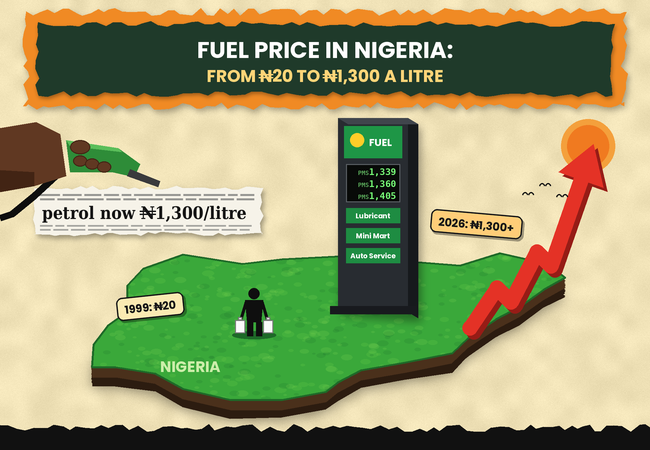
In 1999, a litre of petrol in Nigeria cost N20. By October 2026, the fuel price in Nigeria sits between about N1,340 and N1,410 per litre, depending on the station and how you pay. Oh, young reader, are you still searching for your glasses because you’re not sure what you just read? Yes, there was once a time when N1,000 could buy 50 liters of fuel; now, it can’t even buy one.
That is roughly a 65-fold jump, not from something you pour into a Toyota. Every few years, fuel price behaves like an aspiring academic and reaches higher, and lately it never looks back once it does. So how did we get here, and is there a way back?
Grab a seat. Here is the story, one hike at a time. 
1999-2000: N20 to N30, and a Hasty U-Turn
Nigeria returned to civilian rule in 1999 with petrol at N20, after the military government had cut it from N25. In June 2000, President Olusegun Obasanjo raised it to N30, but after protests led by the Nigeria Labour Congress (NLC), it slid back to N22.
Imagine that, a protest that actually yielded results. Wow! What days!
The price rose to N26 in January 2002 and then N42 in June 2003. The latter triggered an eight-day general strike that ended in a compromise reported at N34 a litre, although official tables still list N42 as the starting point for the 2004 increases. Then it increased to N50 in May 2004 and N65 that August.
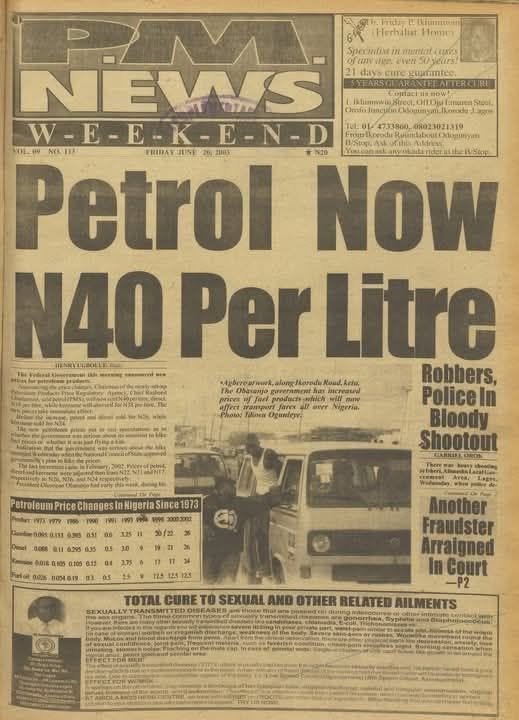
The stated aim over those years was to wean the country off subsidy, while labour’s concern was the cost of living. Same fight, different year.
May 2007: N75, Then a Rare Price Cut
Just days before handing over in May 2007, Obasanjo lifted the price from N65 to N75. His successor, Umaru Musa Yar’Adua, cut it back to N65 the following month. Yes, a price cut. Younger readers, this really happened.
No wonder Nigerians always wish for what could have been under Yar’Adua. Would he have made a good president and ushered us into a prosperous age? Answers we’ll never know.
READ: Dollar Crashes by ₦329 as Naira Exchange Rate Nears Strongest Level in 2 Years
January 2012: N141 and Occupy Nigeria
On New Year’s Day 2012, President Goodluck Jonathan’s government pushed the price from N65 to about N141, an increase of roughly 120%. Result? Bedlam! Protests, the likes of which we’d never seen across the country.
Know what? Talking about it doesn’t do it justice; here are some images:
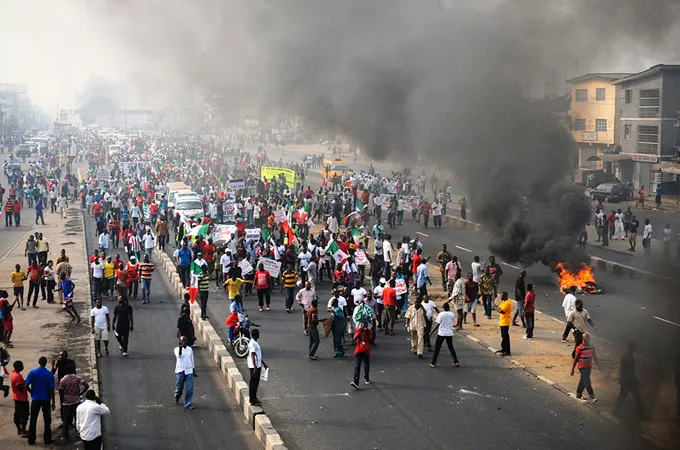
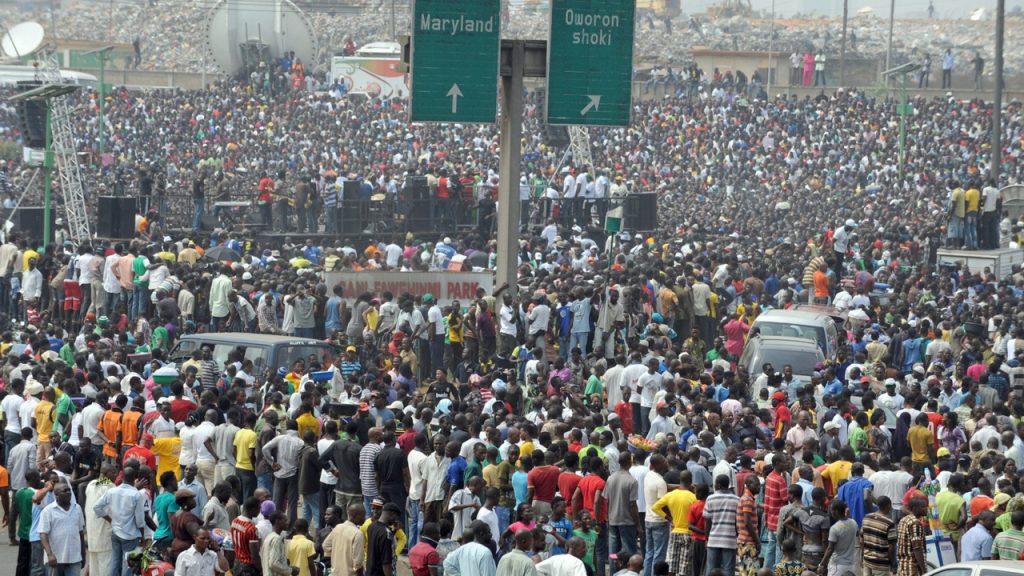
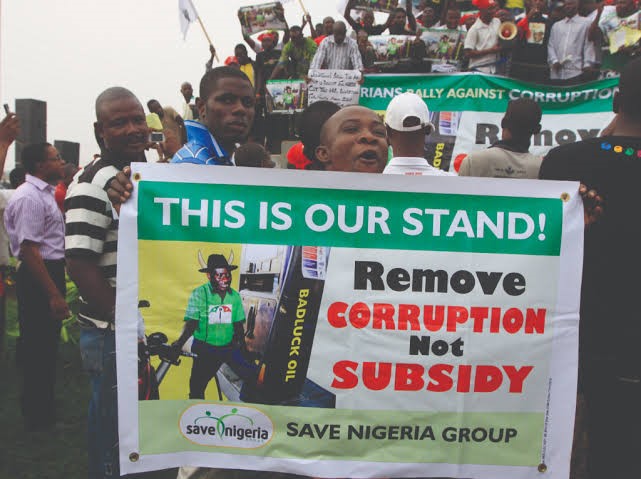
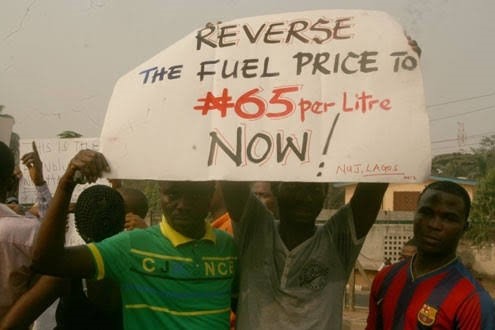
Occupy Nigeria, they called it. The NLC went on strike. Every politician from opposing parties crucified Jonathan, from the NLC president, Adams Oshiomole, to the then Lagos State governor, Bola Ahmed Tinubu. Suddenly, they were all very concerned about the welfare of Nigerians.
The nationwide strike forced Jonathan to cut fuel price to N97 on January 17, and it slipped to N87 by February 2015. Street power had moved a pump price. Remember this for later.
May 2016: N145 and the Long Plateau
President Muhammadu Buhari raised petrol from N87 to between N143 and N145 on May 11, 2016. It then held for years because NNPC quietly absorbed the gap between import costs and the pump price, which is how the subsidy bill ballooned.
By early 2023, pump prices had crept to about N185-N195, and everyone knew the party was ending.
READ ALSO: Dangote Foundation Targets 7 Million Students, Vulnerable Women With N40bn Share Offer
May 2023: “Subsidy Is Gone”
In his inaugural speech on May 29, 2023, President Bola Tinubu declared that fuel subsidy was gone, noting that the budget had made no provision for it from June 2023. Queues formed within hours, some stations shut, and the price rose from about N189 to over N550.
The NLC demanded a reversal and announced a strike for June 7. The petrol price in Nigeria had nearly tripled in days, but this time around, the strike did nothing.
The Central Bank floated the naira in June, the currency slid, and NNPC raised petrol to N617, blaming market dynamics. The NLC issued a seven-day ultimatum and threatened an indefinite strike from August 2, which makes you wonder why when the last one clearly did nothing. Tinubu’s palliative plan, including N75 billion for manufacturers and a promise to review wages, was dismissed by the union as out of touch.
Oh, in case you’re wondering, the indefinite strike was about as effective as its predecessor, in that it absolutely did not move the needle an inch.
September 2024: N897, Then N1,030
NNPC raised its Abuja price to N897 on September 3 and then to N1,030, with Lagos going from N855 to N998. Marketers hailed it as proof that deregulation had arrived. The NLC demanded a reversal and complained that one state-owned company was fixing prices.
Either way, four figures at the pump had become normal.
Dangote’s petrol price had dipped to N699 in December 2025, so for a moment it looked like relief. Then crude passed $80 in early March 2026 due to the Iran War, and the refinery lifted its ex-depot price to N875. It made four increases that month as Nigerian crude surged past $110, with the refinery arguing that few countries sell petrol below $1 a litre without state support.
The price reached N1,245 by March 21. Nigeria recorded Africa’s largest petrol price increase in that period, at 39.5%. Surprisingly, the very voices who had cried out against minimal price increases under past administrations were now silent as petrol price took leaps and bounds; some even support, for generic reasons. Adams Oshiomole was asked in an interview why he’s supporting the new wave when he cried out in the past, but chose to nitpick the interviewer’s choice of words rather than answer the question.
READ: Atiku Rejects FG’s 30-Day Petrol Discount, Says Relief at NNPC Stations Is Too Limited
May–September 2026: Dollar Pricing and N1,350
By May, with crude above $115, Dangote’s gantry price hit N1,350. On July 13, the refinery switched to dollar pricing, and some depots raised prices by up to N113 within days. Marketers urged the government to step in. The government did not. Dangote later resumed naira sales.
On September 12, its gantry price rose again, from N1,265 to N1,350.
Fuel Price in Nigeria Today: Discounts and Ultimatums
On October 8, the government announced a 30-day discount at NNPC stations, with public transporters served first, and said it was negotiating a N1,350 ceiling on landing cost. NNPC says the N66-per-litre discount runs to October 31 for customers paying digitally, yet some stations still raised prices to about N1,405–N1,409 in Abuja last weekend.
Finance Minister Taiwo Oyedele insists it is not a subsidy, since NNPC Retail funds it from its own margin. Meanwhile, the NLC issued a two-week ultimatum on October 9, demanding that petrol return to its price when the N70,000 minimum wage was signed.
Can Fuel Price in Nigeria Ever Go Back Down?
There’s a humorous saying that “Nothing that’s ever gone up in Nigeria can come back down.” So while, yes, fuel price in Nigeria can indeed fall, don’t expect N200 petrol to come back.
Prices already dip when conditions allow, as the N699 low in December 2025 showed. Analysts say a Dangote source floated N900 as possible if oil prices settle, but that was said in June and prices have risen since. Even when crude falls, the naira, costlier older stock and logistics can delay relief.
Then there is the subsidy question. Oyedele warns that restoring it could push petrol to at least N2,000 and the naira toward N3,000 per dollar. That is a government estimate, and not everyone accepts it. A private-sector think tank puts the annual cost near N20 trillion, while presidential candidate Atiku Abubakar has vowed to restore subsidy.
The honest read is that a subsidy lowers the pump price on paper, but someone still pays the bill. But then, subsidy was removed so as to provide relief in other areas, except none has been forthcoming, so will it really be a bad thing?

About The Author