



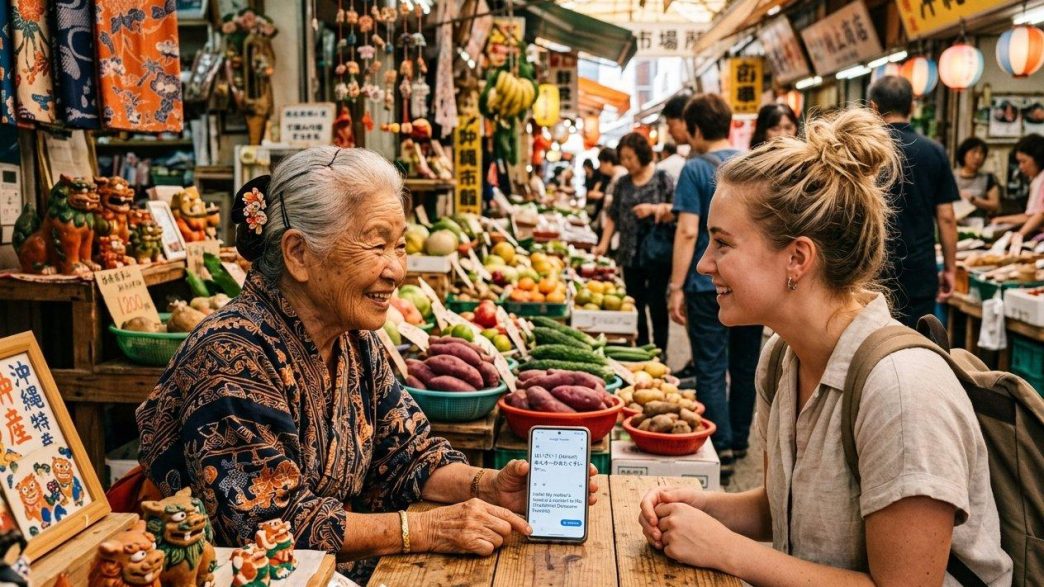
Travelling to a country where you do not speak the local language can be exciting, but it can also produce some unexpectedly funny moments.
A simple request can become a comedy routine, a casual conversation can turn into a guessing game, and sometimes, a person can completely misunderstand what an entire crowd is saying.
For some travellers, these moments can be frustrating. For others, they become some of the most memorable stories of their trips. 
A recent incident in China perfectly captured the lighter side of language barriers.
Language Barriers Turn a Lost Phone into a Comedy
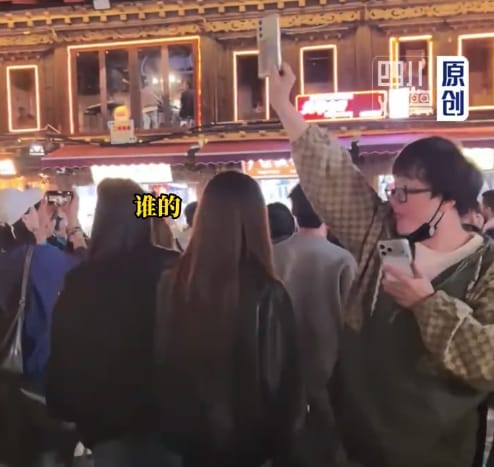
A tourist visiting Dukezong Ancient Town in Shangri-La, Yunnan Province, China, recently found himself at the centre of an amusing misunderstanding.
After a mobile phone was found in the area, people began trying to locate its owner. A crowd gathered, with people calling out in Chinese to find the person who had lost the phone.
The foreign tourist who had misplaced the phone was nearby, but he apparently could not understand what the people were saying.
Instead of realising that they were searching for him, he reportedly thought the crowd was celebrating and happily joined in.
He eventually discovered that the phone everyone was looking for was his.
What could have been an awkward situation instead became a humorous example of what can happen when people are separated by language.
The incident also showed how easily context can be lost when we cannot understand the words being spoken around us.
Language Barriers turn a Simple Request into a Comedy Routine
Another amusing example involved a Singaporean tourist of Malay descent visiting Guangzhou, China.
Muhammad Rifqi Solihin, a 24-year-old travel content creator, was eating at a restaurant when he spilled sauce on his hands and needed some tissue.
The request should have been simple.
However, because of the language barrier, communicating what he wanted became surprisingly difficult.
Rifqi showed a waitress the Chinese wording for his request on his phone. When she still appeared confused, he tried typing “tissue” to make his meaning clearer.
Eventually, the waitress returned to the table carrying a tissue box and gesturing that it had been there all along.
The funniest part came later when she jokingly presented the tissue box to him again and asked, in a mixture of Mandarin and English, “Are you understand?”
Rifqi burst out laughing.
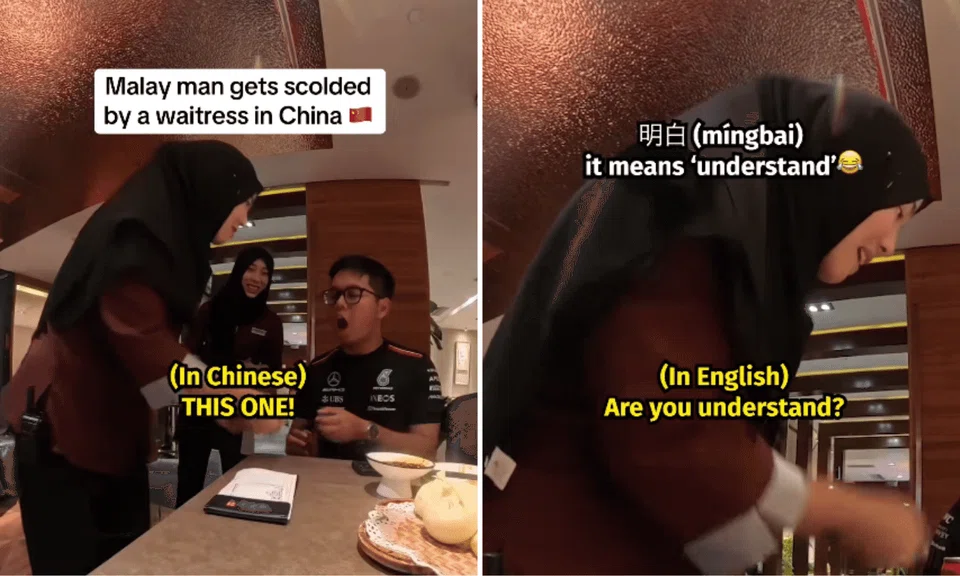
Speaking to Stomp, he said the encounter actually made his day. The restaurant staff continued trying to communicate with him, and he even learned a few Chinese words from them.
Rather than allowing the language barrier to create tension, both sides turned the misunderstanding into a playful interaction.
Sometimes People Talk Without Understanding Each Other
Language barriers can sometimes produce something even more remarkable: conversations between people who do not share a common language.
In March 2026, a foreign cyclist travelling through Vietnam’s Mekong Delta stopped to speak with a local man in Dong Thap Province.
The traveller spoke English while the Vietnamese man, identified as 45-year-old Son, spoke Vietnamese.
Neither man understood the other’s language.
Yet they continued talking.
Their conversation, which lasted about half an hour, was filled with gestures, smiles and laughter. Son eventually invited the cyclist to his home and showed him aspects of everyday life in the Mekong Delta.
He showed the visitor his fish pond, invited him to try walking across a narrow wooden “monkey bridge” and offered him local food.
According to Tuoi Tre News, Son later laughed about the encounter, saying that although they had spent time talking, neither man had actually understood what the other was saying.
Yet somehow, communication still happened.
The encounter is a reminder that communication is not always dependent on vocabulary.
Sometimes, a smile, a gesture or a shared laugh can say enough.
When words fail, gestures take over
For tourists, language barriers can create genuine difficulties.
Ordering food, asking for directions, negotiating prices, using public transport or seeking help can become challenging when a visitor and a local person do not speak the same language.
But travellers often find creative ways around the problem.
Some use gestures. Others point at pictures or objects. Many now rely on translation applications on their phones.
And sometimes, the mistakes themselves become part of the adventure.
A traveller may confidently pronounce a word incorrectly, misunderstand an instruction or accidentally ask for something completely different from what they intended.
The result can be embarrassing at the time, but often becomes a story worth telling later.
An older example from Ghana illustrates how complicated communication can become even when both parties are simply trying to conduct an everyday transaction.
In 2019, Modern Ghana reported on a viral video involving an English-speaking man who wanted to buy game from a hunter.
The prospective buyer spoke English and was asking questions about the animal, including how it had been caught. The hunter, who spoke Twi, and the people around him were discussing matters including the price and preparation of the meat.
Neither side appeared to understand what the other was saying.
Eventually, the attempted conversation ended without the communication problem being resolved.
The incident highlights an important point: speaking different languages does not mean that one person is less educated or less intelligent than the other. It simply means they do not share the same linguistic tool for communicating.
Technology is changing the way tourists communicate
Fortunately, travellers today have access to tools that previous generations could only imagine.
Translation applications can translate written text, menus and signs. Camera-based translation can allow tourists to point their phones at unfamiliar words and receive an instant translation.
Voice translation tools can also help travellers communicate basic questions and responses.
These technologies are particularly useful in situations where gestures are not enough.
However, technology has not eliminated the human side of communication.
The tourist in Guangzhou still ended up laughing with the restaurant workers despite their difficulty understanding one another. The foreign cyclist in Vietnam did not need a translation application to enjoy half an hour with a stranger.
In both cases, the inability to speak the same language did not prevent people from connecting.
Perhaps that is one of the unexpected pleasures of travelling.
A language barrier can make an ordinary moment confusing, awkward or even hilarious. But sometimes, those very misunderstandings become the stories travellers remember long after they have returned home.
After all, when words fail, people still have smiles, gestures, laughter — and occasionally, a little help from Google Translate.

About The Author