


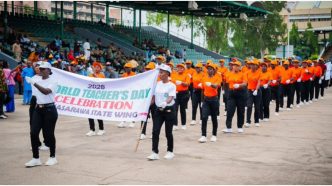
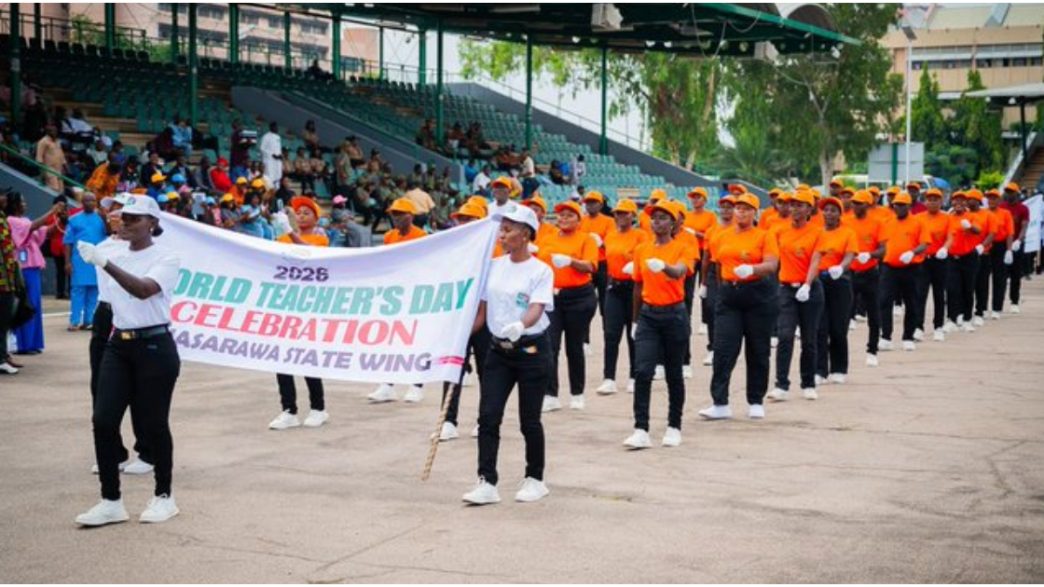
For one day each year, teachers receive praise for shaping children and preparing them for the jobs that keep society moving.
Yet, for teachers in Gombe and Kano states, World Teachers’ Day comes with mixed feelings.
Teachers who spoke to NBG Africa described low pay, rising living costs, poor working conditions and uncertainty about their future. 
Meanwhile, prices have risen sharply since the Federal Government increased the minimum wage from N30,000 to N70,000 in July 2024.
The Wage That Was Meant to Ease the Pressure
President Bola Tinubu signed the new minimum wage into law on July 29, 2024. The law raised the minimum wage from N30,000 to N70,000. It also requires a review every three years. At the time, inflation was above 32%.
Gombe and Kano states later approved minimum wages of about N71,000 for their workers. However, the relief did not last long. In September 2024, the Nigerian National Petroleum Company Limited raised petrol prices from N617 per litre. By October 9, the price had reached N998 per litre in Lagos.
The National Bureau of Statistics also reported that a 50kg bag of local rice cost N95,738 in September 2024. A year earlier, it cost N37,853. That meant one bag of rice cost N25,738 more than the new N70,000 minimum wage.
Teachers Count the Cost of Everyday Living
Headline inflation fell to 15.39% in August 2026, while food inflation stood at 19.57%. However, slower inflation does not mean prices are falling. It simply means they are rising at a slower pace.
The national average petrol price stood at N1,267.75 per litre on September 7, 2026. Five days later, Dangote Refinery increased its gantry price to N1,350 per litre. It was the refinery’s fourth increase since August 20. The NBS had earlier put the national average petrol price at N1,596.25 in May 2026.
Rice prices have also remained high. The NBS recorded the average price of a 50kg bag of local rice at N112,000 in March 2026. Imported rice averaged N133,975 during the same period.
Market checks, however, found local rice selling for about N60,000 in some areas. Prices vary considerably by location.
Egg prices also add pressure. A crate of 30 eggs cost N5,610 in Niger State, N5,400 in Gombe and N6,999 in Taraba in March 2026.
For teachers, these figures translate into difficult choices over food, transport, housing, healthcare and family needs.
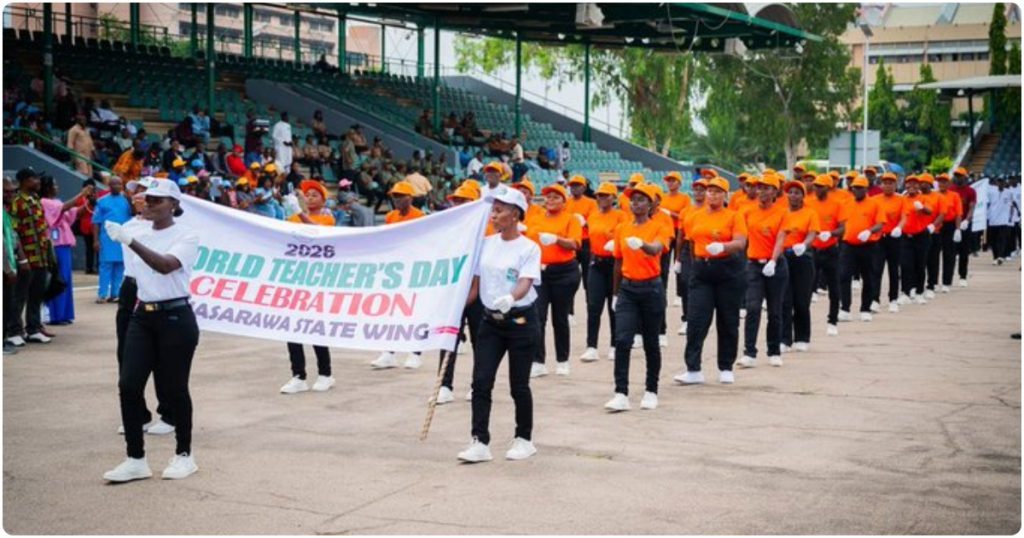
‘Poor Remuneration Is One of Our Challenges’
For Muhammad Rabi’u Jibrin, a teacher at an Islamic school in Gombe, Teachers’ Day is both a celebration and a reminder of teachers’ struggles.
“It is indeed pleasurable to have a single day dedicated globally to someone’s profession. The joy cannot be quantified,” he said.
However, Jibrin said that joy is difficult to separate from the problems many teachers face throughout the year. He described teaching as a noble profession that produces workers for virtually every other sector. Yet, he said teachers often receive inadequate attention.
“Poor remuneration, poor conditions of service, and economic hardship are some of the challenges that teachers face,” he said.
Dr Aishatu Usman Muhammad, a lecturer at Gombe State University, also highlighted the pressure facing teachers. She said many struggle with rising food, transport, housing and healthcare costs while meeting family responsibilities.
“Their commitment should not be taken for granted,” she said.
Muhammad called for fair and timely pay, professional development opportunities and better working conditions.
“When we support teachers, we strengthen the education of our children and the future of our communities,” she said.
READ ALSO: Nigerian Students Bag 28 Medals at 2026 International STEM Olympiad in Italy
Some Teachers Live Below the Wage Floor
For some teachers, teaching alone does not provide enough income to meet their basic needs.
In Kano State, Ja’afar Sani works as a volunteer teacher. He said he relies on selling mobile phones because teaching does not provide a livelihood.
“I relied on selling mobile phones, not teaching, because I don’t work for the government. I am a volunteer teacher,” he said.
Despite the financial difficulties, Sani remains proud of his profession.
“I am proud to be a teacher and I feel the day is totally mine today,” he said.
He also wants the government to improve the education system, which he believes is struggling.
Private school teachers face another set of challenges.
Mariya Sa’idu, who teaches at a private school in Gombe, said some schools impose strict conditions while paying very little.
“If you come late, they deduct your money. They don’t even pay the minimum wage, but still expect you to come at 6:30 a.m. and close by 3 p.m. Less than N50,000 in a month,” she said.
Sa’idu said she remains in the profession partly because her children attend the same school.
“I love teaching because that’s where my kids are studying. At least I am close to them and I don’t have to sit at home,” she said.
She added that watching her pupils learn gives her satisfaction despite the limited financial reward.
ALSO READ: 18-Year-Old Georgia Oviesu Builds Free School and SafeLink App
Even N70,000 Leaves Teachers Counting Every Naira
Ephraim Jatau, a teacher under the Kaltungo Local Education Authority in Gombe State, receives the state’s implemented minimum wage. However, he said the income still has to cover transport, food and his children’s needs.
“Imagine going to school from 7 a.m. to 2 p.m. for five days. How much am I going to spend on transportation and feeding? I have kids too,” he said.
Jatau said some people enter teaching because they have few alternatives in an economy where jobs are scarce.
“Some of us are teaching because we have no options. There are no jobs,” he said.
He remains proud of being a teacher but said the pressures and risks have changed how he views the profession.
“For my safety, I think it’s not worth it these days,” he said.
He has also decided against allowing his children to follow the same career path.
“I won’t allow my kids to teach,” he said.
What N70,000 Can Buy Today
The figures show how quickly the value of the minimum wage can disappear.
Petrol prices have more than doubled since the N70,000 wage became law. A minimum-wage worker can therefore buy roughly half the fuel they could afford when the law was signed.
At the NBS-recorded March 2026 price, a 50kg bag of rice costs about 62% of the N70,000 minimum wage. For someone earning less than N50,000, the same bag costs more than twice their monthly pay.
Ten litres of petrol at N1,267.75 costs about N12,680. That represents roughly 18% of N70,000 and about a quarter of N50,000.
A single crate of eggs can also consume between 8% and 10% of the minimum wage.
Rent, school fees, electricity, healthcare and transport costs then add further pressure.
Labour Calls for a Fresh Look at the Wage
The Nigeria Labour Congress’ acting general secretary, Benson Upah, said N70,000 cannot sustain a family for 10 days after electricity bills are deducted.
Labour has said it would begin renegotiating the wage in July 2026. However, the statutory review is not due until 2027.
In July, the Chief of Staff to the President, Femi Gbajabiamila, described the N70,000 minimum wage as a milestone achieved in 2024. However, he said the wage must be reassessed against current economic realities.
For teachers, World Teachers’ Day remains a moment of recognition. But their stories show that praise alone cannot ease the financial pressures waiting for them after the celebration ends.
READ MORE: Textbooks: Education Ministry Releases Approved List for 2026-2028, Introduces QR Tracking Codes
Story written by Muhammad Tanko, edited by Sola Sanusi

About The Author