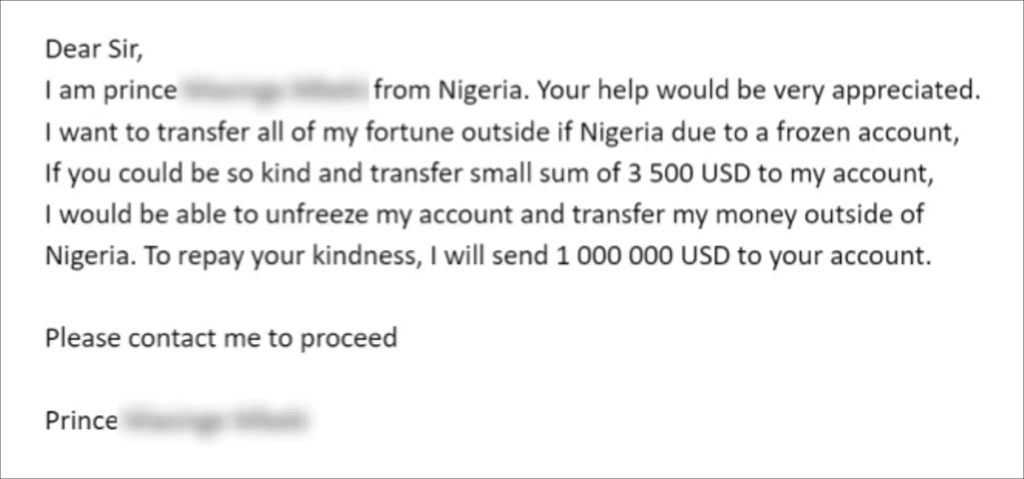
Just like me, you’ve likely seen it somewhere or read about it. “Hello, dear, I am a Nigerian prince, and…”
For decades, that phrase has been a universal shorthand for fraud. It is the punchline of jokes, the warning sign in spam folders, and the digital symbol of deception. Here’s the part most people don’t know: the so-called “Nigerian prince” scam didn’t start in Nigeria, and it didn’t even start online.
With that being the case, how did an entire country become the face of a crime that predates the email technology itself? 
What Is The Nigerian Prince Scam?
Formally, the scheme is known as an advance-fee fraud. The concept is simple: the scammer promises the victim a large reward. Either inheritance money, hidden funds, or business profits, all in exchange for a relatively small upfront payment to “unlock” it.
Once the victim pays, new complications appear. More fees are requested. The promised fortune never materialises. The format exploits something universal: hope or, most times, greed. Or both.
The first time I heard of this was when I read I Do Not ComeTo You By Chanceby Adaobi Nwaubani. It’s fiction, but like most good fiction, it felt uncomfortably close to reality.
The book wrote about the world of 419 in a way that’s almost unsettling. The planning, the scripts, the patience. Everything was structured like the author was a Nigerian princess herself.
And I remember thinking, “Who actually taught Nigerians this?” Where did this format even come from?
Before Email, There Was the Newspaper
Long before inboxes and spam filters, similar scams were already circulating through traditional media. In 1949, someone using the pseudonym “Prince Bil Morrison” placed an advertisement in an American newspaper asking for pen pals.
In a correspondence that followed, he reportedly requested $4 and a pair of trousers in exchange for promises of jewels.
Eventually, authorities discovered there was no prince at all. The writer was a 14-year-old boy with no royal ties and an American, and his age stopped legal actions from being taken. The story is partly obscured by time, and records vary on some details. To date, no one knows who he really is.
The structure, however, is unmistakable: a claim of status, a promise of wealth, and a request for advance assistance. The blueprint was already there decades before Nigeria became associated with it.
ALSO READ: ‘A Sitting President Will Die Before 2027’ — Primate Ayodele Issues Grave Warning
How Did Nigeria Become Attached to it?
The answer lies largely in the late 1980s and 1990s. During that period, advance-fee fraud became more widely reported in connection with criminal networks operating out of Nigeria. Letters, and later emails, were often sent claiming to involve government contracts, oil deals, or the transfer of funds from political upheaval.
Nigeria’s Criminal Code specifically addresses fraud under Section 419, which is why such scams became locally known as “419”. Over time, international media began using the phrase “Nigerian scam” or “Nigerian prince scam” to describe the scheme, and the label stuck.
As email became widespread in the early 2000s, these messages spread globally. The repeated association between Nigeria and advance-fee fraud solidified into a stereotype. One that now transcends the original criminal cases.

The uncomfortable truth is that fraud exists everywhere. Romance scams have been traced to multiple countries. Investment scams originate from various regions, like Southeast Asia. Ponzi schemes have been run from some of the world’s most powerful financial capitals, dating back to Boston in 1920. Yet one specific variation became culturally branded with a single national identity.
Part of the answer is scale and media repetition. As well as timing. Nigeria’s rise into global digital spaces coincided with the rise of email fraud, coupled with the fact that Nigerians are generally smart. This contributed to how easily the narrative hardened into a stereotype.
The term “Nigerian prince” is now so embedded in global culture that it is used casually, often without any reflection on its origins.
Conclusion
Advance-fee fraud didn’t begin with Nigeria. It didn’t begin with the internet. And it certainly didn’t invent deception.
But at some point, Nigeria became its most recognisable face. A part of that has to do with reality.
Then came the high-profile cases that made international headlines. Figures like Ramon Abbas, popularly known as Hushpuppi, who was convicted in the United States for laundering hundreds of millions of dollars and defrauding victims, including stealing approximately $40 million from a U.S. law firm. Cases like this reinforce narratives.
Over time, “Nigerian prince” stopped being just a scam format and became a cultural shorthand. For many Nigerians abroad, that reputation lingers in subtle ways. The country’s reputation has hindered a lot of people’s access to opportunities.
It’s crazy how a pattern of global crime became a national stereotype and how difficult it is to separate one scam done by a non-Nigerian from one done by a ‘Nigerian Prince’ once the world has decided they are the same.

About The Author