




On Tuesday, the Nigeria Catchball Federation made an announcement that would have seemed extreme just a few weeks ago. The federation pulled out of a forthcoming international competition in South Africa, citing escalating xenophobic attacks and growing concerns over the safety of Nigerian athletes and officials.
NCF President Bola Babarinde said the decision served the best interest of players, officials, and the entire Nigerian contingent. “The prevailing tension and uncertainty have inevitably impacted the integrity and feasibility of the competition,” he said.
For anyone following what has unfolded in South Africa this week, the decision makes complete sense. 
What Has Actually Been Happening
This is not a vague atmosphere of tension. There are specific incidents, specific names, and specific deaths.
Two Nigerians, Amaramiro Emmanuel and Ekpenyong Andrew, died in separate incidents linked to rising anti-foreigner tensions. The Nigerian Consulate General in Johannesburg confirmed both deaths.
Emmanuel died from injuries sustained after personnel of the South African National Defence Force beat him on April 20. Meanwhile, police arrested Andrew on April 19 in the Booysens area of Pretoria following an alleged altercation with Tshwane Metro Police officers. Someone later discovered his body at the Pretoria Central Mortuary.
However, what makes these deaths particularly disturbing is that security personnel, the people meant to protect everyone in the country, allegedly carried out both killings.
In addition to the deaths, mobs targeted foreign nationals across several cities. In one widely circulated clip, protesters confronted a Nigerian trader during an anti-immigrant rally and ordered him to leave the country with his family. Despite his plea that he had lived there for years and needed to feed his children, the group insisted he leave.
In a related incident, attackers shot an Ethiopian national dead in downtown Johannesburg in what authorities suspect was a targeted killing. CCTV footage showed the victim being approached and shot at close range. Despite ongoing investigations, police had made no arrests.
The Scale of It
Fresh waves of attacks left Nigerians counting losses, with businesses looted and residents fleeing for safety in parts of Johannesburg and Durban. Mobs targeted foreign-owned shops, vandalised property, and attacked African immigrants throughout the week.
Following the outbreak, the Nigerian Consulate issued an advisory warning of violent demonstrations in East London, Cape Town, Durban, and KwaZulu-Natal, as well as planned protests in Gauteng Province.
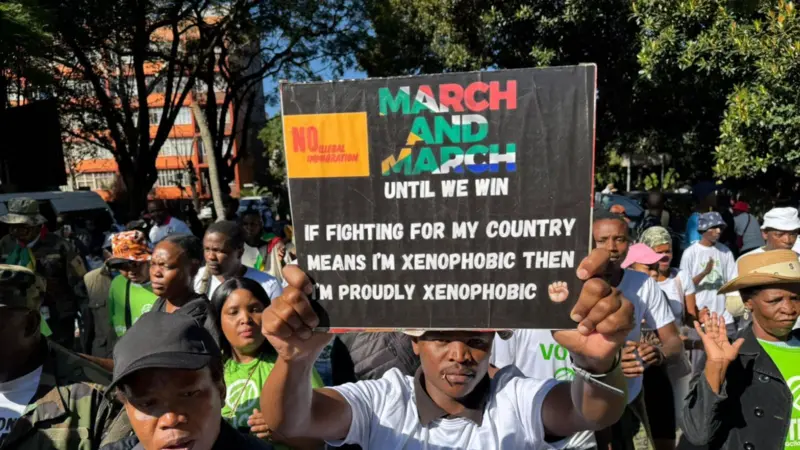
Meanwhile, one particularly chilling message came from a group organising a national shutdown planned for May 4. “We are xenophobic,” the message read. “We want all foreigners, documented or not, out of this country.”
Documented or not. That is the part that matters. Legal papers, valid identification, years of living and working in the country— none of it matters when the people coming for you have already decided your documentation is irrelevant.
Nigeria’s Response
As a result, the Nigerian government called on South Africa to guarantee the safety of Nigerians and other foreign nationals. The Ministry of Foreign Affairs condemned the attacks and urged Pretoria to uphold its obligations. “As brotherly nations, Nigeria calls on South Africa to protect the lives and property of foreign nationals,” the statement read.
In addition, NICASA President Frank Onyekwelu described the situation as alarming. “We are witnessing a troubling normalisation of hostility through inflammatory rhetoric, unlawful intimidation, and discriminatory enforcement practices,” he said, calling for urgent diplomatic intervention.
Following the advisory, the Nigerians in Diaspora Commission told Nigerians to close their businesses temporarily, avoid confrontations, and monitor local media for updates.
SEE ALSO: Kenya’s President, Ruto, Said Nigerians Need a Translator to Be Understood
This Is Not New, And That Is the Problem
South Africa witnessed similar outbreaks in 2008, 2015, 2019, and beyond. The 2008 attacks killed over 60 people and displaced thousands. Despite repeated cycles of violence, perpetrators have operated with near-total impunity, reinforcing a culture where attacks on foreigners rarely face punishment.
Each time the cycle repeats, South African authorities issue the same assurances. However, those assurances have never held. The growing crisis has drawn condemnation from the United Nations Human Rights Council, with experts warning of violations of the right to life and physical security. Furthermore, the situation has escalated to the point where even citizens perceived as foreign face targeting.
The Nigeria Catchball Federation withdrawing from a tournament is one team making a practical safety decision. However, it also represents something much larger — a growing number of African countries deciding that sending their people to South Africa carries a risk they are no longer willing to accept.
The question now is whether South Africa’s government will finally act before more countries follow.

About The Author