


By Damilola Adebayo
The first thing that hit me was not the cage. It was the crowd. As I walked into the Eko Convention Centre on June 13, one thing became immediately obvious: this was not some niche gathering of hardcore fight fans hiding in a corner of Lagos. The arena was packed. Not “decent turnout” packed. Not “better than expected” packed. Properly packed.
People were filing into every available section, and the energy was loud, chaotic, and unmistakably Lagos. Every fighter’s introduction drew a reaction. Every significant strike got a response. Every submission attempt had hundreds of people leaning forward in anticipation. For a brief moment, I stopped paying attention to the fights and started looking around the room because six years ago, I never imagined I would see anything like this in Nigeria. 
I became an MMA fanatic completely by accident. It was 2020, the world was locked down, and my usual sporting lifelines, football and basketball, had completely disappeared. Enter SuperSport, which seemed determined to spend every waking hour airing UFC reruns, classic fights, countdown shows, and enough MMA content to create a new generation of African fight fans accidentally.
Three weeks later, I was hooked and had caught up on major rivalries, legendary champions, infamous feuds, title reigns, and enough UFC lore to qualify for a doctorate in pointless MMA trivia.
Then something funny happened. While most sports remained on pause, the UFC became one of the first major organisations to return to live competition during the pandemic. I kept watching and then kept watching some more.
Fast-forward six years, and MMA has become a permanent part of my sporting diet. My YouTube recap has listed “MMA on Point” as my most-watched channel for two consecutive years. Not football channels. Not basketball channels. MMA.
Being an MMA fan in Nigeria, however, comes with a unique set of experiences. On one hand, some people look at you like you have confessed to enjoying public gladiator battles whenever you mention the sport, a reaction that often reminds me of how MMA was viewed in America during the 1990s and early 2000s.
On the other hand, there is the sleep deprivation that comes with supporting a sport largely built around North American time zones. Any Nigerian MMA fan worth their salt knows the struggle of waking up at ridiculous hours to watch UFC numbered cards live.
For years, I accepted that reality and genuinely believed I would have to leave Nigeria before I ever got the opportunity to experience a major global MMA promotion in person. Looking around the packed arena on Saturday night, I was happy to discover just how wrong that assumption had been.
Before PFL Africa arrived, I had already witnessed the growth of Nigerian MMA through the African Knockout Championship (AKO). I attended AKO 9 after seeing an Instagram ad and had a fantastic experience. I later attended AKO 10 and AKO 12, and what stood out was not just the fights but the growth. Each event felt bigger than the last, more people showed up, more conversations happened online, and more mainstream sports fans started paying attention.
For years, Nigerian MMA fans were treated like a tiny internet subculture. The AKO events began challenging that assumption. By the time PFL Africa announced Lagos as the destination for its West African debut, the question was no longer whether Nigeria could support a major MMA event but why it had taken this long. After spending an evening inside the Eko Convention Centre, I think the answer is clear: the timing was perfect.
Lagos Did What Lagos Always Does
I will admit something upfront: I am a UFC guy. Outside of Francis Ngannou fights and the occasional viral clip, I barely followed the PFL season. I understood the league format and knew the basic storylines, but I was not arriving at the venue as a dedicated PFL fan. I was arriving as an MMA fan, and by the end of the night, I was thoroughly impressed.
The production value was excellent, the pacing was sharp, and the card moved efficiently from one fight to another without long stretches of inactivity draining the energy from the arena. Most importantly, the fights delivered. Compared to many regional events I have watched over the years, the finishing rate was exceptional, and the entire evening felt like a proper MMA event rather than a showcase or experiment.
The biggest takeaway for me was simple: with its global backing, resources, and growing African footprint, PFL is positioning itself to become the dominant force in African MMA. If this event was any indication, they are already moving rapidly in that direction.
The Autopsy
Borrowing a page from the MMA on Point playbook, let us break down the numbers. PFL Africa’s Nigerian debut featured 13 fights, eight of which were finishes. Three ended by knockout or technical knockout, five ended by submission, and only five required the judges’ scorecards. The main card itself delivered four finishes in five fights.
For anyone who bought a ticket hoping to see action, violence, and entertainment, this card absolutely delivered.
A Strange Night for Nigerian Fighters
The night turned into a mixed bag for Team Nigeria. Seven Nigerian fighters competed on the card, with only three emerging victorious. The wins produced some of the evening’s biggest highlights, while the losses delivered some of its most painful disappointments.
Patrick Ocheme, Cornel Thompson, and Raphael Uchegbu got their hands raised. Wasi Adeshina, Juliet Ukah, Richard Muzaan, and Yahaya Yahuza did not.
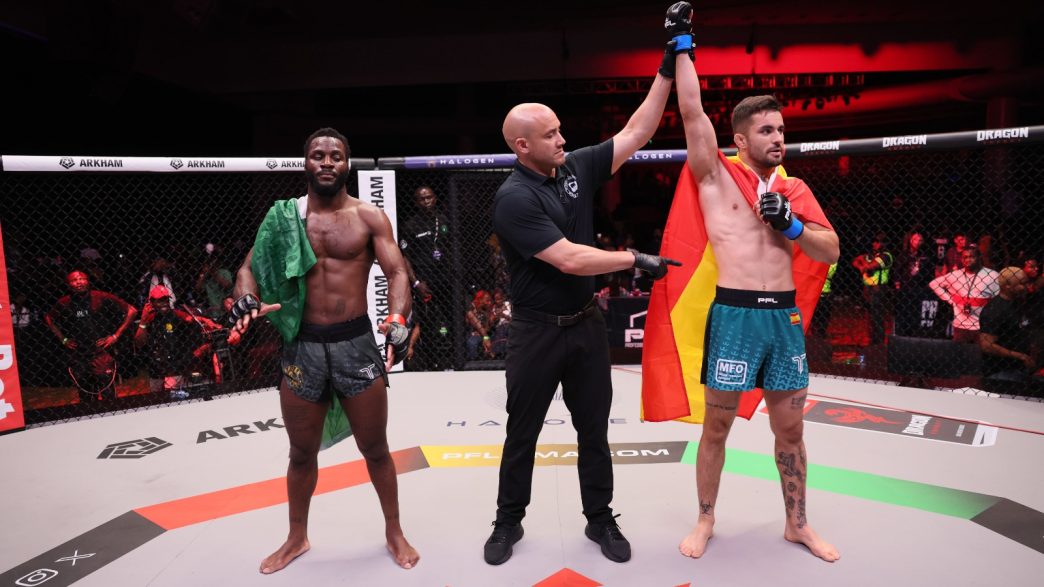
The biggest disappointment for the home crowd came in the main event. Wasi “The Nigerian Jaguar” Adeshina entered the SmartCage as one of the night’s biggest attractions and perhaps the crowd’s most popular fighter. Unfortunately, Spain’s Ignacio Nacho Campos had other plans.
After surviving an early takedown, Campos worked his way back into the fight, secured a rear-naked choke, and silenced the arena in just 1 minute and 45 seconds. The result felt like someone had suddenly pulled the plug on the building’s electricity as the energy inside the arena disappeared almost instantly.
If Adeshina’s defeat was the most disappointing moment of the evening, Juliet Ukah’s loss was undoubtedly the strangest. The previously undefeated prospect suffered the first loss of her professional career after getting trapped in an armbar by Brazil’s Elisandra Ferreira.
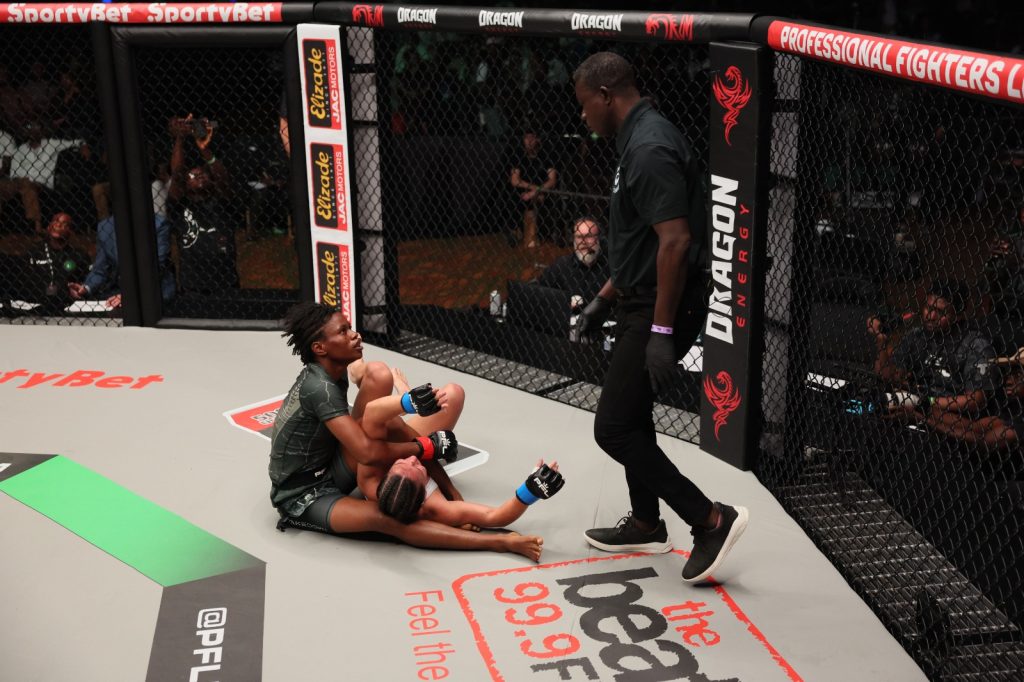
The strange part was not the submission itself but what happened afterwards. Even after tapping, even after the referee intervened, and even after the replay was shown on the big screens, Ukah appeared genuinely confused that the fight had ended. For a fighter competing at that level, it was a bizarre moment that left many people around me scratching their heads.
Yahaya Yahuza, who entered the bout carrying an undefeated 8-0 record and significant local support. His perfect run came to an abrupt end when Cameroon’s Jordan Fongno overwhelmed him with a barrage of punches to secure a second-round TKO victory.
Richard Muzaan’s defeat, on the other hand, felt considerably less surprising. I first watched Muzaan compete on the AKO circuit and have always felt his style depended heavily on aggression, pressure, and landing something explosive. Against Styve Ngono, that approach simply was not enough. The Cameroonian neutralised him over three rounds and cruised to a unanimous decision.
Patrick Ocheme Might Have the Juice
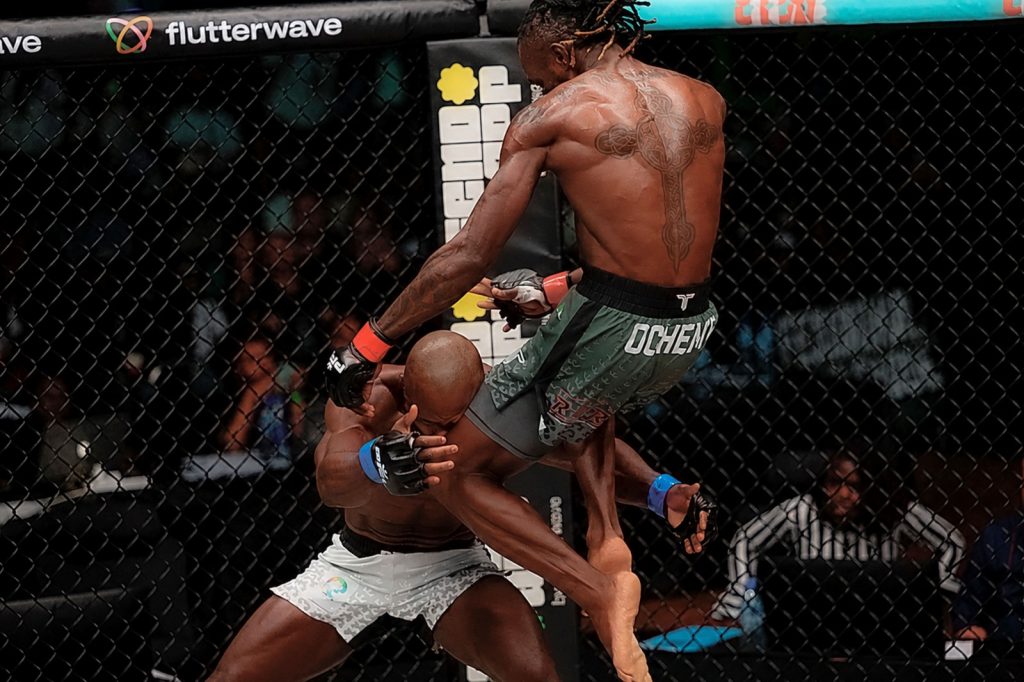
Every promotion needs stars and every tournament needs personalities. Based on what we witnessed in Lagos, Patrick Ocheme may very well be both.
His flying-knee knockout of Cameroon’s Octave Ayinda was already enough to steal the highlight reels. The finish was spectacular, the crowd reaction was immediate, and it was the type of knockout that will continue appearing on highlight reels long after the event is over. Yet Ocheme somehow managed to improve his stock even further during the post-fight press conference.
Reflecting on the performance, Ocheme said:
“One thing I’ve always wanted was to get a flying knee knockout for my career. I was not touched at all as I expected. Ayinda is a warrior, but he’s too predictable. I knew my comeback needed to be loud, like very, very loud.”
Judging by both the knockout and the reaction that followed, Ocheme achieved exactly what he set out to do.
When asked whether there was anyone left in the bracket he was worried about, Ocheme practically shrugged off the suggestion.
“There’s no one I’m worried about.”
The best moment came when a reporter informed him that a future opponent had promised to knock him out. Ocheme smiled before delivering what was easily the quote of the night:
“To dream is for free.”
Give this man a microphone every week.
Raphael Uchegbu and Karim Henniene’s Masterclass
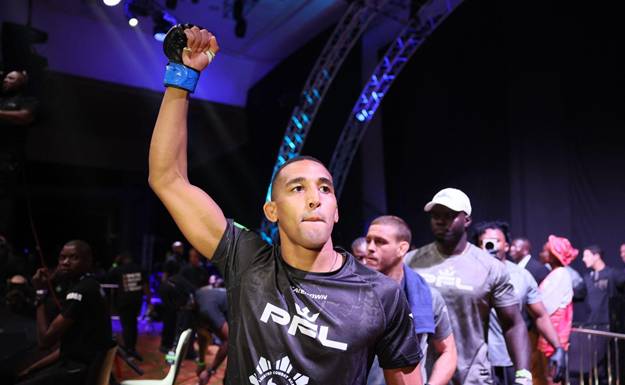
As spectacular as Ocheme’s knockout was, the most technically impressive performance of the evening belonged to Raphael Uchegbu.
The Liverpool-born fighter, who proudly represents Nigeria through his family heritage, put together a dominant display against Edson Machavane. What impressed me most was not necessarily his striking but his grappling, particularly his awareness and composure during dangerous positions on the ground.
At one point, Uchegbu defended a dangerous armbar attempt from top position by using his knees to prevent his opponent from isolating the arm. It was a subtle technical sequence that probably escaped casual viewers but demonstrated exactly why he controlled so much of the fight.
His unanimous decision victory was thoroughly deserved and sets up a fascinating semifinal matchup against Karim Henniene. The Algerian-Canadian remained undefeated after choking out South Africa’s Thimna Mhlauli with a first-round anaconda choke. What fascinated me, however, was not the submission itself but the crowd reaction that followed.
Henniene received one of the loudest receptions of the entire evening and later admitted he had never experienced support like that before, including when competing in Canada. Henniene appeared genuinely surprised by the reception. The crowd, however, knew exactly what it was doing.
Let us just say the current sporting and internet rivalry between Nigeria and South Africa probably helped create the loudest Algerian fan club in MMA history. The enemy of my enemy is my favourite fighter.
PFL Africa Is Not Playing Around
One of the most revealing moments of the evening came after the final fight had ended and attention shifted to the post-fight press conference.
PFL Africa General Manager Elias Schulze appeared genuinely pleased with both the attendance and atmosphere. According to Schulze, the promotion spent over $1 million to stage the Lagos event and considers the investment money well spent. Honestly, it showed. The production was polished, the arena was full, the crowd remained engaged throughout the evening, and the event felt significant rather than experimental.
Schulze also shed light on PFL Africa’s broader philosophy, emphasising that the organisation is focused on supporting athletes across the continent.
“Our core value is respect. As an organisation, we have no issue getting any major fighter in Africa. Our approach is to respect each fighter’s journey and support them wherever we can.”
That vision was echoed by several fighters during the press conference. Liberian bantamweight Dwight Joseph expressed his desire to get back into the cage as quickly as possible while representing a country where MMA is still developing.
“The sport is not really big in Liberia, but people in Liberia follow me and support me and I would be happy to represent them whenever.”
Brazilian strawweight Elisandra Ferreira, fresh off handing Juliet Ukah the first loss of her professional career, was equally complimentary about her Lagos experience.
“If PFL calls, I’ll head back immediately.”
Before wrapping up, Schulze officially announced that PFL Africa’s next event will take place in Casablanca, Morocco, on October 10. He also made it clear that the promotion is interested in returning to Nigeria and is open to exploring other cities, such as Abuja, although he admitted he enjoys the unique chaos and energy that comes with Lagos.
Morocco may be getting the next stop on the calendar, but based on what I witnessed in Lagos, I would be surprised if PFL Africa stays away from Nigeria for very long.
Final Verdict
From a pure entertainment and value perspective, PFL Africa’s Nigerian debut was a home run. The promotion delivered finishes, compelling storylines, breakout performances, and several moments that will continue circulating online long after the SmartCage has been packed away.
More importantly, the event delivered proof that MMA in Nigeria is no longer a niche curiosity followed only by a small community of die-hard fans willing to stay awake until 3 a.m. for UFC numbered cards. The audience exists, the talent exists, and the appetite for high-level mixed martial arts clearly exists as well.
AKO spent years laying the groundwork and proving that Nigerian fans would support combat sports when presented with a quality product. PFL Africa’s arrival felt like the next stage of that evolution, showing what becomes possible when a global promotion enters the market with substantial resources, elite production standards, and a genuinely continental roster.
As I left the Eko Convention Centre that evening, I kept thinking about how far the sport has come in such a short period. For years, Nigerian MMA fans have been told that the future of the sport was coming. On June 13, it felt like that future had finally arrived, and I cannot wait for PFL Africa to bring the SmartCage back to Lagos.Six years after accidentally becoming an MMA fan, I watched a packed Lagos arena welcome PFL Africa and perhaps the biggest sign yet that the sport has truly arrived in Nigeria.
The first thing that hit me was not the cage. It was the crowd. As I walked into the Eko Convention Centre on June 13, one thing became immediately obvious: this was not some niche gathering of hardcore fight fans hiding in a corner of Lagos. The arena was packed. Not “decent turnout” packed. Not “better than expected” packed. Properly packed.
People were filing into every available section, and the energy was loud, chaotic, and unmistakably Lagos. Every fighter’s introduction drew a reaction. Every significant strike got a response. Every submission attempt had hundreds of people leaning forward in anticipation. For a brief moment, I stopped paying attention to the fights and started looking around the room because six years ago, I never imagined I would see anything like this in Nigeria.
I became an MMA fanatic completely by accident. It was 2020, the world was locked down, and my usual sporting lifelines, football and basketball, had completely disappeared. Enter SuperSport, which seemed determined to spend every waking hour airing UFC reruns, classic fights, countdown shows, and enough MMA content to create a new generation of African fight fans accidentally.
Three weeks later, I was hooked and had caught up on major rivalries, legendary champions, infamous feuds, title reigns, and enough UFC lore to qualify for a doctorate in pointless MMA trivia.
Then something funny happened. While most sports remained on pause, the UFC became one of the first major organisations to return to live competition during the pandemic. I kept watching and then kept watching some more.
Fast-forward six years, and MMA has become a permanent part of my sporting diet. My YouTube recap has listed “MMA on Point” as my most-watched channel for two consecutive years. Not football channels. Not basketball channels. MMA.
Being an MMA fan in Nigeria, however, comes with a unique set of experiences. On one hand, some people look at you like you have confessed to enjoying public gladiator battles whenever you mention the sport, a reaction that often reminds me of how MMA was viewed in America during the 1990s and early 2000s.
On the other hand, there is the sleep deprivation that comes with supporting a sport largely built around North American time zones. Any Nigerian MMA fan worth their salt knows the struggle of waking up at ridiculous hours to watch UFC numbered cards live.
For years, I accepted that reality and genuinely believed I would have to leave Nigeria before I ever got the opportunity to experience a major global MMA promotion in person. Looking around the packed arena on Saturday night, I was happy to discover just how wrong that assumption had been.
Before PFL Africa arrived, I had already witnessed the growth of Nigerian MMA through the African Knockout Championship (AKO). I attended AKO 9 after seeing an Instagram ad and had a fantastic experience. I later attended AKO 10 and AKO 12, and what stood out was not just the fights but the growth. Each event felt bigger than the last, more people showed up, more conversations happened online, and more mainstream sports fans started paying attention.
For years, Nigerian MMA fans were treated like a tiny internet subculture. The AKO events began challenging that assumption. By the time PFL Africa announced Lagos as the destination for its West African debut, the question was no longer whether Nigeria could support a major MMA event but why it had taken this long. After spending an evening inside the Eko Convention Centre, I think the answer is clear: the timing was perfect.
Lagos Did What Lagos Always Does
I will admit something upfront: I am a UFC guy. Outside of Francis Ngannou fights and the occasional viral clip, I barely followed the PFL season. I understood the league format and knew the basic storylines, but I was not arriving at the venue as a dedicated PFL fan. I was arriving as an MMA fan, and by the end of the night, I was thoroughly impressed.
The production value was excellent, the pacing was sharp, and the card moved efficiently from one fight to another without long stretches of inactivity draining the energy from the arena. Most importantly, the fights delivered. Compared to many regional events I have watched over the years, the finishing rate was exceptional, and the entire evening felt like a proper MMA event rather than a showcase or experiment.
The biggest takeaway for me was simple: with its global backing, resources, and growing African footprint, PFL is positioning itself to become the dominant force in African MMA. If this event was any indication, they are already moving rapidly in that direction.
The Autopsy
Borrowing a page from the MMA on Point playbook, let us break down the numbers. PFL Africa’s Nigerian debut featured 13 fights, eight of which were finishes. Three ended by knockout or technical knockout, five ended by submission, and only five required the judges’ scorecards. The main card itself delivered four finishes in five fights.
For anyone who bought a ticket hoping to see action, violence, and entertainment, this card absolutely delivered.
A Strange Night for Nigerian Fighters
The night turned into a mixed bag for Team Nigeria. Seven Nigerian fighters competed on the card, with only three emerging victorious. The wins produced some of the evening’s biggest highlights, while the losses delivered some of its most painful disappointments.
Patrick Ocheme, Cornel Thompson, and Raphael Uchegbu got their hands raised. Wasi Adeshina, Juliet Ukah, Richard Muzaan, and Yahaya Yahuza did not.
The biggest disappointment for the home crowd came in the main event. Wasi “The Nigerian Jaguar” Adeshina entered the SmartCage as one of the night’s biggest attractions and perhaps the crowd’s most popular fighter. Unfortunately, Spain’s Ignacio Nacho Campos had other plans.
After surviving an early takedown, Campos worked his way back into the fight, secured a rear-naked choke, and silenced the arena in just 1 minute and 45 seconds. The result felt like someone had suddenly pulled the plug on the building’s electricity as the energy inside the arena disappeared almost instantly.
If Adeshina’s defeat was the most disappointing moment of the evening, Juliet Ukah’s loss was undoubtedly the strangest. The previously undefeated prospect suffered the first loss of her professional career after getting trapped in an armbar by Brazil’s Elisandra Ferreira.
Photo by PFL Africa
The strange part was not the submission itself but what happened afterwards. Even after tapping, even after the referee intervened, and even after the replay was shown on the big screens, Ukah appeared genuinely confused that the fight had ended. For a fighter competing at that level, it was a bizarre moment that left many people around me scratching their heads.
Yahaya Yahuza, who entered the bout carrying an undefeated 8-0 record and significant local support. His perfect run came to an abrupt end when Cameroon’s Jordan Fongno overwhelmed him with a barrage of punches to secure a second-round TKO victory.
Richard Muzaan’s defeat, on the other hand, felt considerably less surprising. I first watched Muzaan compete on the AKO circuit and have always felt his style depended heavily on aggression, pressure, and landing something explosive. Against Styve Ngono, that approach simply was not enough. The Cameroonian neutralised him over three rounds and cruised to a unanimous decision.
Patrick Ocheme Might Have the Juice
Photo by PFL Africa
Every promotion needs stars and every tournament needs personalities. Based on what we witnessed in Lagos, Patrick Ocheme may very well be both.
His flying-knee knockout of Cameroon’s Octave Ayinda was already enough to steal the highlight reels. The finish was spectacular, the crowd reaction was immediate, and it was the type of knockout that will continue appearing on highlight reels long after the event is over. Yet Ocheme somehow managed to improve his stock even further during the post-fight press conference.
Reflecting on the performance, Ocheme said:
“One thing I’ve always wanted was to get a flying knee knockout for my career. I was not touched at all as I expected. Ayinda is a warrior, but he’s too predictable. I knew my comeback needed to be loud, like very, very loud.”
Judging by both the knockout and the reaction that followed, Ocheme achieved exactly what he set out to do.
When asked whether there was anyone left in the bracket he was worried about, Ocheme practically shrugged off the suggestion.
“There’s no one I’m worried about.”
The best moment came when a reporter informed him that a future opponent had promised to knock him out. Ocheme smiled before delivering what was easily the quote of the night:
“To dream is for free.”
Give this man a microphone every week.
Raphael Uchegbu and Karim Henniene’s Masterclass
SEE ALSO: E-Money Gifts Carter Efe ₦50 Million After Epic Victory Over Portable in Celebrity Boxing Showdown
As spectacular as Ocheme’s knockout was, the most technically impressive performance of the evening belonged to Raphael Uchegbu.
The Liverpool-born fighter, who proudly represents Nigeria through his family heritage, put together a dominant display against Edson Machavane. What impressed me most was not necessarily his striking but his grappling, particularly his awareness and composure during dangerous positions on the ground.
At one point, Uchegbu defended a dangerous armbar attempt from top position by using his knees to prevent his opponent from isolating the arm. It was a subtle technical sequence that probably escaped casual viewers but demonstrated exactly why he controlled so much of the fight.
His unanimous decision victory was thoroughly deserved and sets up a fascinating semifinal matchup against Karim Henniene. The Algerian-Canadian remained undefeated after choking out South Africa’s Thimna Mhlauli with a first-round anaconda choke. What fascinated me, however, was not the submission itself but the crowd reaction that followed.
Henniene received one of the loudest receptions of the entire evening and later admitted he had never experienced support like that before, including when competing in Canada. Henniene appeared genuinely surprised by the reception. The crowd, however, knew exactly what it was doing.
Let us just say the current sporting and internet rivalry between Nigeria and South Africa probably helped create the loudest Algerian fan club in MMA history. The enemy of my enemy is my favourite fighter.
PFL Africa Is Not Playing Around
One of the most revealing moments of the evening came after the final fight had ended and attention shifted to the post-fight press conference.
PFL Africa General Manager Elias Schulze appeared genuinely pleased with both the attendance and atmosphere. According to Schulze, the promotion spent over $1 million to stage the Lagos event and considers the investment money well spent. Honestly, it showed. The production was polished, the arena was full, the crowd remained engaged throughout the evening, and the event felt significant rather than experimental.
Schulze also shed light on PFL Africa’s broader philosophy, emphasising that the organisation is focused on supporting athletes across the continent.
“Our core value is respect. As an organisation, we have no issue getting any major fighter in Africa. Our approach is to respect each fighter’s journey and support them wherever we can.”
That vision was echoed by several fighters during the press conference. Liberian bantamweight Dwight Joseph expressed his desire to get back into the cage as quickly as possible while representing a country where MMA is still developing.
“The sport is not really big in Liberia, but people in Liberia follow me and support me and I would be happy to represent them whenever.”
Brazilian strawweight Elisandra Ferreira, fresh off handing Juliet Ukah the first loss of her professional career, was equally complimentary about her Lagos experience.
“If PFL calls, I’ll head back immediately.”
Before wrapping up, Schulze officially announced that PFL Africa’s next event will take place in Casablanca, Morocco, on October 10. He also made it clear that the promotion is interested in returning to Nigeria and is open to exploring other cities, such as Abuja, although he admitted he enjoys the unique chaos and energy that comes with Lagos.
Morocco may be getting the next stop on the calendar, but based on what I witnessed in Lagos, I would be surprised if PFL Africa stays away from Nigeria for very long.
Final Verdict
From a pure entertainment and value perspective, PFL Africa’s Nigerian debut was a home run. The promotion delivered finishes, compelling storylines, breakout performances, and several moments that will continue circulating online long after the SmartCage has been packed away.
More importantly, the event delivered proof that MMA in Nigeria is no longer a niche curiosity followed only by a small community of die-hard fans willing to stay awake until 3 a.m. for UFC numbered cards. The audience exists, the talent exists, and the appetite for high-level mixed martial arts clearly exists as well.
AKO spent years laying the groundwork and proving that Nigerian fans would support combat sports when presented with a quality product. PFL Africa’s arrival felt like the next stage of that evolution, showing what becomes possible when a global promotion enters the market with substantial resources, elite production standards, and a genuinely continental roster.
As I left the Eko Convention Centre that evening, I kept thinking about how far the sport has come in such a short period. For years, Nigerian MMA fans have been told that the future of the sport was coming. On June 13, it felt like that future had finally arrived, and I cannot wait for PFL Africa to bring the SmartCage back to Lagos.
ALSO READ: 5 Nigerian Female Boxers with the Highest World Rankings

About The Author