


For many Lagos residents, a medical emergency in the middle of the night, during a heavy downpour, is the kind of nightmare that exposes the city’s weakest points. But for one family in Badagry, it became a story of a government service that worked when it mattered most.
In a post on X that has attracted attention, a user identified as @AbuUbayy1, whose profile describes him as a Muslim tailor and fashion designer, recounted how a call to the Lagos State emergency line resulted in an ambulance travelling about 24 kilometres before dawn to help his seven-month-old daughter.
According to him, the ordeal began around 3:20 a.m. when his daughter, who had been running a fever for two days, suddenly became much worse. 
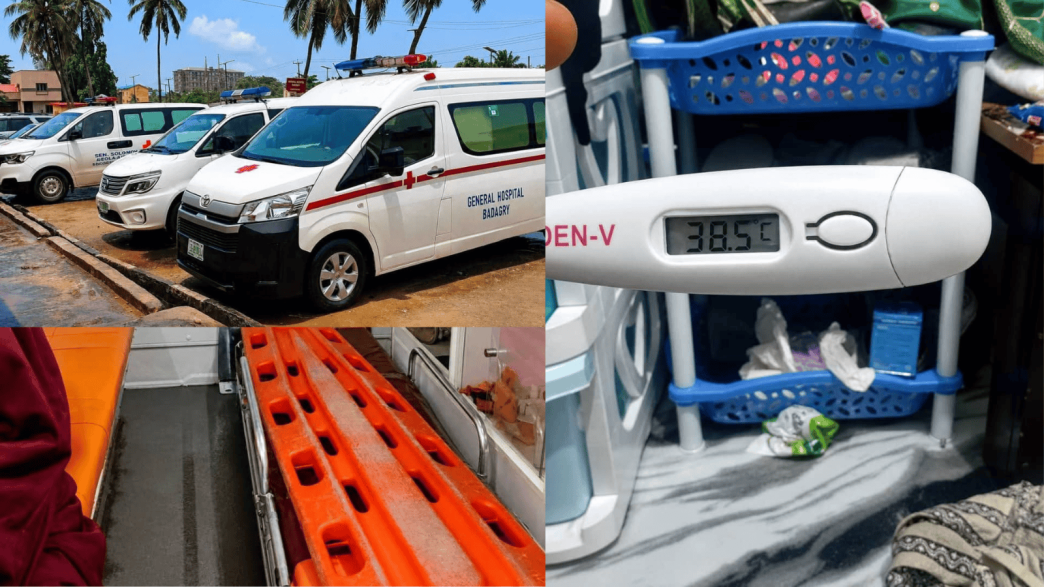
“The thermometer showed 38.5 degrees Celsius,” he wrote, adding that he and his wife became increasingly worried as heavy rain made it impossible to leave immediately for a hospital. The couple resorted to using a wet towel to cool the baby’s body while waiting for the rain to subside.
With no car and transport almost impossible, he remembered the Lagos emergency number, 112. At about 4:07 a.m., he placed the call. A female operator answered, calmly listened as he explained the situation, took his address and a nearby landmark, and assured him help would be sent. The crying baby, he said, could be heard in the background throughout the conversation.
About 20 minutes later, the family received another call from the emergency control room informing them that an ambulance had already been dispatched from Badagry General Hospital. The officer also discussed the easiest route for the crew to locate the family in the darkness and the heavy rain.
As the ambulance drew closer, the control room called again, this time to inform the family that the vehicle had arrived at Checkpoint Bus Stop, the nearest point it could safely access because of the condition of the road leading to their street. The family was asked to make their way there.
At about 5:07 a.m., after the rain had eased, the family rode a motorcycle to Checkpoint Bus Stop, where they found the ambulance already waiting. The emergency team then transported them to Badagry General Hospital after explaining that their local Primary Health Centre at Ilepo did not operate round the clock.
The X user suggested that the ambulance was unable to reach his street because of the poor condition of the Ibiye-Checkpoint-Magbon Road, arguing that improving such roads could make the difference between life and death during emergencies.
“What amazed me was that the ambulance came all the way from Badagry General Hospital, about 24 kilometres, just to respond to our emergency,” he wrote. “Honestly, we are still shocked. I only see this happen in developed countries.”
At the hospital, his daughter was attended to immediately. The family paid ₦2,000 to open a new patient file because records from their Primary Health Centre could not be accessed. Laboratory tests, including a Full Blood Count and malaria test, cost ₦8,000, while prescribed injections and medications from the hospital pharmacy cost about ₦4,000.
Beyond praising the emergency responders, the father also highlighted gaps that Lagos authorities could address. He called for the rehabilitation of the road leading to his community, saying poor infrastructure can slow emergency response. He also urged the state government to develop a unified electronic medical records system that would allow patients’ records to be accessed across government hospitals, reducing delays and duplication during emergencies.
His account has resonated with many readers because it offers something often missing from conversations about public services in Nigeria: an example of a government emergency response system functioning as intended, while also reminding policymakers that efficient services depend not only on dedicated personnel but also on good roads, integrated healthcare systems and accessible primary care.

About The Author