
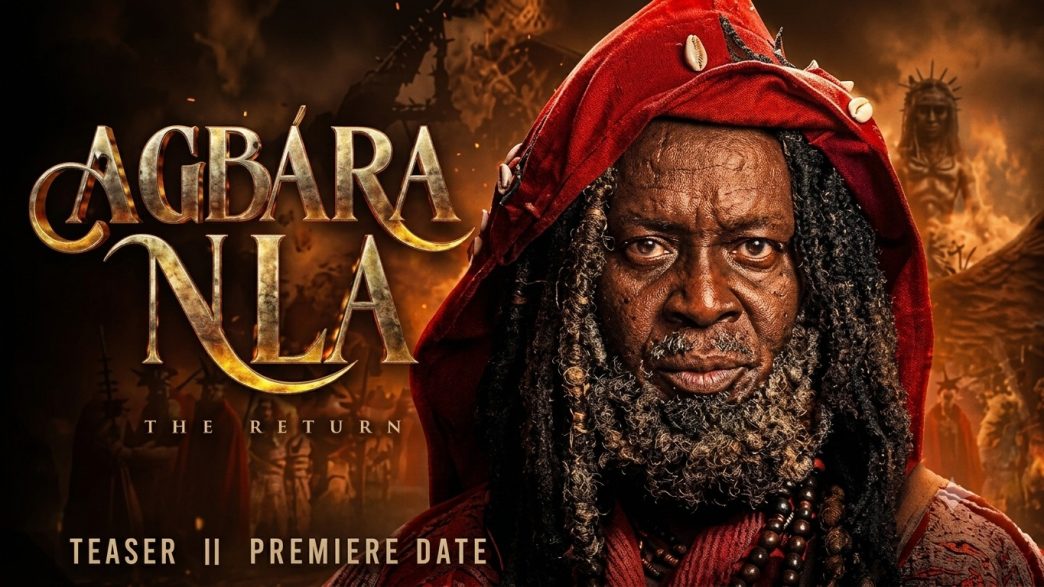
There is a difference, I believe, between presenting the Christian faith and presenting Yoruba culture as the natural habitat of darkness. That distinction is exactly what Joshua Mike-Bamiloye, son of Mount Zion Films founder Mike Bamiloye, seems unable or unwilling to acknowledge. I strongly suspect that the inability and the unwillingness are the same thing wearing different shirts.
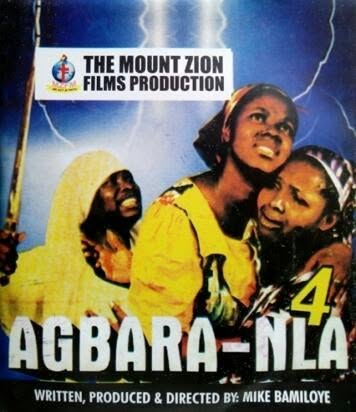
It is that unwillingness that has turned Mount Zion’s cheerful announcement into a row. The ministry declared that ‘Agbara Nla’, one of its most celebrated productions, would return to cinemas on October 1, more than 30 years after its original release. I imagine the announcement was written in a spirit of triumph. What followed was considerably less triumphant. 
An X user identified as Ifesola articulated what many people have long felt but rarely expressed so plainly. For decades, Mount Zion built much of its dramatic universe around a formula in which Yoruba traditional religion serves as the villain in almost every story. It did so consistently and predictably.
Expectedly, the younger Bamiloye responded. His reply was revealing, not for what it conceded but for what it declined to address.
He argued that Mount Zion regularly celebrates Yoruba identity through language, proverbs, traditional attire, royalty and cultural values, pointing to the Abejoye character as evidence that Christian conversion in the films does not require the abandonment of cultural identity. It is a defence that sounds reasonable until one examines what it quietly leaves out.
Nobody can validly argue that Mount Zion films do not feature Yoruba proverbs, traditional dress and royal pageantry. For that, they deserve applause, even if, as I suspect, it is an unintended consequence. But the criticism has never been about those things. It is about what the films do with Yoruba religious practice, which is an entirely different matter.
A film can dress its characters in aso-oke, sanyan or alaari and still present the Ifa priest as a Fellow of the Chartered Institute of Satan and a denizen of the occultic world. The colours and the language are not the culture in its entirety, however convenient it may be to pretend otherwise.
The younger Bamiloye also argued that fewer than 30 per cent of Mount Zion’s more than 200 films are set in traditional contexts, insisting that the criticism is built on a minority of the catalogue viewed through a lens of cultural grievance and amounts not to analysis but to feeling dressed up as fact.
It is interesting to see a statistician’s defence deployed in a cultural argument. It has no legitimacy whatsoever. If 30 per cent of 200 films amounts to about 60 productions systematically portraying traditional Yoruba religion as a demonic enterprise, the scale of the output does not dilute the pattern. It compounds it. It is like saying the gbegiri is only 30 per cent arsenic.
Bamiloye Jr. further challenged the framing of the debate as Yoruba spirituality versus a foreign religion, insisting that Mount Zion’s productions simply depict light versus darkness, with darkness having no nationality. This is the most evasive part of his defence, a kind of intellectual conjuring trick that deserves closer examination.
SEE ALSO: Osas Ighodaro Lands Major Role in Nollywood-Bollywood Microdrama ‘Imported Babu’
It is true that Mount Zion does not explicitly label its stories Christianity versus Yoruba religion. It does something considerably more effective. Film after film after film casts the herbalist, the Alayelala, the masquerade and the shrine as the familiar face of darkness. The face of light and all that is good is invariably the Bible-toting born-again Christian wearing an expression of serene superiority.
In that situation, the audience does not need a caption to understand which culture has been assigned to which side of the holiness ledger. For decades, the films have built their dramatic power around the same familiar gallery. The village herbalist is always sinister. The Ayelala priest is usually manipulative. The Saluku or Omunale priest is bloodthirsty. Masquerades are demonic manifestations. Traditional festivals are runways to satanic oppression. Shrines are Satan’s Defence Headquarters, efficiently staffed and apparently well-funded.
Even where traditional religion offers solutions to existential torment, those solutions are invariably presented as coming at grotesque costs. The beneficiary may be required to retrieve the toenail of a long-dead mother, have a woman publicly urinate into his mouth every Christmas Day or sacrifice a child till he or she is childless, after which he is relieved of his capacity to inseminate.
The message is rarely subtle and the audience it has shaped over three decades is not a small one, which brings makes me want to ask the obvious question, the one that tends to make certain Christians suddenly very interested in the ceiling.
What would Bamiloye and his fellow believers think if a filmmaker repeatedly portrayed Christianity through its worst examples of corrupt pastors, fake miracles, ritual abuse and greed? Would they not accuse him of denigrating their faith? Would they not remind us, at considerable volume, that the gates of hell shall not prevail? The questions answer themselves, as questions of this kind usually do when put to people who would rather not answer them.
Nobody is saying Mount Zion should stop preaching Christianity. Evangelism is their calling and they have pursued it with conviction, if not always with considerable craft. I question the craft because the few productions I watched, back when they were genuine smash hits, were only marginally better than Ijapa and Yanibo folktales in terms of storytelling. I lost interest quickly because I believed that an evangelism requiring the wholesale caricaturing of another people’s heritage was calumny. Calling it spiritual warfare does not change what it is.
Long before colonialism arrived with its own confident assumptions about what was holy and what was heathen, Yoruba civilisation had developed sophisticated systems of governance, philosophy, medicine, poetry, architecture, music and jurisprudence. But in Mount Zion productions, all that complexity obligingly disappears behind smoke-filled shrines, chanting priests with red wrappers around the waist and evil covens whose only purpose is to be routed by prayer and a well-timed Bible verse.
No stretch of the imagination makes that documentation. It is theology-driven storytelling. Maybe there is nothing inherently wrong with that. What is certainly wrong is pretending it has no cultural consequences. Generations of young Nigerians have grown up associating virtually every visible symbol of Yoruba traditional religion with witchcraft and satanic power. That is not because they studied the culture, but because that is how it has been represented on screen, repeatedly, lucratively and, until very recently, without serious challenge.
Mike-Bamiloye says the ministry’s focus has always been spiritual transformation rather than cultural erasure. The distinction sounds perfectly neat in a press statement. It becomes considerably murkier when yours is the culture whose religious practices have supplied the primary raw material for 30 years of spiritual horror films, each one more confident than the last that it knows exactly where the devil keeps his office.
Mount Zion has every right to make Christian films. Critics have every right to point out that those films have often reduced Yoruba traditional religion to a horror genre. Both propositions can be true simultaneously and the conversation will not advance until the Bamiloyes stop treating the second as an assault on the first.
To be fair to them, however, they are not the pioneers of this enterprise. The colonialists did much the same when they brought Christianity to these shores, only with considerably greater institutional backing. The chapel at the old site of my secondary school, Baptist Boys’ High School, Abeokuta, was said to have been built directly on the grove of masqueraders. It was a way of making a point and the point was anything but subtle. It was to convey the impotence of masqueraders so beloved by my friends, Harry Iwuala and Ikem Okuhu.
Early missionaries elsewhere continued the tradition with enthusiasm. Muslims did the same and, in many places, still do, as anyone who has spent ten minutes watching Facebook reels can testify. Clerics calling traditional religionists “elebo” has become a minor genre of its own. They even enjoy royal backing from the Oluwo of Iwo, who appears in several such videos threatening to expel traditional religionists from his domain altogether. He seems perfectly confident that the Almighty endorses the eviction notice.
Had Muslims lacked the capacity to hit back and viciously, they might well have been mocked into submission in the same way traditional religionists have been. Mount Zion Films and other heavy metal Christians, therefore, treat them as they would improvised explosive devices. Muslims themselves have displayed similar attitudes in many places. Two years ago in Ilorin, the Isese Day celebration was stopped, with the police lending the exercise a helpful air of official endorsement.
Traditional religion in that city knows exactly where it stands and the position is anything but enviable.
Pentecostal Christianity has proved especially gifted at this sport. In its early years, it mocked even the legacy churches with cheerful abandon, viewed Islam with unconcealed suspicion and pissed freely on Yoruba traditional religion and its deities, sometimes in the very same sermon.
What drives this conduct, more than anything else, I think, is insecurity. A faith that is genuinely confident in itself does not need to borrow its energy from contempt. I have tried for years to persuade myself otherwise and have consistently failed.
I can personally attest to the power of negative portrayal. In my third year in secondary school, I left the boarding house to attend a Christian crusade at Arinlese in Abeokuta. The evangelist, CAC-ish in style, arrived with a projector through which we watched what I then believed was a documentary on Indian religious practices.
I did not know it at the time, but it was calumny from beginning to end. He narrated the entire thing, telling us Indians worshipped cows and all manner of other things. I left that crusade hating Indians, including those teaching and living in the staff quarters of my school. Crazy, that.
Mount Zion Films have spent decades doing much the same thing. They have simply done it with better production values.
ALSO READ: ‘I Will Find You’ Review: Why Everyone Is Watching Netflix’s No. 1 Series
NOTE: The opinions expressed in this story are those of the author, not NBG Africa.

About The Author