


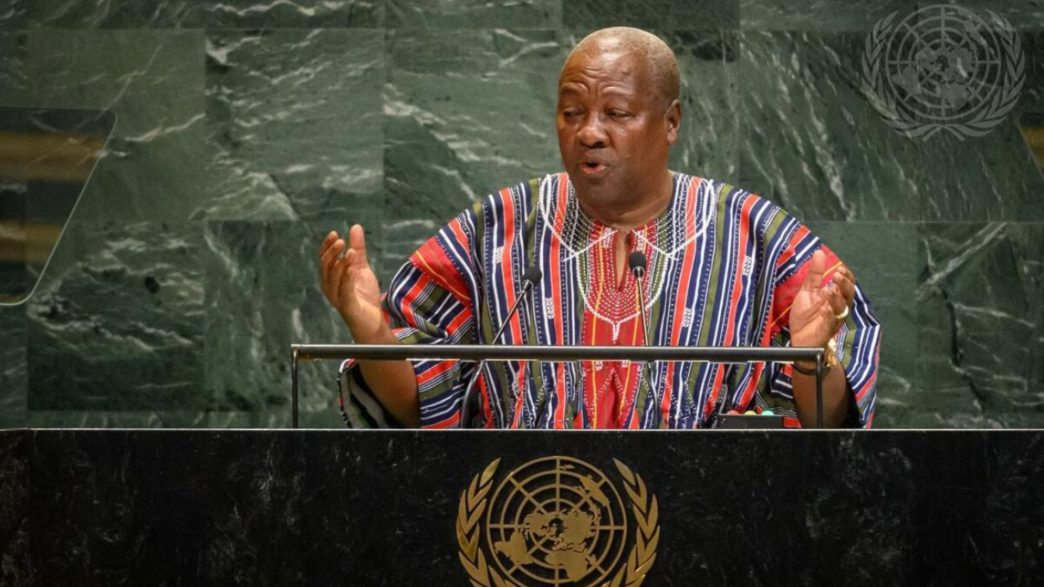
When John Dramani Mahama stood before the United Nations General Assembly, it wasn’t just another diplomatic moment, it was a deliberate attempt to force a long-avoided global reckoning.
Ghana has, over the years, positioned itself as a cultural and symbolic home for descendants of enslaved Africans, but this move went beyond symbolism.
Mahama’s goal was to shift the conversation from passive acknowledgment to explicit accountability. 
“Let it be recorded that when history beckoned, we did what was right for the memory of the millions who suffered the indignity of the slave trade and those who continue to suffer racial discrimination,” Ghana’s President John Mahama told the UN general assembly.
Calling slavery “bad” was no longer enough; the language had to reflect the true scale of what happened. By pushing for the transatlantic slave trade to be officially recognised as the gravest crime against humanity, Ghana essentially challenged the world to stop diluting history.

ALSO READ: John Mahama’s Honorary Doctorate Cancelled in the US Over Ghana’s Anti-Gay Bill Controversy
The Reality of the Transatlantic Slave Trade
To understand why this label matters, you have to confront what the slave trade actually was. It was a system of highly organised dehumanisation on the black race. Millions of Africans were captured, sold, and transported across the Atlantic under horrific conditions.
Many died before reaching their destination, and those who survived were forced into lives of extreme exploitation. Their identity, culture, and basic human rights stripped.
Beyond the physical violence, there was also a deliberate effort to construct a racial hierarchy that justified this system. Black people were considered lesser breeds.

Worse still, that idea didn’t disappear when slavery ended. It embedding itself into institutions and societies in ways that are still visible today.
The Present-Day Impact of Slavery
The effects of slavery are still playing out in the 21st century.Across different parts of the world, people of African descent and coloureds continue to face discrimination in employment, education, housing, and policing.
A long time consequence of a system built to exploit and devalue black lives.
What Mahama’s stance makes clear is that you cannot separate past injustice from present reality. The structures created during slavery did not simply vanish, they evolved.
The Call for Apology and Reparations
This is why the demand went beyond recognition. Mahama called for formal apologies from countries that played central roles in the slave trade, alongside serious discussions about reparations.
However, this is more than financial compensation. Its about acknowledgment, responsibility, and repair.
The Vote
When John Mahama’s resolution was put to a vote at the United Nations General Assembly, it had a strong support, but the reactions from major world powers revealed something else.
A total of 123 countries voted in favour, signalling an agreement with Ghana’s position.However, the United States, Israel, and Argentina voted against the resolution.
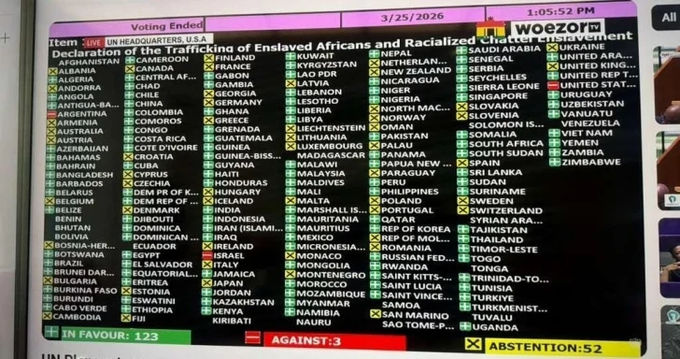
The US’s ambassador to the UN said his country “does not recognise a legal right to reparations for historical wrongs that were not illegal under international law at the time they occurred”.
Their justification also includes that modern legal standards should not be applied to historical events, and that labeling one atrocity as the “gravest” risks creating a hierarchy of suffering.
This can be seen as a way to avoid the legal and financial implications.The United Kingdom and several other European countries chose to abstain.
The UK, despite being one of the major powers involved in the transatlantic slave trade, said the resolution is problematic in terms of wording.
In the words of the UK ambassador to UN, James Kariuki, “No single set of atrocities should be regarded as more or less significant than the other”.
According to other countries who abstained from voting , their reasons centred on concerns about the legal and political consequences of the resolution, particularly in relation to reparations.
Abstaining allowed these countries to avoid direct opposition while also sidestepping full accountability. Which goes to say a lot when looked into deeply.
What UN’s Declaration Really Means
What Ghana has done goes far beyond securing a UN resolution. It has forced a shift and, more importantly, exposed where countries truly stand when confronted with the full weight of history.
Some are ready to acknowledge the depth of the injustice. Others are still cautious, hesitant, amd unwilling to engage with what that acknowledgment might require of them.
The conversation is no longer just about whether slavery was wrong. This fact has long been established. The focus is now on how it should be understood, and what responsibility the world bears because of it.
By successfully pushing for the strongest language ever used by the UN on this issue, Ghana has made it harder for that responsibility to be ignored.
If slavery is the gravest crime against humanity, what is going to be done about it? Where do we go from here?

About The Author