In Nigeria’s megacity and commercial hub, Lagos, where dreams chase money, success, and a better life, a darker pursuit has taken hold.
Young people are turning to substances known as Colos and Crack, which are cheap, potent escapes that promise relief but deliver devastation. NBG Africa’s new documentary on Colos and Crack, released to mark the International Day Against Drug Abuse and Illicit Trafficking, shows the raw, human story of lives unravelling in Nigeria’s growing drug crisis.
SEE ALSO: NDLEA Busts Multi-Billion-Naira Drug Lab in Oyo Forest, Arrests 1 Mexican and 4 Others 
What Are Crack and Colos?
Colos is a synthetic psychoactive mix, often cannabis laced with toxic chemicals that vary by batch, sending users into oblivion for days. Crack is a solid, smokable form of cocaine, which makes it highly addictive, expensive, and insatiable. Users crave more with every hit.
In this documentary by NBG Africa, experts note that while both destroy, Colos is especially dangerous. It drowns judgment and detaches people from reality, leaving them hallucinating and unresponsive to the real world around them.
These drugs spread through campuses, motor parks, under bridges, and forgotten corners. For Benedict, it started as curiosity and became dependence. For Raphael, grief, trauma, and economic pressure fuelled his intake. As for many more, low self-esteem and the relentless search for escape push them to the crack and colos wall.
Raphael Wanted Solace
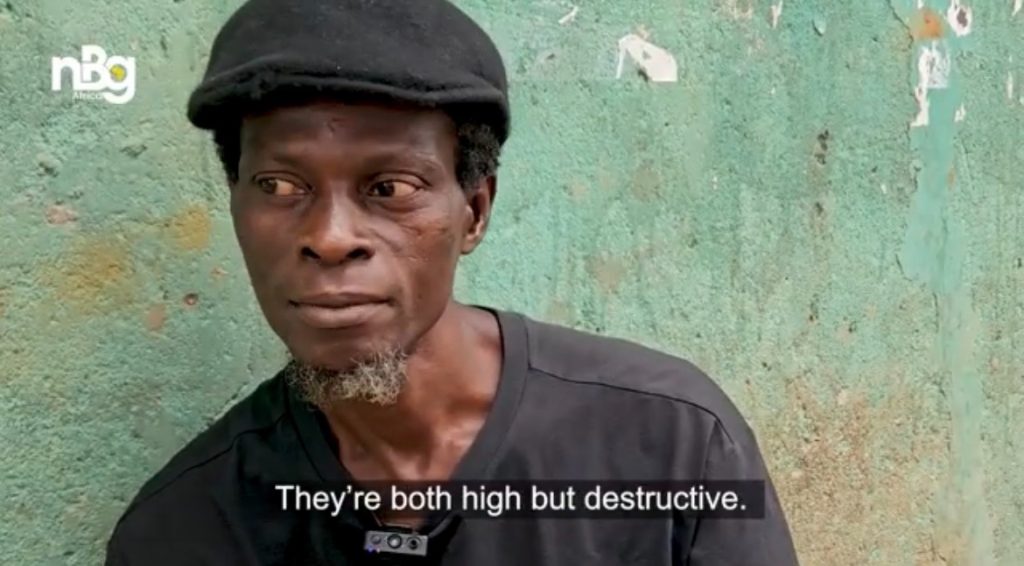
Raphael was an undergraduate studying political science until he dropped out and became a family man with a wife and son.
He worked at a textile company and was doing fine until tragedy struck. His wife faced complications in pregnancy, leading to a cesarean section. These complications led him to miss work until he lost his job. Three months later, he lost his son, and then his wife passed away during childbirth. At this point, everything fell apart. Then, a friend introduced crack and colos to him.
“I was just looking for solace,” he recalls. Alcohol wasn’t enough. Crack and colos felt different. They felt better. What began as a temporary balm to numb the sorrow quickly spiralled out of control. It’s safe to say that he found solace, but according to him, the high lasted only five to ten minutes before the feeling of sorrow returned worse than before.
SEE ALSO: Here is Why Rent in Lagos Keeps Rising
From Artist to Addiction
Benedict, who holds an HND from the graphic arts department at Yaba College of Technology, grew up in a polygamous home. Parties with “big guys” introduced him deeper into the crack and colos scene.
Now for him, as an artist, it is difficult to draw without being high. Imagine working on a commissioned piece and spending almost half the pay on crack and colos just to get through the drawing.
He speaks of friends he started with losing their lives to addiction. His legs are swollen from the abuse; his teeth have rotted from cocaine. Benedict talks about how it has been difficult for him to get out of it. In fact, he claims to be writing a book called Scars, about the marks left behind by drug abuse.
For another user, insecurity and low self-esteem kept him lingering at school to avoid going home. One day, older boys offered him a cigarette, and because he was teased as a “small boy,” he took it to belong. That led to more experiments.
Even those who tried to help others fell in. One man, who is now in rehabilitation, brought friends struggling with addiction to his house, thinking he could support them. Curiosity led him to try it himself. Now, he says from experience, “Drugs will kill that dream you have.”
The Experts’ Insight
Addiction specialists had some things to say too, as they paint a clear picture in the documentary: As humans, there’s often something missing, like a gap of pain, failure, or unmet expectations. These substances fill it temporarily, but then create deeper voids. The users lose jobs, families, health, and identity.
According to these experts, crack drives endless craving, while colos can leave people in a hypnotic, detached state for extended periods, up to a week. Recovery in cases like Raphael’s and Benedict’s requires life skills, emotional management, and addressing root causes like trauma and societal pressures.
Once a person is dependent, survival revolves around the next fix, either through stealing, begging, or something worse.
A Cycle of Traps and Hope
“It’s better not to venture into it at all,” one user warns in the documentary.
Their stories echo a short-term euphoria that steals many other things, such as health, relationships, and potential. The users know the harm substance abuse causes, yet they feel too powerless to let go.
The documentary by NBG Africa emphasises that behind every high is either a student, an artist, or a parent whose life was once full of promise. They go for a sniff or a drag. When the smoke clears, reality sets in for them again, and then they rinse and repeat.
About The Author