




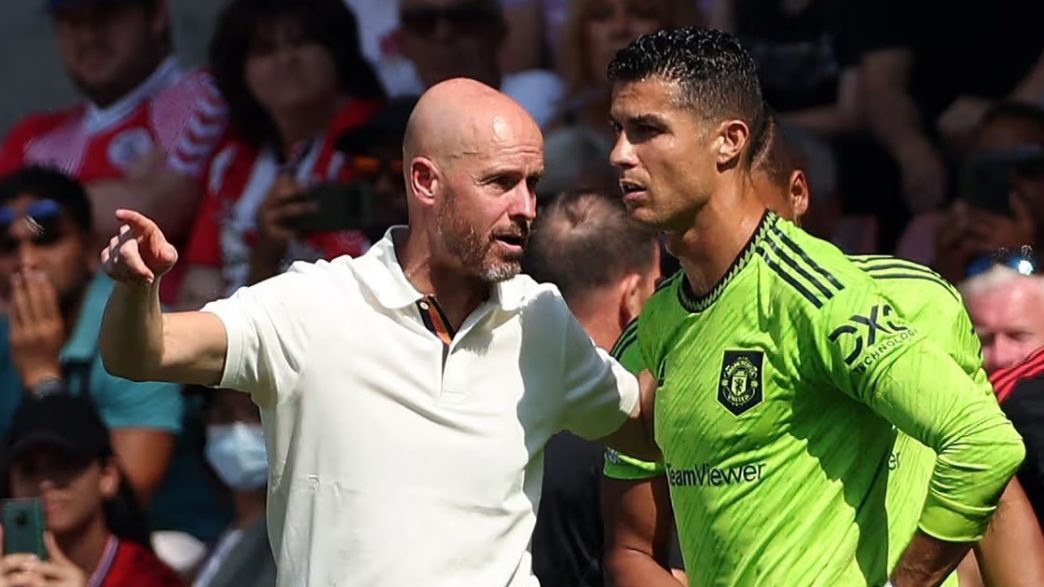
Erik Ten Hag has reopened one of Manchester United’s most entertainingly toxic football break-ups, and Cristiano Ronaldo is once again the man in the firing line.
Speaking on ESPN Netherlands’ Goedemorgen Eredivisie, the former Manchester United manager revisited his brief and turbulent relationship with Ronaldo, insisting that the Portuguese superstar’s decline began after his Juventus days.
Ten Hag did not stop there. He claimed Ronaldo failed to prepare properly, struggled to meet the physical demands of his system and did not run enough, either with or without the ball. 
“He ran neither in possession nor out of possession. The reason was because he didn’t prepare himself,” Ten Hag said.
That is quite an accusation against a man who has spent much of his career treating his body like a top-secret military project.
But was Ten Hag right? Did Ronaldo genuinely become a passenger at Manchester United, or was the Dutchman trying to fit a world-class goalscorer into a system that no longer suited him? The numbers offer a more complicated answer. And, as usual with football, both sides have a few receipts.
Erik Ten Hag’s Ronaldo criticism: What exactly did he say?
Ten Hag’s latest comments follow an earlier interview with The Athletic, in which he accused Ronaldo of letting Manchester United and the manager down.
The Dutchman claimed Ronaldo missed training sessions, failed to work at the intensity required and did not complete the running exercise assigned to the squad after United’s humiliating 4-0 defeat at Brentford in August 2022.
According to Ten Hag, Ronaldo completed only two of the three laps. He also alleged that the forward encouraged teammates to “save your legs” during training. Ten Hag argued that a superstar should receive special treatment only when he is delivering for the team.
In his view, Ronaldo’s reputation could not excuse him from the collective demands of modern football.
There is a reasonable point buried in there. No player, not even one with five Ballon d’Or awards, gets to negotiate his own football constitution. However, Ten Hag’s claim that Ronaldo simply did not run raises another question: what do the match statistics actually show?
SEE ALSO: Ronaldo Beats Messi Again as 2008 Season Wins Ballon d’Or of All Time Fan Vote
Ronaldo’s goals at Manchester United: The numbers Erik Ten Hag cannot ignore
If the argument is that Ronaldo had become useless at United, his first season back at Old Trafford makes that a difficult case to prosecute.
During the 2021/22 campaign, Ronaldo scored 24 goals in 37 appearances in all competitions, according to season statistics compiled by Planet Football. In the Premier League alone, he scored 18 goals in 30 appearances, including a hat-trick against Tottenham and a memorable late winner against Villarreal in the Champions League.
He also scored six goals in the Champions League, helping United reach the knockout stages. Those were not the numbers of a forward who had completely forgotten where the goal was.
Indeed, FBref records Ronaldo’s Premier League return that season at 18 goals and three assists in 2,456 minutes. That works out at approximately 0.66 goals per 90 minutes. He also scored 15 non-penalty goals.
United were hardly a well-oiled machine around him. They finished sixth in the league, struggled for consistency and changed managers during the season. Ronaldo’s goals often kept them competitive when the rest of the team looked like it had misplaced the instruction manual.
But there is a catch: goals do not tell the entire story of a striker’s contribution.
The pressing problem: Was Ronaldo really doing enough?
This is where Erik Ten Hag’s argument becomes considerably harder to dismiss.
Modern football increasingly demands that forwards do more than wait for the ball, threaten the penalty area and occasionally produce a spectacular finish. They must also press defenders, close passing lanes and help the team win possession higher up the pitch.
Ronaldo’s pressing numbers were not particularly flattering.
A StatsBomb-based analysis published by Stats Insider in October 2021 recorded him making 4.03 pressing actions per 90 minutes in the Premier League. For comparison, Mohamed Salah averaged 14.67, Harry Kane 12.36 and Jamie Vardy 12.38 in the same analysis.
That is a sizeable difference. Ronaldo was not exactly leading the league’s pressing revolution.
BBC Sport also highlighted his weak pressing output early in the 2021/22 campaign. Its StatsBomb data showed that he averaged just 0.74 successful presses per 90 minutes, ranking near the bottom among Premier League outfield players who had played enough minutes to qualify.
Those numbers support the argument that Ronaldo was not an especially effective presser. However, there is an important distinction between saying a player presses less and saying he does not run at all. Pressing statistics measure specific defensive actions, not every movement a footballer makes.
They also do not establish whether a player is following tactical instructions, conserving energy for attacking positions or simply failing to execute the manager’s demands.
So, Erik ten Hag has evidence for questioning Ronaldo’s pressing contribution. His sweeping claim about the forward not running in either phase is harder to verify through the available public data.
Distance covered: Where is the smoking gun?
Erik ten Hag’s comments also invite scrutiny of Ronaldo’s running distance.
Unfortunately, publicly available statistics do not provide a consistent, comprehensive match-by-match distance record for Ronaldo across his entire second United spell that would conclusively prove or disprove the manager’s claim.
Some reports from the early part of the 2021/22 season highlighted low Champions League running distances, including an average of around 3.7 miles per game. But that figure appeared in media reporting rather than a complete, independently accessible dataset covering both seasons.
It would therefore be misleading to present it as definitive proof of Ronaldo’s overall work rate under Ten Hag.
There is also a timing issue. Ronaldo’s first season back at United came under Ole Gunnar Solskjaer, Ralf Rangnick and Michael Carrick, while Ten Hag arrived in the summer of 2022. The Dutchman managed Ronaldo for only a portion of the following season. Combining every running statistic from the two campaigns and presenting it as evidence of how Ronaldo performed specifically under Ten Hag would be statistical gymnastics worthy of a desperate title-race fan.
The more defensible conclusion is that Ronaldo’s pressing contribution was limited, while the public data available does not settle the broader distance-covered accusation.
Under Erik ten Hag, Ronaldo’s goals dried up
If 2021/22 offered Ronaldo’s defenders plenty of ammunition, his final months at Old Trafford gave Erik ten Hag considerably more.
Ronaldo scored just three goals in 16 appearances in all competitions under the Dutchman before his departure in November 2022.
In the Premier League, he managed one goal in 10 appearances, a sharp decline from the previous campaign. He also lost his guaranteed starting position, clashed with Ten Hag over his role and eventually refused to come on as a substitute against Tottenham in October 2022.
United subsequently dropped him from the squad for the Chelsea game.
The relationship deteriorated further when Ronaldo gave his explosive interview with Piers Morgan, accusing the club of betraying him and saying he did not respect Erik ten Hag. His contract was eventually mutually terminated in November 2022.
It is fair to say that the relationship was beyond repair by then. But three goals in 16 appearances do not, on their own, prove that Ronaldo lacked fitness or commitment. They also reflect limited playing time, a fractured relationship with the manager and a team that was still finding its feet under a new coach.
SEE ALSO: Uberlândia vs Mamoré: Match in Brazil Shatters World Record as Referee Dishes Out 51 Red Cards
Ronaldo’s training reputation: The other side of the argument
Ten Hag’s claims about Ronaldo’s preparation also clash with the reputation the forward built over two decades.
Former Manchester United power development trainer Mick Clegg, who worked with Ronaldo during his first spell at Old Trafford, described his training habits as extraordinary. Speaking to The Independent, Clegg recalled five and a half years of what he called the hardest work he had seen from any athlete.
Former United midfielder Nicky Butt also described Ronaldo’s approach as “total dedication, total commitment, and total hard work”, explaining how the young Portuguese worked to build his physique and adapt to the Premier League’s demands.
These are strong testimonials, but there is a catch: they describe Ronaldo during his first spell at United, between 2003 and 2009. They do not automatically prove that he maintained exactly the same habits at 36 and 37.
Ronaldo himself also criticised United’s training and conditioning standards during his 2022 interview with Piers Morgan, comparing the club unfavourably with Real Madrid and Juventus.
In other words, while Erik ten Hag accused Ronaldo of telling teammates to save their legs, Ronaldo had his own complaints about the club’s approach to training, nutrition and recovery.
Neither account independently settles what happened inside the training ground. But they show that the disagreement was about more than one player’s willingness to run.
Fred, Martínez and other teammates tell a different story about Ronaldo’s work ethic
Ten Hag’s criticism becomes more interesting when placed beside what Ronaldo’s former teammates have said about his training habits.
Fred, who played alongside Ronaldo during his second Manchester United spell, recently recalled arriving at the training ground about 90 minutes before a session, only to find the Portuguese already working in the gym. The Brazilian said he would finish his own work and leave, but Ronaldo would still be there.
“I would arrive about an hour and a half early and find him already there in the gym. Then I would leave and find that he was still there. I thought to myself: ‘My God, this man is really on another level,’” Fred recalled.
Lisandro Martínez, another teammate from that period, offered a similar assessment, describing Ronaldo as a professional who arrived early, left last and carefully watched what he ate.
David de Gea also praised his focus in every training session and game, while Diogo Dalot said Ronaldo’s professionalism and mentality had positively influenced his own career. Raphael Varane went even further, calling him the best example in the world of work ethic and winning mentality.
Older teammates who also praise Ronaldo’s work ethic
The praise did not begin in Manchester. Ben Foster recalled Ronaldo being the first player into training and the last to leave during their earlier United days. Carlos Tevez even joked that he could not beat Ronaldo to the training ground, no matter how ridiculously early he arrived.
These accounts do not prove that Ronaldo followed every instruction Ten Hag gave him in 2022. Nor do they tell us whether he completed every pressing assignment during matches.
But they make the claim that Ronaldo simply stopped preparing himself rather difficult to accept without qualification. If several teammates who trained alongside him continued to describe him as obsessively professional, Ten Hag’s version deserves scrutiny too.
Perhaps the distinction is between a player who works extraordinarily hard on his own preparation and one who is willing or able to perform every tactical task his manager demands. Those are not necessarily the same thing.
Was Erik Ten Hag right, or did Ronaldo simply outgrow his system?
The fairest verdict is that Ten Hag had a legitimate footballing complaint, but his language was probably more absolute than the available evidence allows.
Ronaldo’s pressing numbers were poor compared with several Premier League forwards. His contribution without the ball was a tactical concern, and his final months at United were a clear decline from his impressive first season back.
Erik ten Hag was entitled to demand that his striker contribute to the team’s defensive structure. A manager cannot build a pressing system around one player being exempt from the work.
But the suggestion that Ronaldo had simply stopped running ignores the bigger picture. He scored 24 goals in his first season back, remained a significant attacking threat and had a training reputation built over years of elite performance.
The 2022/23 collapse also happened in the middle of a public falling-out, not in a neat laboratory experiment where fitness was the only variable.
And there is a little irony in Ten Hag presenting himself as the uncompromising authority on team standards. Manchester United eventually sacked him in October 2024, after a poor start to the season, despite his FA Cup triumph and League Cup success.
That does not make his criticism of Ronaldo wrong. It simply means neither man gets to claim a spotless record in this particular divorce.
So, do the stats tell the full story?
Not quite. They show that Ronaldo was a prolific goalscorer in 2021/22 but a limited presser, and that his output fell dramatically under Ten Hag. They do not independently prove every allegation about his training habits or establish that he literally refused to run.
Ten Hag may have won the argument about what his system needed. Ronaldo’s goals, meanwhile, make it difficult to pretend the Portuguese had nothing left to offer.
Perhaps the real problem was that United wanted a modern pressing forward, while Ronaldo still saw himself as the man who should be waiting at the end of the move to put the ball in the net.
And when a manager and a five-time Ballon d’Or winner disagree over who should do the running, somebody’s ego was always going to pull a hamstring.
ALSO READ: From Football’s Favourite Punchline to Ballon d’Or Winner: The Harry Kane Redemption Story

About The Author