


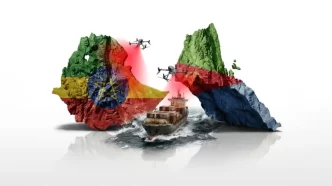
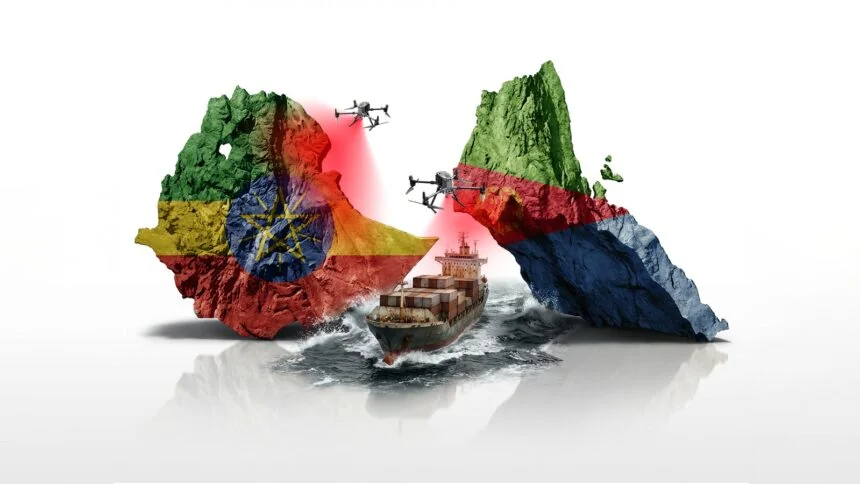
Here’s an explainer on the strained relationship between Ethiopia and Eritrea and the role the Fano are playing.
Eritrea was an independent nation before being colonized by Italy from 1869 to 1941. After Italy’s defeat in World War II, the United Nations decided Eritrea would join Ethiopia while retaining significant autonomy. Eritrea wanted independence and fought Ethiopia for 30 years in order to achieve it. In 1993, Eritrea gained its freedom and became a country of its own. 
After independence, they argued over the border; with the two countries refusing to come to an agreement, a war broke out that lasted from 1998 to 2000.
A war that claimed the lives of tens of thousands of people. After the war, a peace talk was had where Ethiopian leader Abiy Ahmed and Eritrea’s leader Isaias Afwerki shook hands and declared peace. Borders were opened, and Abiy even won a Nobel Prize for it.
Who are the Fano, And How Do They Come Into All This?

Fano is a loose network of Amhara national fighters. Between 2020 and 2022, when war broke out in northern Ethiopia between federal forces and the Tigray People’s Liberation Front (TPLF), Fano fighters aligned with the Ethiopian government and allied forces to confront the TPLF.
The conflict provided Fano with access to weapons, combat experience, and political leverage, as the federal government relied on local militias to bolster its military campaign. Many Fano fighters were drawn from Amhara communities bordering Tigray, where long-standing territorial and security grievances against the TPLF already existed.
However, this alliance began to unravel following the November 2022 Pretoria peace agreement, which formally ended the Tigray war. Federal efforts to disarm regional forces and dissolve informal militias were met with resistance from Fano groups, who accused Addis Ababa of sidelining Amhara security concerns after the war.
By mid-2023, tensions escalated into open confrontation, with Fano factions turning their weapons against federal forces and launching a decentralised insurgency across the Amhara region. What began as a wartime partnership has since transformed into one of Ethiopia’s most serious internal security challenges.
“Fano is very fragmented and decentralised,” says Horn of Africa analyst Abdifatah Hasan Mohamed. “They are united by the broad goal of protecting Amhara interests and opposing the Addis Ababa government.
ALSO READ: Africa’s Largest Floating Swamp, ‘Makoko’, Destroyed as Lagos Govt Breaks Promise
What Exactly Is Causing The Current Rift Between Ethiopia And Eritrea?
Ethiopian police have accused Eritrea of sending over a thousand rounds of ammunition to the Fano group, encouraging their attacks on Ethiopia. Eritrea has denied the accusations and, in turn, accused Ethiopia of “floating false wars to justify the war it has been itching to justify for two long years.” ”.
Three years after the war, Ethiopia’s government has been grappling with a violent insurgency started by the Fano rebels, who now have total control of many parts of the Amhara region.
Continuously, Eritrea has denied meddling in Ethiopian affairs.
For lack of trust in a nation that was once one with them, Ethiopia calls for access to the Red Sea through Eritrea, a demand that has further strained their relationship in recent months.
Ethiopia wants a path to the sea because the sea allows countries to easily bring in food, fuel and goods and sell things to the rest of the world, and without it Ethiopia must depend on other countries’ ports, which makes trade more expensive and leaves the country vulnerable if access is ever blocked.
In 2023, Ethiopian Prime Minister Abiy Ahmed Ali publicly announced that his country’s access to the sea was an actual matter which Eritrea ignored.
Eritrean President Isaias Afwerki in a recent interview accused Abiy’s party of declaring war on his country, but even with Eritrea not wanting war, “We know how to defend our nation,” he said.
The war might never happen, but Eritrea seems ready to fight for her nation should Ethiopia decide to strike.
About The Author