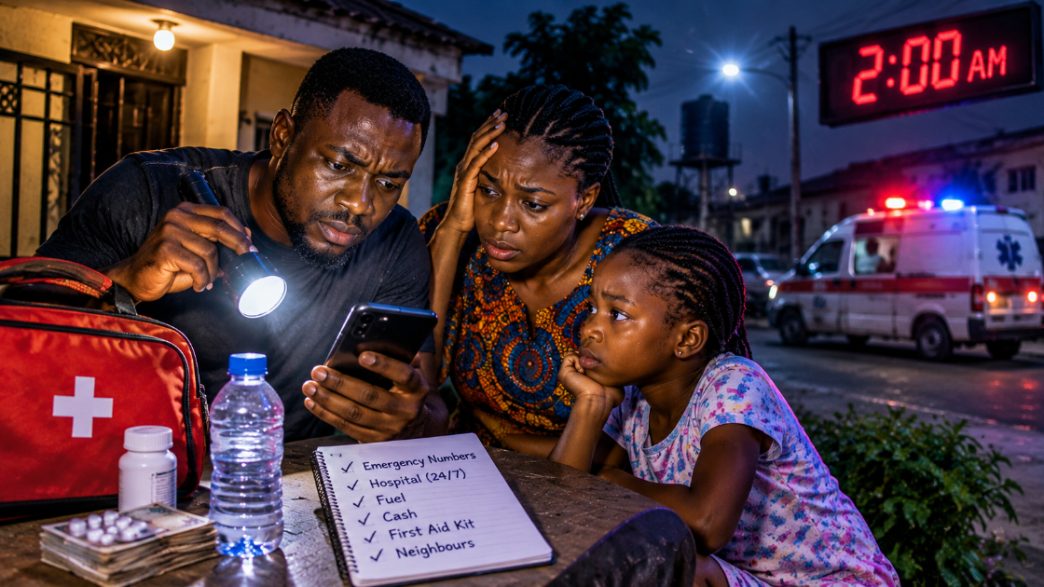
A 2 AM emergency in Nigeria can quickly turn into a nightmare, especially when you are unprepared. Imagine a family member suddenly struggling to breathe, a child developing a frightening fever or a fire breaking out while everyone is asleep. You need help, but your banking app is not working, the nearest hospital is not answering its phone, your car has almost no fuel and the estate security man has disappeared into the night, a real member of the Night’s Watch.
And just when you think things cannot get more complicated, you encounter a police checkpoint on your way to the hospital.
Emergencies do not respect office hours, and Nigeria’s emergency response system still has its limitations. While you cannot control everything that happens, you can prepare your household to respond faster when things go wrong. 
Here is how to get ready for a middle-of-the-night emergency without turning a difficult situation into a full-blown family disaster.
2 AM Emergency in Nigeria: Hospitals, Ambulances and Police Wahala
1. Keep emergency cash, but know your hospital rights
Keeping physical cash at home is sensible. At 2 AM, your bank’s mobile app may decide to misbehave, your transfer may remain pending and the nearest ATM may be several kilometres away.
Set aside some emergency money in a secure location. Keep an active debit card and make sure you can access funds without running into restrictive transaction limits.
However, there is something important Nigerians should know about hospital deposits. Section 20 of the National Health Act 2014 says healthcare providers must not refuse emergency medical treatment for any reason. That means a hospital should not leave someone in a life-threatening condition unattended simply because the family has not paid an admission deposit.
Erm, hello… has anyone informed Nigerian hospitals that this law exists?
Note, though, that this does not mean every treatment or hospital bill is free. You may still have to pay for medication, investigations, admission and other services.
Keep copies of health insurance details, identification documents, prescriptions and relevant medical records somewhere accessible. If someone in your household has a serious medical condition, make sure their regular medication is easy to find.
ALSO READ: Insurance in Nigeria: 6 Types of Cover Every Household and Small Business Should Know
2. Save emergency numbers before you need them
Nobody should be searching Google for an ambulance number while someone is struggling to breathe.
Nigeria has adopted 112 as its national emergency number, intended to connect callers with services such as the police, fire service, ambulance providers and other responders. However, the Federal Government announced in September 2026 that it was developing a roadmap for nationwide operational rollout. So, do not assume every state or neighbourhood has the same response capacity.
If you live in Lagos, save 767, the LASEMA emergency line. You can also save Emergency Response Africa’s toll-free emergency number, 08000 2255 372. The organisation says its service operates around the clock and coordinates emergency dispatch, medical response and hospital access.
Before relying on any private provider, call to confirm its coverage area, charges, operating arrangements and alternative contact numbers.
Save these contacts in your phone and also write them down somewhere visible. Your phone battery should not be the only thing standing between you and emergency assistance.
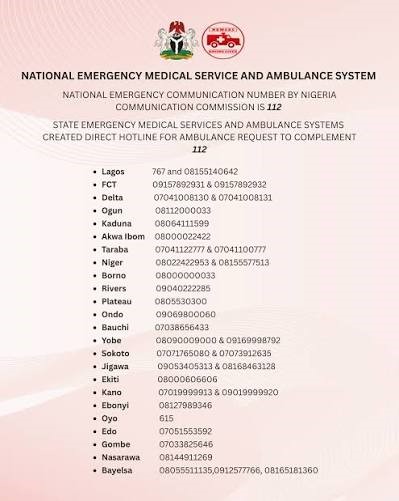
Let’s be honest, though. We’re very much aware that, sometimes, these numbers don’t work. I have a firsthand experience of a time there was a gas explosion nearby and I kept calling the emergency numbers, only to be told I was number twelve in line and I’d have to wait five minutes. Five minutes in an emergency is a lifetime; the person would have gotten to God and shaken hands with Jesus. But just because they sometimes don’t work, doesn’t mean they aren’t viable. They are still dedicated lines for emergency, and you might be lucky to find yourself in front of the queue when you call.
And besides, they’re just one option in this list, so, moving on.
3. Find two hospitals that actually work at night
A hospital being close to your house does not automatically make it useful during an emergency.
Identify at least two hospitals within reasonable driving distance and confirm that they operate functional emergency departments overnight. Ask whether doctors and nurses remain physically available, whether they can handle severe bleeding or breathing difficulties, and whether they have oxygen and essential emergency equipment.
Find out whether they have backup generators or inverters and whether those systems power their emergency departments.
Do not rely entirely on a hospital’s website or a receptionist who says, “We are open 24 hours.” Visit if possible, preferably at night. You do not want to discover during an emergency that the hospital’s 24-hour service means the security guard is available around the clock.
Also, ask where they refer patients when they cannot handle a particular emergency. Knowing the next hospital to visit can save valuable time.
4. Arrange transport before your car becomes a flower pot
If you own a vehicle, try not to let the fuel level fall below a quarter tank. You do not want to discover at 2 AM that your car has enough fuel to reach the estate gate and admire the street.
Keep your tyres, battery and engine in good condition. A torch, reflective warning triangle and basic roadside equipment should also stay in the vehicle.
If you do not own a car, identify at least two reliable neighbours or relatives who can help with emergency transport. Save the number of a trusted local driver as well.
E-hailing apps can be useful, but drivers may be scarce in suburban or less busy areas in the middle of the night. Your emergency plan should not depend entirely on an app finding a driver who happens to be awake and nearby.
Finally, know your address properly. Save your full house address, estate name, street and location pin. Memorise nearby landmarks such as filling stations, churches, schools or popular shops. “That house after the big mango tree” may work with a visitor, but an ambulance driver needs something more useful.
5. Prepare for police wahala on the way to the hospital
Sometimes the emergency is bad enough already, but the journey introduces another challenge: a police checkpoint.
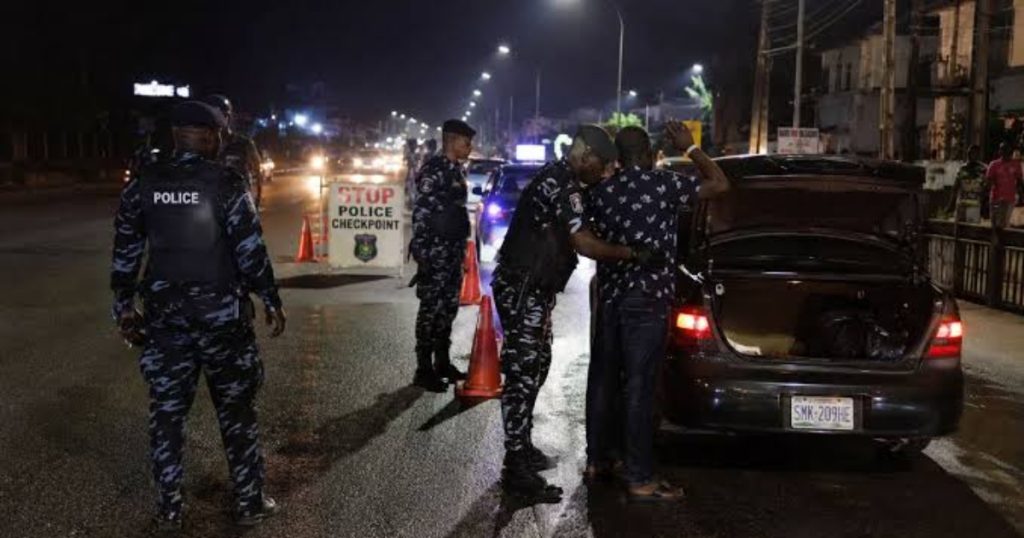
If you must drive someone to the hospital, keep your driving licence and vehicle documents accessible. If officers stop you, remain calm, explain that you are transporting someone who needs urgent medical attention and ask for permission to proceed.
SEE ALSO: How to Check If Your Vehicle Number Plate Is Genuine in Nigeria
If another adult is in the vehicle, let that person explain the situation while the driver concentrates on the road. Avoid arguments, threats or attempts to force your way through a checkpoint.
If you are using an ambulance, allow the crew to handle communication with security personnel. Do not assume that an ambulance automatically exempts its driver from lawful checks.
If an officer demands an unofficial payment or harasses you, prioritise the patient’s safety. When you are out of immediate danger, document the officer’s details, location and time, provided you can do so safely.
The Nigeria Police Force has a Complaint Response Unit for reporting misconduct, including harassment and extortion. Its published channels include 0805 700 0001, 0805 700 0002 and WhatsApp/SMS 0805 700 0003.
There is no prize for winning an argument with an armed officer while someone is bleeding in your back seat. Get the patient help first; pursue a complaint afterwards.
6. Prepare your home for power cuts, fires and break-ins
An emergency can become more dangerous when the lights go out.
Keep a rechargeable torch within easy reach of the bedroom. Charge your phones before sleeping and keep a power bank ready. If someone in your household depends on electrically powered medical equipment, arrange a reliable backup power source and discuss an outage plan with their healthcare provider.
Never use a generator or fuel-powered equipment indoors or in poorly ventilated spaces. Carbon monoxide poisoning is a serious risk, and your generator is not a bedroom appliance.
SEE ALSO: Generator Fumes Can Kill: How to Use Your Generator Safely
For fire emergencies, keep an appropriate fire extinguisher in an accessible location and learn how to use it. Make sure everyone knows the quickest exit route. Do not block doors with furniture, and keep keys where adults can find them quickly in the dark.
If a fire spreads, get everyone out and contact the fire service or emergency responders. Do not waste precious time trying to rescue your television, freezer or expensive electronics.
7. Build a neighbourhood emergency network
Your neighbours may become your first responders long before an ambulance arrives.
Exchange phone numbers with two or three trusted neighbours, estate security personnel and your landlord or facility manager. If you live in a gated estate, find out who holds the gate keys and how security personnel can open the entrance quickly for an ambulance or fire service.
Share your house number, location pin and important access instructions with trusted contacts. If your street has confusing house numbering, agree on a recognisable meeting point where someone can receive emergency responders.
A neighbourhood WhatsApp group can help, but do not assume everyone will see a message at 2 AM. A direct phone call is usually more reliable. Being the cool, mysterious neighbour who never talks to anyone might get you aura points during the day, but aura never solved an emergency.
8. Put together a nighttime emergency bag
Keep a small emergency bag close to the master bedroom or another easily accessible location. It should contain:
- Essential daily medications and a list of known allergies.
- A basic first-aid kit with bandages, gauze and antiseptic.
- A charged power bank and charging cable.
- A small torch and spare batteries.
- Some physical cash.
- Copies of important identification and medical information.
- A whistle for attracting attention if you cannot call for help.
Do not turn the bag into a travelling warehouse. It should contain items you may need immediately, not everything you own.
Also learn basic first aid and CPR from a qualified provider. Having a first-aid kit is useful, but it will not magically teach anyone how to manage a medical emergency.
9. Practice your emergency plan before disaster arrives
Knowing where your front-door keys are in daylight is not the same as finding them during a blackout. Walk through your emergency plan with everyone in the household. Show family members where to find the torch, first-aid kit, emergency contacts, fire extinguisher and main electrical breaker.
Practise how to leave the building during a fire and agree on an outdoor meeting point. Make sure children know how to contact a trusted adult or emergency service.
If someone in the household has a serious medical condition, agree on who will call for help, who will arrange transport and who will gather their medication and medical records.
Review the plan every few months, especially when you change phone numbers, move house or switch hospitals.
Final thoughts: Do not wait for a 2 am emergency in Nigeria to start preparing
The best time to prepare for a 2 AM emergency in Nigeria is when absolutely nothing is happening.
Save emergency numbers, identify hospitals, arrange transport, keep some cash accessible and build a relationship with neighbours who can help. Check that your phones, torches and power banks work before bedtime.
Most importantly, understand the limitations of the emergency response system in your area. Nigeria’s adoption of 112 is an important step, but nationwide coordination and response capacity remain works in progress. The UK government also notes that Nigeria does not have a national ambulance service and that hospital-owned ambulance services are limited.
You may never need your 2 am emergency plan in Nigeria. Hopefully, you will not. But if something goes wrong in the middle of the night, you will be grateful that you did not spend the first 30 minutes looking for a phone number, a car key or Taofeek, the latest member of the Night’s Watch.
READ ALSO: WhatsApp Group Status: How to Post an Update Only One Group Can See

About The Author