
Making friends after university can feel surprisingly difficult. After university, friendship no longer happens automatically.
At school, students share lecture halls, hostels, assignments, societies and everyday routines. As a result, people become familiar with one another even when they are not deliberately trying to make friends. In addition, there is usually someone nearby to talk to, eat with or invite out.
However, adult life is less structured. After graduation, people begin demanding jobs, get married, have children, relocate or move abroad. Meanwhile, some work remotely and rarely meet anyone outside the home. Others remain close to old friends, but their schedules no longer match. 
Therefore, making friends after university requires more intention. It does not mean becoming the most outgoing person in the room. Instead, it means finding regular spaces where people with similar interests meet and giving relationships enough time to develop.
Making friends after university requires intention
First, adults need to stop waiting for friendship to happen by accident. Although spontaneous connections are still possible, they are less common when everyone has separate responsibilities.
A better approach is to choose one activity that fits your schedule, budget and location. For example, you could attend a weekly sports session, a monthly book club or a regular fitness class. Similarly, you could join a faith group, volunteer programme or creative community.
Most importantly, choose an activity you can attend repeatedly. A group that is far away or difficult to reach may sound exciting; however, it will not help much if you can only attend once every few months. Give a new community at least three visits before deciding whether it suits you. The first meeting may feel awkward, but returning creates familiarity.

Making friends after university through sports clubs
Sports clubs make conversation easier because the activity gives everyone something to focus on. For instance, you can talk while warming up, learning a skill or waiting for a game to begin.
Adults can join running clubs, football teams, basketball groups, tennis clubs, volleyball teams, cycling groups, swimming clubs and martial arts communities. In addition, hiking and recreational sports groups can provide a relaxed way to meet people outside work.
For beginners, it is important to look for groups that welcome different ability levels. A highly competitive environment may be motivating for some people; however, a friendly group is often better for anyone whose main goal is to make friends.
Moreover, sports friendships grow through repetition. Members may train together, share a meal afterwards or remain connected through a group chat. Eventually, a weekly game or run can become a social routine rather than just an exercise session.
Book clubs for making friends after university
Book clubs are useful for adults who prefer thoughtful conversation to loud social events. The book gives everyone a shared subject, so nobody has to begin with a deeply personal question.
For example, members can discuss a character, a plot twist, an argument or an author’s writing style. As a result, quieter people often find it easier to participate. They can contribute gradually instead of trying to dominate the conversation.
There are many kinds of reading communities. Some focus on fiction, while others discuss memoirs, history, personal development or professional subjects. In addition, silent reading groups allow people to read alongside one another before deciding whether to socialise.
Book clubs can also suit adults with demanding schedules. For many readers, making friends after university becomes easier when a monthly meeting provides a dependable social routine. Since many meet monthly, they may be easier to fit around work and family responsibilities. Afterwards, a good discussion can lead to a smaller coffee meeting, book exchange or reading challenge.
Religious groups
Religious communities can provide a strong social foundation, especially for adults who are new to a city or experiencing a major life change. Nevertheless, attending a service and leaving immediately may not be enough to build friendships.
Instead, look for smaller groups and practical activities. These may include young-adult fellowships, singles’ groups, couples’ groups, choirs, welfare committees, study circles, outreach programmes, parent groups and professional fellowships.
In this way, people meet repeatedly and support one another beyond formal worship. Married adults may meet other couples, while single adults can develop friendships that are not centred only on dating or nightlife. Likewise, people who have recently relocated can find advice and encouragement from others in the community.
Even so, it is important to choose a group that respects personal boundaries. A healthy religious community should not pressure members into unnecessary spending, constant availability or unwanted relationships.
Volunteering
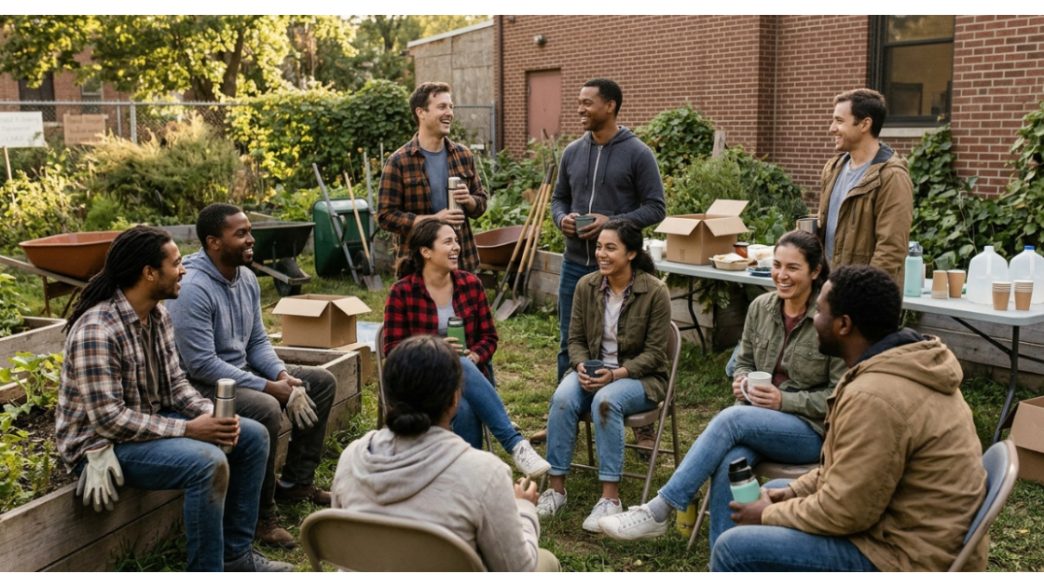
Volunteering creates connection through shared purpose. Rather than standing at an event and searching for something to say, people work together on a clear task.
They might distribute food, tutor children, support a health programme, clean a public space, assist at an animal shelter or organise a charity event. Because the work provides a natural reason to interact, volunteering can be especially helpful for shy people.
Furthermore, it attracts people who care about similar issues. That shared interest can create a stronger starting point than small talk at a party. As a result, friendships may develop while people are solving problems together.
Still, the strongest connections usually come from consistency. Show up reliably, contribute properly and remain in touch with people you enjoy working with. Instead of saying, “We should hang out sometime,” suggest a specific plan connected to a shared interest.
Fitness classes
A regular gym can become lonely when everyone wears headphones and leaves immediately after exercising. Therefore, group fitness classes may create more opportunities for recognition and conversation.
Adults can try yoga, Pilates, boxing, dance, spinning, aerobics, circuit training, strength classes or swimming lessons. The best class is not necessarily the most expensive or fashionable one. Rather, it is the class you can attend consistently.
For example, go at the same time each week and learn the names of people who attend with you. Then, ask simple questions such as, “Have you attended this class before?” or “Are you coming next week?” At first, the conversation may be brief. However, repeated contact can gradually make it easier to talk.
You do not have to become extremely outgoing. Instead, shared effort and regular attendance can create familiarity naturally. For adults making friends after university, that regularity often matters more than a confident first conversation.
Gaming and creative communities
Gaming communities offer social opportunities for adults who connect more easily through shared interests. Console and PC gaming groups, mobile tournaments, esports teams, board-game clubs and tabletop communities can all help people meet like-minded friends.
Similarly, creative communities bring together writers, photographers, filmmakers, designers, musicians, poets, actors and artists. For example, adults can join writing workshops, film groups, photography walks, open-mic events, art classes, dance communities, makerspaces and music groups.
The advantage of these communities is that members often work on something together. A short film, exhibition, performance, game or writing project creates repeated contact. In addition, it gives people a reason to keep communicating after the first meeting.
For introverted adults, a shared project can be less intimidating than a traditional social event. Instead of trying to be interesting, they can contribute to something meaningful and allow conversation to develop along the way.
READ ALSO: Lagos Life Game: Built Overnight in 8 hours, Now Valued at $1 Billion
When work, marriage and relocation change everything
Work can provide companionship; however, colleagues should not become an adult’s only social circle. Joining a community outside the workplace creates balance and reduces dependence on one environment.
Marriage can also change friendships. Married people may want to build friendships with other couples, but they should not lose their individual relationships. At the same time, single friends should not be treated as if they are no longer part of the group.
Relocation requires patience. When someone moves to a new city, they may feel like an outsider for months. Nevertheless, joining a neighbourhood group, professional association, religious community or regular class can create a sense of belonging.
It also helps to accept that the first friendships in a new place may begin as simple acquaintances. Over time, repeated contact can turn those acquaintances into trusted friends.
Turning acquaintances into friends
Joining a community is only the first step. To develop real friendships, adults can take several small actions:
- First, attend regularly. Consistency creates familiarity and trust.
- Next, learn people’s names. Remembering someone makes future conversations easier.
- Then, ask follow-up questions. Show interest in what brought them to the group.
- After that, make a small invitation. Suggest coffee, lunch or a conversation after the activity.
- Be specific. “Are you free next Saturday morning?” is more useful than “We should hang out.”
- Follow up. Send a message after meeting someone instead of waiting for them to make the next move.
- Finally, accept slow progress. Adult friendships may take months to become close.
Making friends after university is not about recreating student life. Instead, it is about creating new routines that fit the person you have become.
Work, marriage, relocation and responsibility can make friendship harder, but they do not make it impossible. Sports clubs, book clubs, religious groups, volunteering, fitness classes, gaming communities and creative spaces all provide places to begin again.
The key is to show up, participate consistently and give ordinary conversations enough time to become something deeper.
ALSO SEE: 5 Nigerian Celebrity Friendships Everyone Enjoys Watching

About The Author