

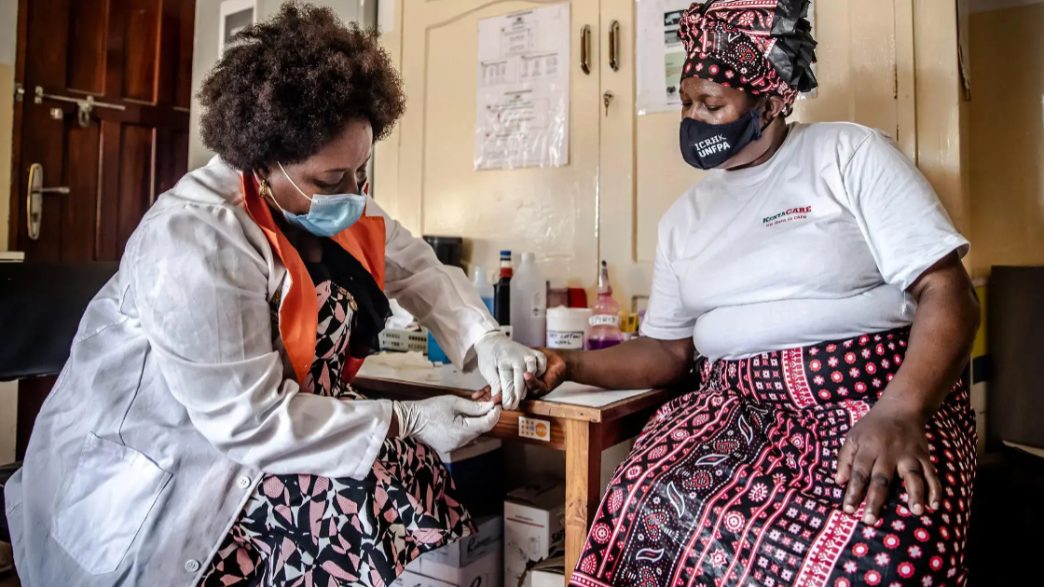
Nigeria has more than 1.65 million people living with HIV and currently enrolled on antiretroviral therapy (ART). However, there is a worrying little twist in the latest treatment figures: fewer people started treatment in October than in the preceding months.
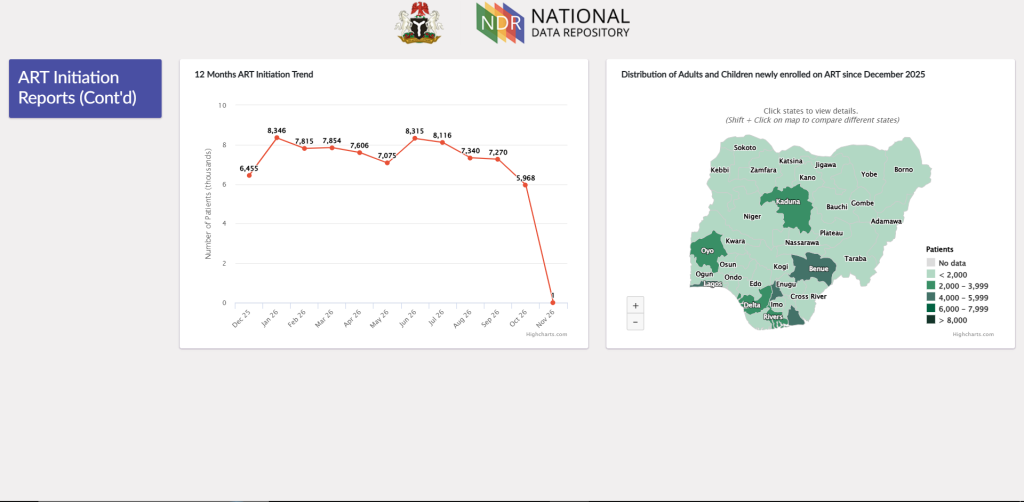
Data from the Federal Government’s National Data Repository (NDR) show that 5,968 people began ART in October 2026, down from 7,270 in September. That represents a decline of about 17.9%. It also shows that there are twice as many women on treatment as there are men, at 66% to 33%.
It is not exactly the sort of statistic that calls for a celebratory dance. Or what the women were hoping to win with the ages old “what a man can do, a woman can do better” debate. And while one month’s decline does not establish a long-term reversal, it raises an important question about the country’s HIV response: how well is Nigeria identifying people who need treatment and getting them into care? 
The November 2026 dashboard provides a useful snapshot of the progress made so far, including the number of people receiving treatment, the gender distribution and the proportion of tested patients who have achieved viral suppression.
HIV in Nigeria: New ART initiations fall in October
The NDR’s ART initiation chart records 6,455 new treatment enrolments in December 2025. The figure climbed to 8,346 in January 2026 before fluctuating between roughly 7,000 and 8,300 for much of the year.
June recorded 8,315 initiations, while July had 8,116. However, the numbers gradually weakened towards the end of the period, falling to 7,340 in August and 7,270 in September before dropping to 5,968 in October. The October figure is the lowest complete monthly figure shown on the chart.
November’s dashboard entry shows just one initiation, but that figure should not be treated as a full-month result. It likely reflects incomplete reporting at the time the screenshot was captured, as November was still in progress. Hence, treating that number as evidence of a nationwide collapse in treatment enrolment would be like judging a football match after the first minute.
This decline deserves attention. Diagnosing HIV is only one part of the job. People who test positive must also be linked to treatment and supported to remain in care.
READ ALSO: Ikeja Electric Blames Grid Shortfall For Poor Supply, But Nigeria’s Electricity Problems Run Deeper
Women account for two-thirds of patients receiving HIV treatment in Nigeria
One of the clearest patterns in the dashboard is the difference between male and female treatment enrolment.
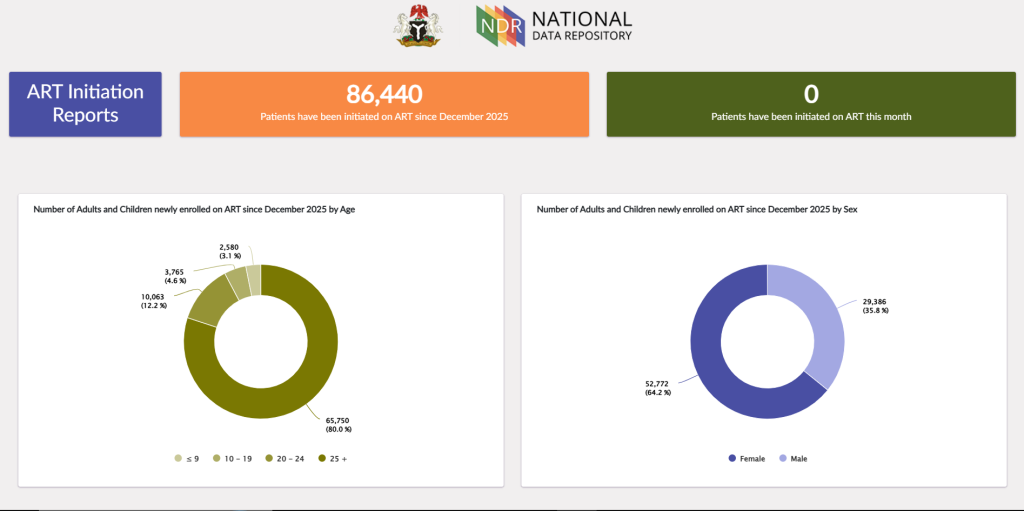
Of the 1,650,918 people currently enrolled on ART, 1,098,595 are women, representing 66.5%. Men account for 552,323, or 33.5%. The gender gap also appears among newly initiated patients. Women make up 52,772 of the 82,158 patients in the dashboard’s demographic breakdown, compared with 29,386 men.
That means women account for 64.2% of new enrolments, while men represent 35.8%.
The figures raise questions about HIV testing, access to healthcare and treatment-seeking behaviour among men. They do not, however, prove that men have lower infection rates or that women acquire HIV at a higher rate.
The wider national picture also shows why the gender dimension matters. ICAP’s CQUIN programme cites UNAIDS estimates indicating that, in 2024, HIV prevalence among Nigerian adults aged 15–49 stood at 1.5% among women and 0.8% among men.
That difference provides useful context, although prevalence estimates and treatment enrolment figures measure different things. The challenge for Nigeria is to ensure that men are not left behind in testing and treatment programmes, while maintaining the services that help women access care.
People currently receiving HIV treatment by state
A November 3, 2026 report citing National Data Repository figures gives a national total of 1,664,322 people currently receiving HIV treatment, using data dated October 29, 2026. It provides a breakdown across all 36 states and the Federal Capital Territory. GossipsNG.com
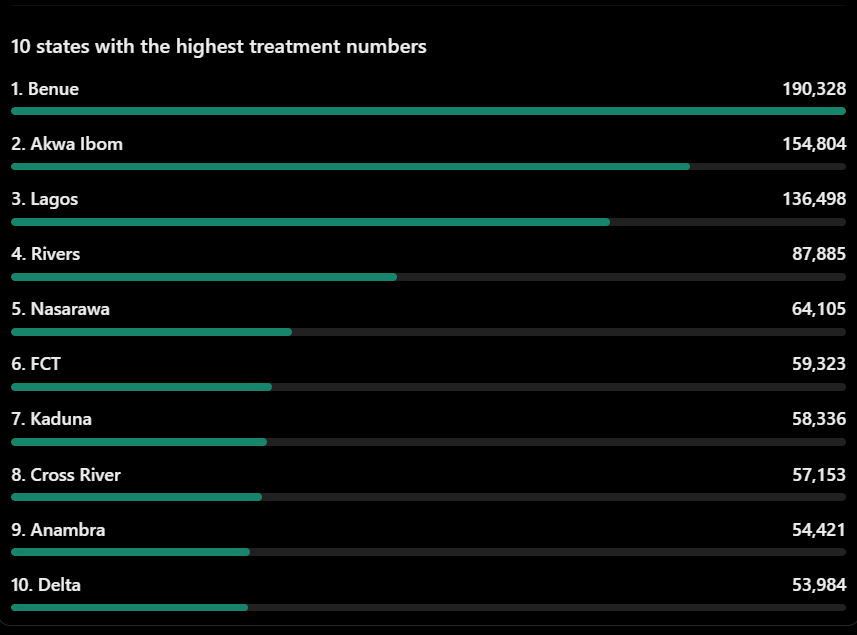
The distribution is uneven. Benue has the largest number of people on treatment, followed by Akwa Ibom and Lagos.
Full state-by-state breakdown
| State / territory | People on ART |
|---|---|
| Benue | 190,328 |
| Akwa Ibom | 154,804 |
| Lagos | 136,498 |
| Rivers | 87,885 |
| Nasarawa | 64,105 |
| FCT | 59,323 |
| Kaduna | 58,336 |
| Cross River | 57,153 |
| Anambra | 54,421 |
| Delta | 53,984 |
| Taraba | 51,946 |
| Enugu | 47,359 |
| Plateau | 46,310 |
| Adamawa | 41,967 |
| Abia | 41,064 |
| Imo | 39,620 |
| Kano | 37,796 |
| Kogi | 37,082 |
| Niger | 33,737 |
| Oyo | 33,179 |
| Ogun | 31,731 |
| Edo | 29,493 |
| Gombe | 28,822 |
| Bauchi | 25,249 |
| Osun | 24,867 |
| Borno | 22,711 |
| Ondo | 22,064 |
| Kebbi | 20,467 |
| Bayelsa | 18,930 |
| Katsina | 16,968 |
| Ebonyi | 15,640 |
| Kwara | 15,558 |
| Sokoto | 14,668 |
| Zamfara | 13,963 |
| Jigawa | 13,594 |
| Ekiti | 12,528 |
| Yobe | 10,172 |
Source: NDR figures reported November 3, 2026, for October 29, 2026. These are treatment counts, not state HIV-prevalence estimates.
SEE ALSO: Binance Hack: How $6.36 Billion Breach Exposes Crypto Custody Risks
Benue has the highest number of patients receiving HIV treatment in Nigeria
Benue State leads the country’s state-level distribution of people currently receiving HIV treatment, according to the National Data Repository dashboard. The state stands out on the dashboard’s treatment distribution map, with other states also recording substantial numbers of patients on antiretroviral therapy.
This may reflect differences in HIV burden, diagnosis, treatment access, programme coverage and reporting. The numbers alone cannot tell us which factor explains the gap.
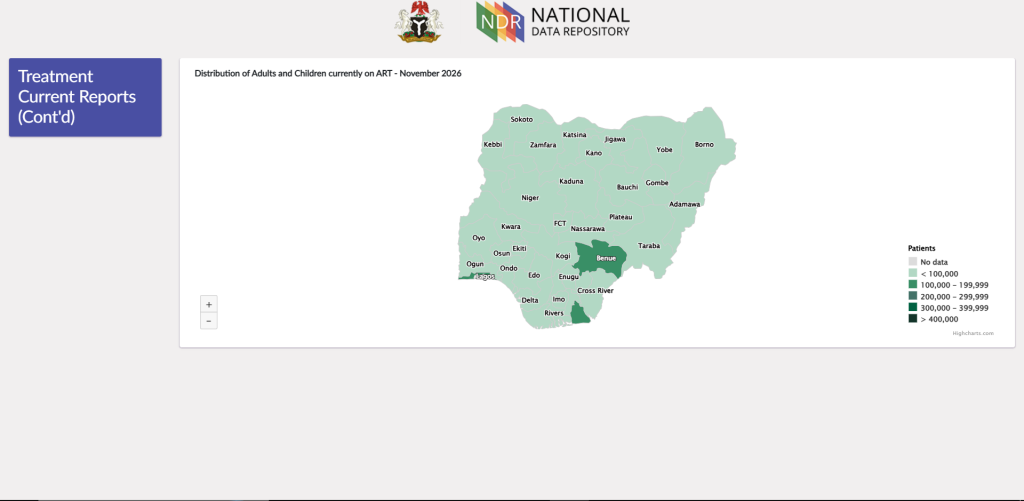
Benue’s position is particularly important because it highlights the concentration of treatment needs in parts of the country. A national total of 1.65 million patients may look impressive on paper, but the work of providing medication, monitoring patients and maintaining healthcare services happens in individual states and communities.
The figures should not be confused with the total number of people living with HIV in each state. They represent patients currently receiving treatment, not every person who may have the virus.
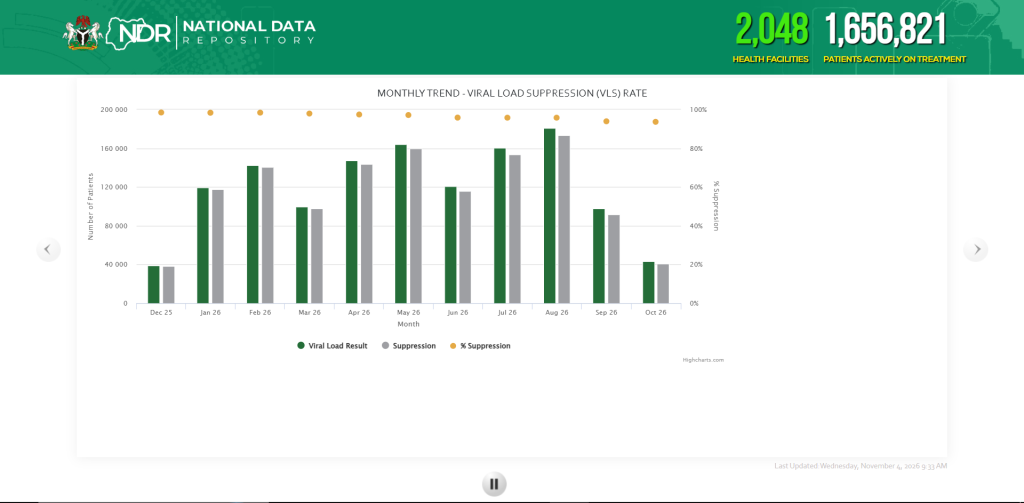
More than 1.45 million patients recorded as virally suppressed
There is better news in the dashboard’s viral-load figures.
The NDR reports that 1,517,061 patients have had a viral-load test since October 2017. Of these, 1,459,143 were recorded as virally suppressed. That works out to approximately 96.2% of the patients represented in those cumulative figures.
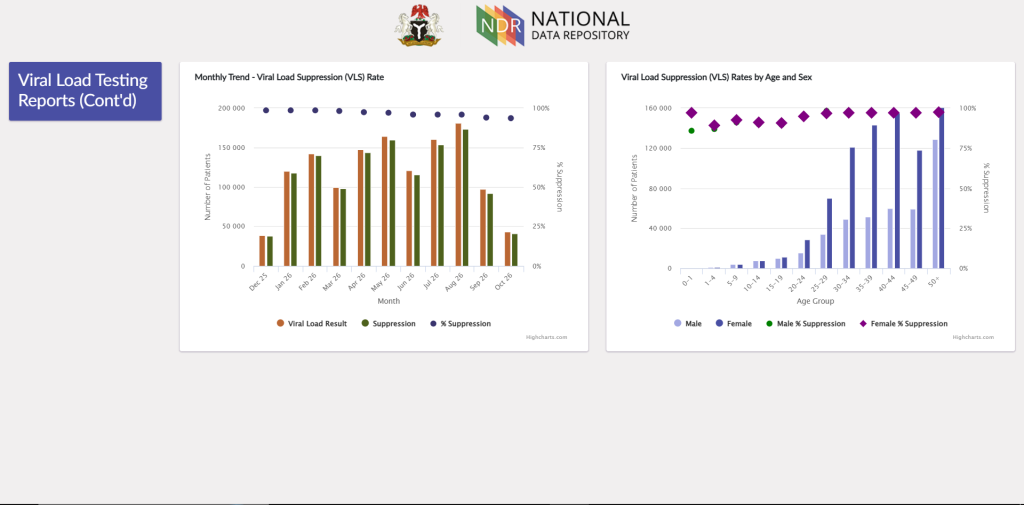
Viral suppression means treatment has reduced the amount of HIV in a person’s blood to a very low level. People who maintain an undetectable viral load do not sexually transmit HIV — a principle commonly described as Undetectable = Untransmittable, or U=U.
However, the 96.2% figure should be interpreted carefully. It represents the proportion of the dashboard’s recorded viral-load tests associated with suppression, not the percentage of every Nigerian living with HIV who is virally suppressed.
The distinction matters because people who have not been tested, have dropped out of care or are not captured in the reporting system are not necessarily represented in that calculation.
Nigeria’s HIV response still has work to do
Nigeria has made considerable progress in expanding HIV treatment, but the scale of the challenge remains significant.
ICAP’s Nigeria programme profile cites UNAIDS estimates of approximately two million people living with HIV in 2024. It also reports that 84% knew their status, 83% of those who knew their status were receiving treatment, and 79% of those on treatment were virally suppressed.
These figures provide a broader national picture, but they are not directly interchangeable with the November 2026 NDR snapshot. The underlying reporting periods and measurement methods differ.
Funding and programme sustainability also remain important concerns. In its 2025 World AIDS Day report, UNAIDS warned that disruption to international HIV funding threatened progress in countries including Nigeria, which has historically relied heavily on external support for its HIV response.
The Nigerian government announced additional domestic funding to help protect treatment services. That commitment will need to translate into reliable medicines, testing, prevention and support for patients across the country.
The 2025 HIV Health Sector Programme Report published by NASCP also identifies gaps in case identification, paediatric services, treatment coverage, viral-load testing and data quality.
The real test is keeping people in treatment
Nigeria’s latest HIV figures tell two stories at once. More than 1.65 million people are enrolled on ART, and the dashboard records encouraging viral-suppression results among those tested.
But October’s fall in new treatment initiations is a reminder that the work does not stop once a country has built a large treatment programme.
People must know their HIV status, access treatment without unnecessary barriers and remain in care long enough to benefit from it. That requires consistent funding, reliable medicines, accessible testing and public-health messaging that reaches people who might otherwise avoid screening.
The October decline may turn out to be temporary. But Nigeria cannot afford to assume that it is.
After all, the goal is not simply to count how many people have started treatment. It is to make sure that everyone who needs it can get it, stay on it and live a healthy life.
READ ALSO: 2 AM Emergency in Nigeria: 9 Steps To Prepare for a Midnight Crisis

About The Author