


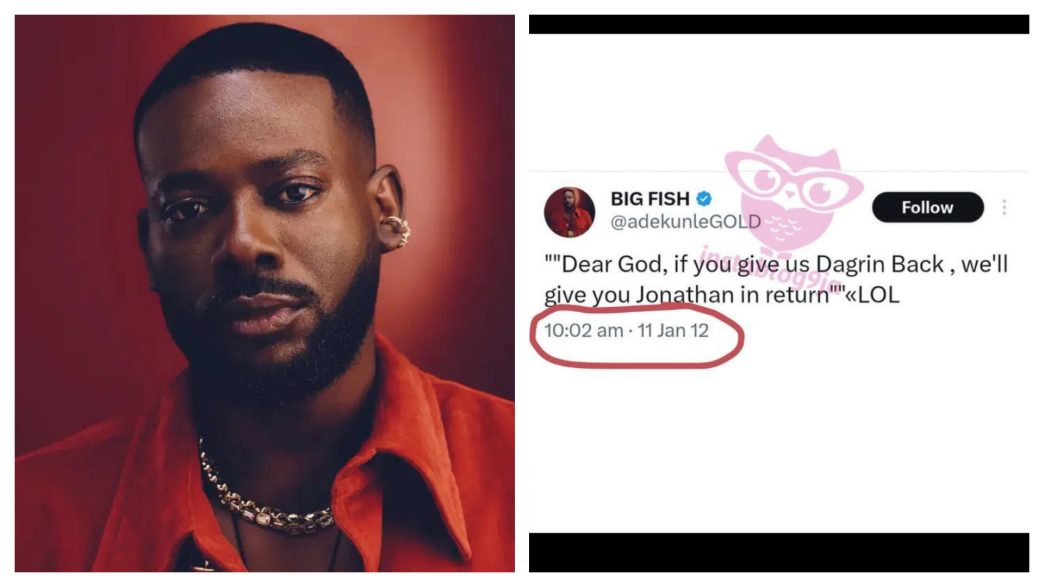
Let us start with the tweet. January 2012. A young man named Adekunle Kosoko, now called Adekunle Gold, typed out his feelings about President Goodluck Jonathan and hit send.
“Dear God, if you give us Dagrin back, we’ll give you Jonathan in return.”
Then, four days later, another one: “Dinner Set =»300mil… Die Goodluck, Die.” 
And another: “So witches, wizards and babalawo’s don’t have powers except in our movies? Foolish people… make GEJ mad. You can’t? Very simple task.”
He was a young, anonymous Twitter user blowing off steam about a president he clearly had no love for. Nobody arrested him. Nobody filed a cybercrime charge. He grew up, made music, became famous, married Simi, had a daughter named Déjà, and became one of the most beloved artists in Nigeria.
Then someone made a joke about his daughter. And that person is now in prison.
What Happened to Swanky
A Twitter user identified as ‘Swanky_concept’ posted what Nigeria’s internet has broadly described as a tasteless banter post, implying that Adekunle Gold’s daughter, Déjà, had died. He posted a candle emoji. He wrote condolences to the Adekunle Gold family. It was dark humour. It was cruel. It was the kind of thing that Nigerian Twitter has always trafficked in, loudly and without consequence, for years.
Adekunle Gold did not find it funny. He went to the police. Then to court.
Swanky pleaded guilty. He has been sentenced to two years in prison.
Two years. For a tweet. About someone’s child, yes, but still, it’s a tweet.
The Hypocrisy Question
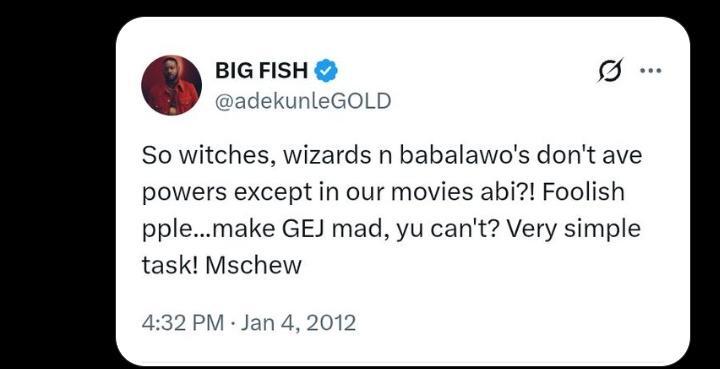
This is where Omoyele Sowore, activist and publisher of Sahara Reporters, placed the question plainly on X:
“This was Adekunle Gold in 2012, openly criticising then-President Goodluck Jonathan. Back then, it was rightly called free speech, and if he had been arrested for those tweets, we would have been on the streets demanding his immediate release. How then does someone who benefited from freedom of expression turn around years later to use the police, courts, and the brutal cybercrime framework against ordinary Nigerians over online banter and social media exchanges? You cannot enjoy free speech when you are powerless and criminalise it the moment you become influential.”
It is a hard argument to dismiss. Not because what Swanky posted was acceptable; it was not, but because the contrast is glaring enough to deserve an honest conversation rather than defensive deflection.
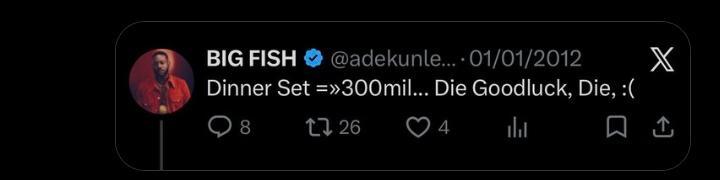
Adekunle Gold wished a sitting president dead. On multiple occasions. With specific language. He was a private citizen at the time, yes. But Swanky was also a private citizen. The difference is not the character of the speech. The difference is the power of the person who was offended by it.
What Nigeria Is Saying
The replies are divided, and both sides are making arguments worth hearing.
One user, @larrylere1, put the receipts side by side: ‘Some of you wished death on a sitting president, Jonathan, including this Adekunle Gold, and none was jailed. Soon the DSS will go for y’all, calling Tinubu a druggie, right?”
@LiNasha07 went further: “Power comes with receipts. Don’t turn influence into a shutdown button. Two years for a troll’s banter? That’s chilling and sets a dangerous precedent. Accountability, not criminalisation.”
On the other side, @creature wrote, “Every parent should inform their child to stay away from Sowore. How can someone justify a guy wishing someone’s child death?”
And @Ikennamagn offered the most legally grounded take: “Freedom of expression is guaranteed by the Constitution, but such expression must be done within the confines of the law. Our cyber act is the most active legislation because of its abuse by the people in power.”
That last sentence is the one that stings. Nigeria’s cybercrime law exists and has teeth. The question is not whether it can be used; clearly it can. The question is who it gets used against and who decides when speech crosses the line from banter to criminal matter.
SEE ALSO: Did Adekunle Gold and Simi Really Welcome a Set of Twins?
The Uncomfortable Truth
Here is what is actually true simultaneously. What Swanky posted was wrong. No parent should have to see a candle emoji and fake condolences about their child, regardless of how famous they are. Déjà is a baby who did nothing to anyone, and using her as a prop for dark humour is indefensible.
Also true: Adekunle Gold posted worse, explicitly and repeatedly, about a real human being who was running a country. He faced zero consequences. He benefited from a society that treated political speech, even cruel political speech, as protected expression.
Also true: a young man with 17,000 followers is now spending two years in prison for something that, by the standards of Nigerian Twitter, is not far from the daily discourse Adekunle Gold himself once participated in freely.
The hypocrisy question is not really about Adekunle Gold the individual. It is about what happens when ordinary people become powerful, when the thing that was once called free speech, when it was directed at someone else, suddenly becomes a criminal matter the moment it lands at your door.
“You cannot enjoy free speech when you are powerless and criminalise it the moment you become influential,” Sowore wrote.
It is not a comfortable sentence. But for anyone who remembers those 2012 tweets, now resurfaced, timestamped, and sitting beside a two-year prison sentence, it is a hard one to argue with.

About The Author