


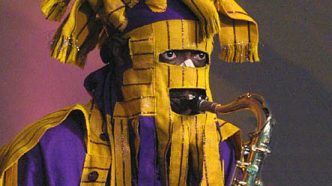
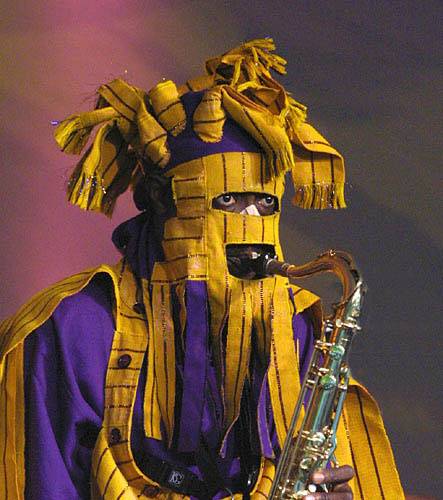
His name, in Yoruba, means “nobody,” “a faceless one,” or “anonymous.” He chose it deliberately. And in over thirty years of performing, he has never once broken character.
Bisade Ologunde was born in Lagos in 1960. In the early 1990s, he made a decision that most musicians would consider career suicide: he put on a mask, gave himself a name that translates roughly to the Yoruba equivalent of “John Doe,” and told the world that the face behind the music was none of their business.
He has kept that promise ever since. 
The Man Behind the Mask
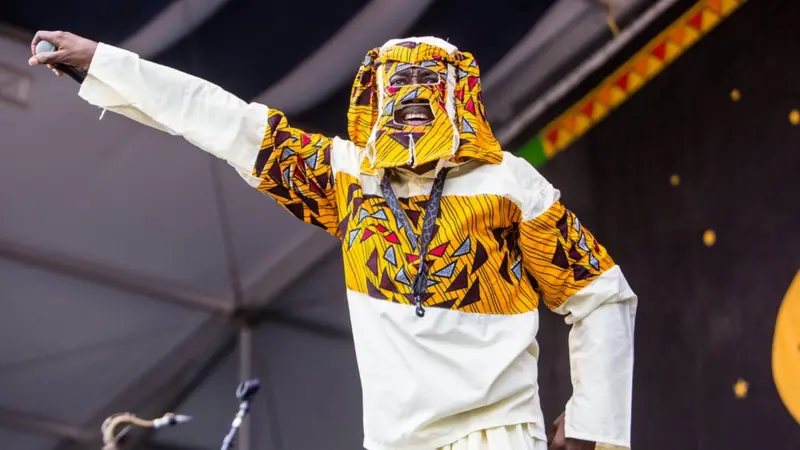
The mask itself is striking: a split textile and rubber construction that covers his entire face, leaving just enough room for him to breathe, sing, and play. He wears it at every performance, every interview, and every public appearance. It is not a Halloween costume; it is a deliberate philosophical statement rooted in the carnival tradition of Yoruba culture—the idea that the masquerade represents something larger than the individual wearing it. Lagbaja chose the mask because he wanted to represent the common man. Not a celebrity. Not a star. Everybody. Nobody. The person in the crowd whose name nobody asks.
What makes this remarkable is what he built while wearing it. He taught himself to master the saxophone. He assembled a band. He performed at the French Institute in Lagos, at concert halls across Nigeria, and at international festivals that took him far beyond the continent. His 2000 album, We Before Me, confronted Nigerian politicians directly, demanding honesty and urging unity, using music to say the things people were afraid to say out loud. He won awards. He performed at the Howard Theatre in Washington, D.C. His name appeared in the pages of the New York Times.
And through every single moment of it, the mask stayed on.
The Philosophy He Refuses to Abandon
There is a moment in one of his interviews that tells you everything. A journalist asked him about his personal life, whether he had children and how he related to them. His response was immediate and completely in character.
“I don’t know this guy you’re talking about,” he said. “You need to go find him so he could talk to you about himself.”
That is not deflection. That is a man who has thought deeply about what fame does to art and decided he wanted no part of it. His argument, sustained across three decades, is that the messenger should be invisible—that the music, the message, and the people the music speaks for should be what you see. When you look at Lagbaja, you are not supposed to see Bisade Ologunde; you are supposed to see yourself.
His identity has reportedly been revealed at various points over the years, but even that is uncertain. When the supposed face behind the mask circulated, speculation immediately followed about whether the face shown was even real, or whether it was simply another layer of the same performance.
At this point, it almost does not matter. The mask has outlasted the mystery. The music has outlasted both.
SEE ALSO: Why William Onyeabor is Africa’s Most Mysterious Musician
Why He Still Matters
In an era where musicians curate their personal brands down to the breakfast they eat—where visibility is currency and anonymity is treated as failure; Lagbaja made the opposite choice and sustained it for thirty years without blinking. That alone is remarkable. But the music he made under the mask, political, rhythmic, and deeply rooted in Afrobeat and Yoruba musical tradition, would have mattered regardless of whether the face was visible.
He built a legacy entirely on the strength of the work. And the work is extraordinary.
The question Nigerian music culture has never fully answered is whether Lagbaja was right, whether the music hits differently because you cannot see the man making it, or whether the mask has become the story and the music has been forgotten underneath it.
Go listen to We Before Me and decide for yourself.

About The Author