

The video is difficult to watch.
Blessing Orji, popularly known as Bebe Jewelry, is sitting in what appears to be a shop in China. People are moving around her. Then she appears to hold her chest. Moments later, she slumps from her chair.
That was the part that stayed with me. 
Not just the fact that she collapsed, but the thought that this could happen to anyone, anywhere — at work, in a market, at home or even in the middle of a busy business trip.
CCTV footage of the incident began circulating widely on social media on August 16, 2026. Reports identify the woman as Nigerian businesswoman Blessing Orji, also known as Bebe Jewelry. Several reports say she died after she fell to the ground.
But there is something we need to be careful about before turning the incident into a medical diagnosis.
Nobody has publicly established from the CCTV footage that Bebe Jewelry suffered a heart attack, cardiac arrest or died from stress.
What the video does give us is a disturbing moment that raises an important question: If someone suddenly develops chest discomfort and falls down in front of us, would we know what to do?
What We Know About Bebe Jewelry’s Collapse
According to reports, Bebe Jewelry was in China when she fell inside a commercial store. In the CCTV footage circulating online, she appears to touch her chest before falling from her chair. People around her continue with their activities as she lies on the floor.
The footage has understandably generated grief and anger. Some people have questioned why nobody appeared to intervene immediately.
But a short CCTV clip does not tell us everything.
We do not know exactly what the people around her understood about what was happening. We do not know how quickly medical help was called or what happened after the footage ended.
And, most importantly, we do not yet have a verified medical explanation for her death.
So, while social media has connected the incident to high blood pressure and stress, we should not present either as the cause of her death without medical evidence.
That distinction matters.
It also gives us an opportunity to talk about something much bigger than one tragic incident: heart emergencies and what ordinary people can do when they happen.
Chest Pain Should Not Always Be Ignored
Many of us have experienced chest discomfort and assumed it was nothing serious.
Maybe it was gas. Maybe it was stress. Maybe we were simply tired.
Sometimes, it is none of those things.
The American Heart Association says chest pain or discomfort is one of the most common signs of a heart attack. It may feel like pressure, squeezing, fullness or pain. Other warning signs include shortness of breath, nausea, sweating, unusual tiredness and pain or discomfort in the arm, shoulder, back, neck or jaw.
Women may also experience symptoms that are less obvious. These can include unusual fatigue, nausea, dizziness, shortness of breath or discomfort in the back, neck or jaw.
This is why telling somebody who complains of unusual chest discomfort to “just rest” may not always be good advice.
When something feels seriously wrong, it is better to get medical help than to assume it will pass.
Why Nigerians Should Take Heart Health Seriously
Heart disease is not a problem that happens only to people in other countries.
The World Health Organization says cardiovascular diseases remain the world’s leading cause of death. Its 2025 fact sheet estimates that 19.8 million people died from cardiovascular diseases in 2022, with heart attacks and strokes accounting for 85 per cent of those deaths. More than three-quarters of cardiovascular deaths occur in low- and middle-income countries.
Nigeria is part of this picture.
One of the major risk factors is hypertension.
You Can Have High Blood Pressure And Feel Fine
This is one of the reasons hypertension can be so dangerous.
You may wake up, go to work, run your business, attend meetings and return home without feeling anything unusual — while your blood pressure remains dangerously high.
The WHO describes hypertension as a serious condition that increases the risk of heart, brain and kidney disease. It recommends detecting and treating high blood pressure early.
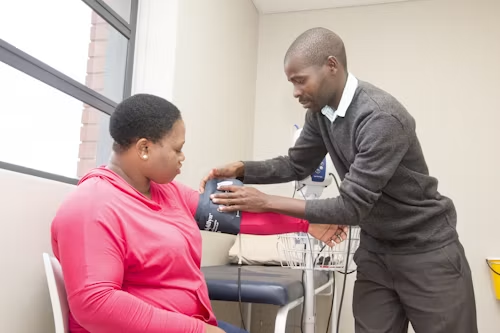
That is why checking your blood pressure should not be something you remember only when you have a headache or feel unwell.
Know your numbers.
What About Stress?
This is probably where many Nigerians will connect Bebe Jewelry’s story with their own lives.
We live in a culture that celebrates the hustle.
We praise the person who works late into the night. We admire the business owner who travels from one market to another. We tell ourselves that we will rest when the money comes.
But the body does not always wait for us to finish hustling before it demands attention.
That said, we need to separate a general health warning from Bebe Jewelry’s individual case.
There is no verified evidence at the time of writing that stress caused her death.
Stress itself, however, is not something to treat casually. Chronic stress can affect behaviours and health factors linked with cardiovascular disease, including physical inactivity and unhealthy eating.
The important point is not that every stressful day will cause a heart attack. It is that prolonged stress is one of the things we should take seriously as part of our overall health.
For the Nigerian worker, trader or entrepreneur, perhaps the message is simple: the hustle is important, but so is the person doing the hustling.
When Seconds Matter: A Doctor Explains Why Basic First Aid Matters
The tragedy also raises a difficult but important question: what happens when an ordinary person is suddenly faced with a medical emergency and does not know what to do?
Dr J.C. Diara, a medical doctor who works with KNCV Nigeria, believes this is an area that deserves far more attention.
According to Dr Diara, medical emergencies happen every day, but the number of people who have the basic knowledge and confidence to recognise and respond to them remains relatively small.
“Most of these life-saving measures don’t require you to have any professional medical background,” he explained, noting that many basic emergency-response techniques can be learnt relatively quickly.
Three Emergencies Everyone Should Recognize
Dr Diara highlighted three emergencies in particular: cardiac arrest, choking and stroke.
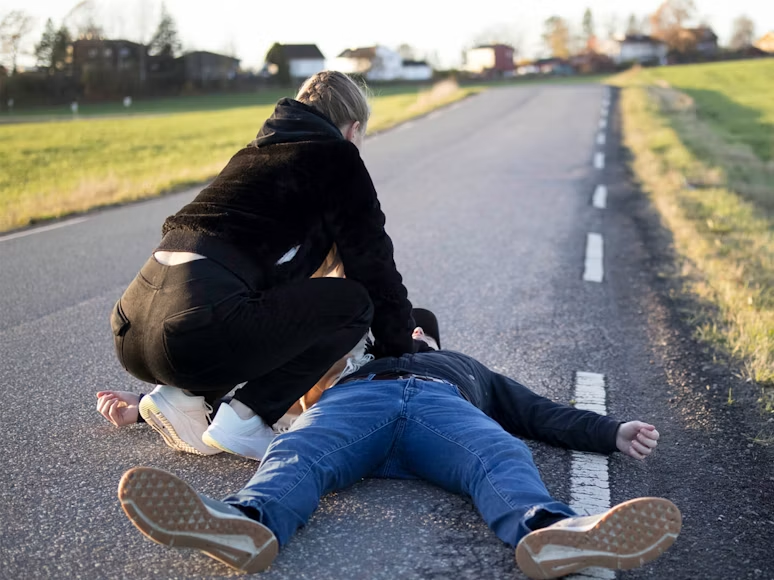
Cardiac arrest is especially time-sensitive. When the heart suddenly stops pumping effectively, immediate intervention can help maintain circulation until professional medical assistance arrives. Cardiopulmonary resuscitation (CPR), when performed appropriately, can therefore become a crucial link between the onset of an emergency and the arrival of trained medical personnel.
But recognising the emergency is just as important as knowing what to do.
For stroke, for instance, Dr Diara’s presentation emphasised the BE FAST warning signs: sudden problems with Balance, Eyes, Face, Arms and Speech, alongside the need to act quickly. The message is simple: when these symptoms appear, every minute matters.
His point goes beyond one particular tragedy.
“Life-saving skills” should not be seen as knowledge reserved for doctors, nurses and other healthcare professionals. In an emergency, the first person at the scene may be an ordinary passer-by, friend, colleague or stranger.
And that person may have only minutes to make a difference.
Dr Diara’s perspective does not determine what would or would not have happened in Bebe Jewelry’s case. Rather, it highlights a broader lesson from the tragedy: knowing how to recognise a medical emergency and respond appropriately can buy precious time while professional help is being sought.
Don’t Wait Until Your Body Forces You To Stop
We may never know exactly what happened to Bebe Jewelry until an official medical account becomes available.
But her story has already started an important conversation.
Check your blood pressure.
Pay attention to unusual symptoms.
Do not dismiss persistent chest discomfort as stress or “ordinary” tiredness.
If you have risk factors for cardiovascular disease, talk to a qualified health professional about them.
And learn basic CPR.
The WHO says many cardiovascular diseases can be prevented or reduced by addressing risk factors such as unhealthy diet, physical inactivity, tobacco use, harmful alcohol use and high blood pressure.
We cannot control everything that happens to our bodies.
But we can pay attention.
Bebe Jewelry’s Story Is A Reminder, Not A Diagnosis
There is still much we do not know about Bebe Jewelry’s death.
We should allow the facts to emerge rather than allowing social media to write the medical report for us.
But we also do not have to wait for every answer before learning something from the tragedy.
A woman appears to clutch her chest. She collapses. Within moments, an ordinary day becomes a medical emergency.
For those of us watching from thousands of kilometres away, the least we can do is learn from it.
Know the warning signs.
Know your blood pressure.
Know how to respond when someone collapses.
And perhaps most importantly, stop treating rest and medical check-ups as things we will get around to “when there is time.”
Sometimes, there isn’t.
This article is for health education and does not establish or diagnose the cause of Bebe Jewelry’s death. Anyone experiencing possible heart-attack symptoms or witnessing a medical emergency should seek immediate emergency medical assistance.

About The Author